Showing posts with label Geography. Show all posts

Monday, September 30, 2013

Urban and Rural Voting: 2000 Presidential Election Case Study


This is a paper I wrote in early 2008. At the time it was original research, a topic that was hinted at and understood to be true, but without any real published work. A few months later, Bill Bishop's excellent 'The Big Sort' was published. This book dealt with some similar topics, but did not have the same level of detailed methodology that my paper did, and it was not as scientific in nature. 

The reason why I am posting this now is as a response to this article on the Atlantic (Cities sub-magazine). This article misstates the differences in voting as 'Democrat' vs. 'Republican', rather than a simple preference of presidential candidates. People do not vote exclusively based upon party lines, this is abundantly clear. Anyway its not worth my time to go through it line by line so just read my work.


Do Urban Voters Favor Democrats? 
A Case Study of the 2000 United States Presidential Election


Introduction:
The purpose of this project was to determine if voters living in urban areas in the 2000 United States Presidential Election were more likely to vote for the Democratic candidate Al Gore, rather than the Republican candidate, George Bush. It is a popular belief that people in the urban areas are significantly more liberal and therefore vote for the Democratic candidate rather than the Republican. 

Methods:
Election results and levels of urbanization from 639 counties in 15 states were correlated. Data from the 2000 United States Census Summary File 3 were used to assess urbanization. Urbanization was defined as a ratio of the number of urban residents in a county divided by the total number of residents of the county. The resultant ratio could then range from 0-1. The election results were manually entered from the results posted on CNN.com. Third party candidate data were removed to create a two variable system. Counties with a third party candidate earning 10% or more of the vote were excluded from this analysis. Then a ratio of votes for a particular candidate divided by the total number of votes for the county was calculated to create another column with calculated values from 0-1. These numbers were then correlated to derive a Pearson’s product-moment correlation coefficient.

The definition of an “Urban Area” or “Urban Cluster”, which together make up Urban Population, is a census block or block group that has a density of 1000 people per square mile with surrounding blocks or block groups of similar density. The difference between them is the population size, where “Urban Area” is larger than “Urban Cluster”. 
I felt that aggregating data at a countywide level would provide the most accurate measure of urbanization, and election results would correspond to this. Any aggregation level smaller than this would be either excessively time-consuming or limited in scope. Using state data would be problematic because states are physically large, populous, and varied in urbanization. Generalizing by state would be an ecological fallacy. 
For the voting data I used CNN.com. These data were mostly reported on a county-by-county basis, although in some cases such as Connecticut, the reporting system differed. It was important to use voting data which matched the geographic break down of the census data.
I decided the most effective way to measure the correlation is to create a two-variable system, one being urbanization level, and the other, candidate selection. To compare the two principle candidates necessitated eliminating data from other candidates. In most cases the percentage of the population that voted for the third party was small, but in five to ten counties this exceeded 10%. These counties were excluded to avoid skewing the results. Other counties that were excluded included counties with fewer than 4000 voters. 
There were other data management difficulties to deal with in this analysis. There are 3119 counties in the United States and so performing an analysis on that scale with would have been excessively time-consuming for this project. Additionally, in several cases the election data reported by CNN.com were on a different scale in some states than the rest of the United States. The data for several Midwestern states such as Illinois were reported by county, but also by city which created complications. 
I felt that it would be most appropriate to select states that all together had a mean level of urbanization similar to that of the entire US. Also I selected states that had a ratio of Gore to Bush votes similar to nationwide election results. Several of the states selected such as Idaho, Utah and Wyoming heavily favored George Bush, while others like California, Delaware and Maryland strongly favored Al Gore.  New Mexico and Oregon with were split almost exactly between the two candidates. The final sample included 639 counties with the number per state ranging from 3 to 109. The mean was 42.6, the median was 29 and the standard deviation was 30.98. 
Microsoft Excel was used to create a spreadsheet with columns for votes for the two candidates and calculated columns for the percent of these total votes for each of the two major candidates respectively. The urban population of each county was calculated. 
The null hypothesis was that urban voters did not differ in candidate selection from rural voters. The alternate hypothesis was that urban voters did differ in candidate selection from rural voters. Pearson’s correlation test was used to test these hypotheses

Results:
For the 639 counties there was an r-value of .22. There was a 1% chance of making a type I error. The null hypothesis was rejected with very little chance of being incorrect. To compare states to each other, r-values were calculated for these smaller data sets. The states that had significantly significant correlations were California, Colorado, Georgia, Indiana, Louisiana, Maryland, Oregon, and Wyoming. They were all positive correlations ranging from .23-.67. 

Table 1

Counties
% Gore
% Urban
Pearson
Statistically Significant
Alabama
67
42.47
55.44
-0.14
No
Arizona
14
47.07
88.23
-0.21
No
California
52
57.60
94.76
0.59
Yes
Colorado
35
45.65
87.07
0.37
Yes
Delaware
3
56.85
80.02
0.97
No
Georgia
109
43.80
74.33
0.35
Yes
Idaho
24
29.86
70.74
0.33
No
Indiana
87
42.04
71.24
0.23
Yes
Louisiana
63
46.05
72.76
0.26
Yes
Maryland
24
58.65
86.07
0.67
Yes
Mississippi
74
41.73
49.38
0.20
No
New Mexico
23
49.88
76.31
-0.16
No
Oregon
29
50.53
79.23
0.50
Yes
Utah
19
28.43
89.54
0.09
No
Wyoming
16
33.63
67.66
0.64
Yes
TOTAL
639
50.16
83.23
0.35
Yes
NOTE: The Pearson’s r for “TOTAL” is from a correlation of the states not the counties


Table 2

Sample
Total US
Bush Votes
13886458
50456169
Gore Votes
13973898
50996116
Counties
639
3119
% Population Urban
83.2
80.6

Figure 1

Discussion: 
There was a statistically significant difference between the likelihood of urban voters to favor Al Gore over George Bush.  This was consistent across 8 of 15 states.  While the difference was not large, the study data provide sufficient power to say with confidence that these findings are meaningful
This study would have been improved with the inclusion of all 50 states and countywide election results. Alaska does not report their election results by county so this may be difficult. I decided that 4000 voters was a good cut off point for inclusion because of the way in which this could have skewed election results. There may be a more appropriate number to use as a cutoff point to get better results. 
The states used for this study are mainly in the West, South and Southwest. This regionally skewed data set should not be a big factor however because the ratio of voters who picked Gore and Bush in this study was very consistent with the overall national ratio. Likewise, if the level of urbanization in the states used for this study was different from the urbanization in the US, there could have been some problem. 
The data were entered manually and there so is a chance of human error. Automating the data transfer would have reduced this source of error.
There were a few instances of apparent errors in CNN’s posted data. The county voting totals in some instances did not add up to equal the totals for the state. Results for California and Georgia showed statewide totals for the winning candidate that were lower than the totals of the counties added together would indicate. This error puts the reliability of data from those states into question.
Third party candidates were not included in this study to simplify the data analysis. Ralph Nader has been blamed for giving the election to George Bush because of the high likelihood that many of those who voted for him would have voted for Al Gore instead if the election had only two candidates. These voters would have been enough to give the presidency to Al Gore. Excluding the data from this candidate may have skewed the results slightly. It is unclear if those who voted for Ralph Nader were concentrated in urban or in rural counties so the effect on the correlation between voters for Gore and an urban area is uncertain. 
The biggest possible flaw with the data used is the urbanization data. Some counties had very few residents yet had a significant number of “urban” residents. Most people would not count a county with less than 30,000 people as urban at all. The common perception of “Urban” is likely to be a little more exclusive than this. In some ways having a broader definition is good because it allows for a greater variation between the data points instead of having a lot of counties that have no urban residents. In one case there was a county with around 13,000 residents, and 15 people that lived in an “urban cluster”. 

Conclusion:
There was a statistically significant correlation between the proportion of urban voters in a county and the proportion of voters who voted for Al Gore in the 2000 Presidential election. It is not a strong correlation but it is clear and definitive. The correlation was clear and statistically significant as well in more than half of the states using a smaller data set.  The strength of these data suggests that the findings would not be changed by an analysis less limited by the possible errors identified.

  HYPERLINK "http://www.cnn.com/ELECTION/2000/results/president/" http://www.cnn.com/ELECTION/2000/results/president/ Data Accessed: 04/25/08-04/30/08
 Connecticut, Maine, Massachusetts, New Hampshire, Rhode Island, and Vermont reported by township and city
 80.6% is the percent of urbanization in the United States. My sample has an urbanization percent of 83.2
 The overall percent of voters in the United States who selected George Bush in the adjusted (3rd party candidates removed) voting percent was 49.73%. The overall percent of voters who selected Al Gore was 50.26%. In my sample the percent of voters who selected George Bush was 49.84%. The percent who selected Al Gore was 50.16%.  
 The states selected were Alabama, Arizona, California, Colorado, Delaware, Georgia, Idaho, Indiana, Louisiana, Maryland, Mississippi, New Mexico, Oregon, Utah, and Wyoming


Sunday, August 18, 2013

More than a Game: Palestine Vs. Afghanistan, a World Cup Qualifier in Ramallah

Those who know me know how much of a soccer enthusiast I am. For better or worse, the sport has dominated my life, and I have gone to extraordinary lengths at times to play or to watch the sport. When I was young we used to travel to every San Jose Earthquakes (originally known as the San Jose Clash) home game, despite the 100+ mile journey. I traveled throughout most of the western United States during my youth career, and even to the United Kingdom for a youth tour. When I visited Spain with my family in the early 2000s, we were fortunate enough to attend a Champions League 1/4th final match between F.C. Barcelona and Chelsea FC. Despite these diverse experiences, of all the times that I've had with the sport, my most interesting was probably a World Cup Qualifying match I attended while a student in Israel. 
My sisters and I with Pep Guardiola before the Barcelona/Chelsea match


I always enjoy attending matches in foreign countries because of the different types of fans and environments that are out there. So when I heard of a most interesting and unique soccer game in the summer of 2011, I was very excited. The match was a preliminary round World Cup Qualifier (for Brazil 2014) in the Asian Football Confederation between two unlikely opponents, Palestine and Afghanistan. Both footballing organizations have endured, despite a difficult last few years. The Taliban's rule over Afghanistan was repressive (the national stadium in Kabul was used for public executions, not soccer), and even though the United States and NATO had intervened by 2001, the violence of the Taliban and Haqqani Network have continued to render the country unsafe for many. The Palestinian Football Federation as well, has had a tough time with Israeli travel restrictions preventing players from the West Bank and Gaza from traveling to the other area, or even from leaving to play qualifiers abroad. 

Israel and the West Bank have long been unsafe, but while I was studying at Tel Aviv from 2010-2012 things had become quite a bit calmer. Still, the United States Embassy restricts its staff from traveling to the West Bank. Israelis too, with the memory of the Ramallah lynching of 2000 fresh in their minds, would never dream of traveling to the Palestinian portion of the West Bank (Israeli citizens are currently prohibited from traveling to Area A, the part of the West Bank under control of the Palestinian Authority). 

I, however, in my bravery (or naïveté), was unfazed, and determined to attend this unique matchup at all costs. I tried to recruit some classmates and friends, but most were either out of town or unwilling to travel all this way just for a soccer game (we had a 4 hour Arabic lesson early the next morning). It did not help my cause that I had nothing more than the city and a time for the game; I did not know what stadium it would be played out, how much it cost, how to get there, and if foreigners would be restricted from going. I nearly did not go because I did not wish to travel alone, but in the end, a friend of mine who happened to have arranged a group of his friends to go to Ramallah, said that he would come with me to the game. 

Us on the bus in Jerusalem about to go to Ramallah 
The day of the game was incredibly hot, even for an Israeli/Palestinian summer's day. I remember waiting at the bus stop next to the dormitories before 8 am and feeling the sweat dripping down my back. The bus ride from Tel Aviv to Jerusalem was unremarkable. We met my friend's friends in Jerusalem where the buses to Ramallah were supposed to pick us up. The stop was basically a run-down parking lot, certainly not a place I would want to be after dark, but because were a variety of minibuses there with Arabic signs, we figured that we were probably in the right place. We all checked to make sure that we had our passports so that we would be able to re-enter Israel, and hopped on the bus.

Traveling out of Israel into the Israeli controlled portions of the East Jerusalem and the West Bank is a cinch, I've accidentally done it a few times in a rental car while lost in Jerusalem's labyrinth like maze of highways, although once we had passed Qalandia checkpoint it became clear where we were. What struck me the most about the short drive into Ramallah was the amount of construction. Under Prime Minister Fayyad the economic situation in the West Bank had improved drastically. There were new projects under construction all around us, both residential and commercial. In Ramallah this too was the case. I was surprised at how nice some of the shops and streets in Ramallah were. Many of them would not have been out of place in a fancy neighborhood of Tel Aviv or Jerusalem. 

After my friend and my new acquaintances had lunched and had some of the best Limon-Nana (fresh Lemonade with Mint) we'd ever had at a local coffee shop (no, not the infamous Stars and Bucks), we decided to travel around the city a bit. We visited the old city, a beautiful, well-kept, quiet neighborhood just outside the center of town. One of the highlights of this part of the day was being ambushed by a young boy who pretended to shoot us with a stick servicing as a gun. A few years earlier this would probably have made most of us nervous, but because things have been more peaceful in recent years, this was nothing more than a charming interaction with a local.
View from lunch of the main intersection in Ramallah. Photo Credit: Axel Angeles 


Yasser Arafat's Tomb. Photo credit: Axel Angeles
We made our way back into town and then out again as we walked to the tomb of Yasser Arafat. At the site there was a heavy security presence, but once the guards saw our passports and heard us speak English, they were all very friendly and wanted to speak with us. I had thought that they may resent our presence because we had come from Israel, but they did not seem to mind one bit. I ended up asking them about the soccer game which was supposed to be somewhere in Ramallah later that evening. Because Football (Soccer) is widely considered the global sport and the World Cup is it's biggest stage, I'd thought that there would be incredible excitement for the rare occurrence of a qualifying match, but none of the guards even knew that there was a game going on

We then went into town for dinner which was both cheap and delicious, and again I asked our waiter about the game. He too did not know that there was a game, but said that if there was one, it would be at Arram stadium (in colloquial Arabic especially, the 'Al' article marker drops the 'l' sound, in this case changing Al-Ram to Arram) a town just outside Ramallah. The waiter pointed in several directions (West and North) while saying that it was near Jerusalem (which is to the Southeast). Because I am a geographically obsessed person who is always aware of the cardinal directions at all times this was frustrating for me, but the maitre'd said that we wouldn't have a problem if we were to take the bus towards Jerusalem, or in the worst case we could find taxi drivers who would know how to get there. So me and my friend (the others decided they did not want to go to the game) went downstairs and began to look for the bus stop where we could catch a ride to the stadium.

Mural of Marwan Barghouti near Qalandia. Photo credit: Axel Angeles
I'd been studying written Arabic for almost a year at this point and so I knew that the local name for Jerusalem in Arabic was Al-Quds. I asked many people on the street for the bus to 'Al-Quds' as I became increasingly frantic, but they were either unable to help me or had no idea what I was talking about. Finally someone came up to me and asked if I meant 'Al Ouds'. At this point the game had been going for almost 15 minutes so me and my friend both were willing to take the risk. The man led us into a dark and dirty garage and we were both a bit worried that something might happen to us, but once the driver of the minibus and several others got on, we figured we would be safe. 

The drive to the stadium was not a lengthy one, but the traffic and construction made it seem like an eternity. Fortunately the driver had the football match on the radio, so while it was in rapidly spoken Arabic, I was able to distinguish some of what was happening in the game. While in the minibus we drove past Qalandia checkpoint, but this time we went around rather than through it. We then travelled alongside the separation barrier for another couple of kilometers. For the majority of its length, the separation barrier is nothing more than a wire fence, but in the Jerusalem area in particular, it is a massive 5 meter+ concrete wall. It was an interesting experience for me seeing all of the graffiti written on the wall. Surprising to me was the amount of non-Arabic script. The majority was in English (without too many grammatical mistakes common to non-native speakers), although many other European languages were common as well. Finally we got to the stadium which was basically in an alley off the side of the frontage road along the wall. There were several dozen young boys outside the stadium, and again a significant and heavily armed security presence (I am not sure if I will ever get used to seeing uniformed individuals walking around in a civilian environment while carrying automatic weaponry even though I lived in Israel for over 2 years). There were even fewer English speakers at the stadium than there were in Ramallah and it took us several minutes talking to the guards to find someone who could speak English to us. Eventually we located one and we explained that we wanted to see the game. The police man looked at us, clearly perplexed, and asked for our passports. We both handed them over and he took them over to his boss. The man quickly returned and ushered us into the stadium, allowing us to skip the ticket booth and the line to get in. 

We had made it to the game just before half time and the sun was getting quite low in the sky behind us, and the bank of seats cast a broad shadow across the pitch. The stadium, while small and dilapidated, had a significant concentration of fans. There were even some fans waving Afghan flags. I am not certain if they were Afghans who had travelled from Afghanistan, but because there was a youth national team in the stands as well, it certainly seemed a possibility. Even more surprising for my friend and I, was that there were women and children at the game as well. In many of the more conservative Islamic places this would not be allowed so it was interesting to see a more open environment. Earlier in the day after our lunch the owners of the cafe had let slip that women were not allowed into the establishment, but since we were visitors it was ok just this one time. After this experience, the presence of women at the game was even more interesting and strange to me.
Some of the Afghan fans with flags. Photo credit: Axel Angeles

The game itself was boring and of very poor quality. I remarked during the game to my friend that I and/or most of my college teammates, if we were eligible to play for either team, would not have been anywhere near the worst players on the pitch. The fans too were not very enthusiastic, and seemed more interesting in talking to each other than the game. This may have been a function of the stifling heat or something else entirely, but this is unclear. Palestine had won the first game 2-0 (played in Tajikistan due to security concerns) and needed to win, tie the game or lose by just one goal to advance to the next round which would be a home and home series against Thailand. Palestine scored just before we arrived to the stadium making the total aggregate 3-0, before Afghanistan clawed one back early in the 2nd half. The score stayed the same until the final whistle and Palestine were through to the next round. 

The match! Palestine is in Green and Afghanistan in Red. Photo credit: Axel Angeles
My friend and I were a bit nervous at this point because it was near dark and we were over a mile from the Qalandia checkpoint and about 5 miles from the bus stop in Ramallah where we knew we could get a bus back to Jerusalem. We would have preferred to take a bus back to Ramallah or Qalandia, but because the frontage road was so busy and neither of us spoke serviceable Arabic, we figured this was an impossible task. On the bright side this gave us a great opportunity to examine the wall and its graffiti even closer. It was getting closer and closer to dark so I was pushing my friend to get back to the checkpoint so we could get back to Jerusalem safely. In hindsight I was very glad that he took so much time taking photographs because they are quite good and help me remember parts of the day.
The wall. Photo credit: Axel Angeles


The wall. Photo credit: Axel Angeles

We eventually reached the checkpoint, but because we had not come with a bus or a car we were a bit worried if we would be able to cross. The Israelis also are known to close the border unannounced for indefinite periods of times and neither of us wanted to be stuck in an unfamiliar territory after dark without any language skills, much in the way of money, and no mobile phone service. For a while we walked behind a young boy dragging a cooler full of water he was trying to sell to the dozens of cars and vans waiting for permission to cross the border, and eventually hopped one of the first buses in line. We had to get off the bus right away to go through the checkpoint and show our identification to the Israeli border guards.
The boy and his cooler as we approached the Qalandia Checkpoint near sunset. Photo credit: Axel Angeles

One of the common horror stories from Palestinians is how they are subject to humiliating conditions at checkpoints, and Qalandia is known to have some of these problems, partially due to the high volume of traffic at this location. The experience of walking up to the actual checkpoint is uncomfortable. You enter a passageway with chicken-wire on both sides and above your head, sometimes doubled up and always just above your head. Despite the open air blowing through, its a claustrophobic and stressful time. Even though there were only a handful of people in front of us, it took us about ten minutes of waiting before they cleared the people ahead of us. Because my friend and I were both Americans we breezed right through once they saw our passports, but others were subject to much heavier scrutiny. We jumped back onto the bus and headed back into Jerusalem and then to our final destination of Tel Aviv.

It was a fascinating day full of adventure and learning (I found out from my Arabic professor the next day that Al-Ouds is the local colloquial way of saying Al-Quds or Jerusalem), and I am glad that I took the leap of faith and traveled to an unfamiliar and potentially dangerous place. I will never forget this day and the interesting events which took place. While the quality of the soccer match was abysmal, and the fans were not the most exciting or interactive that I have experienced, for socio-political-geographical reasons this is the most interesting soccer-related experience I have had.

UPDATE 1: the mural with a man's face is of Marwan Barghouti, not Omar Barghouti.

Tuesday, April 16, 2013

You are what you read

One of my school projects which I am most proud of is a statistical study of presidential voting patterns versus urban population in the 2000 US Presidential Election. I made a fantastically well-designed study with great methodologies, and I ended up finding statistically significant results (If someone actually cares I can explain to them why this study was so well-considered, but its a bit technical so I'll hold back for now). My research questions was whether urban voters (or counties heavy in "urban" populations), as designated by the US Census Bureau, voted for the Democratic candidate, Al Gore, or the Republican candidate, George W. Bush. The only significant problem with my study was Ralph Nader, but overall he did not receive too many votes (with the except of one county which I then had to exclude). Surprisingly, at the time of this project (I believe it was Fall 2007), there were ZERO serious papers that addressed the topic of urban versus rural voting patterns. It is always assumed that urban voters are more liberal because of their increased likelihood of being in a heterogenous environment, but at this time it had not been addressed. Since then journalist Bill Bishop wrote an excellent book, "The Big Sort" about how populations are clustering based on ideological values. 

The results of my study were that urban voters were statistically significantly more likely to vote for the Democratic candidate rather than the Republican candidate. Bishop's book took this idea a step further in saying that it is more than just urban/rural people that are clustering, but also within this areas a similar smaller-scale clustering is happening.

Recently I've become more and more active on Twitter. Though typically outspoken, and likely to tell someone when I disagree with them, I try to keep my arguments civil and merit-based, rather than personal. Yesterday someone who I almost always disagree with wrote something thoughtful and respectful (for a change) and so I wished to jokingly tell this individual that we finally agree on something, hell must have frozen over blah blah blah. When I went to this person's Twitter page it would not allow to me reply to the tweet or even send tweet in general. Apparently this means the person has blocked me. I know people often block other people that they find annoying or who have sent nasty messages (and spammers of course), and while I am not the most innocent of Twitter users, I found it shocking that someone has blocked me for no apparent reason. 

It really made me wonder why someone who openly speaks of themselves as progressive would actively work to silence someone with a dissenting opinion, no matter what that opinion is. If we are excluding people because we disagree with their politics, we are only causing further problems. I myself follow people and organizations I do not like or agree with, but because they command some respect from a variety of other people or may be important some how, I like to know what they are saying and thinking. Of course I am not perfect, and I really dislike MSNBC and Fox and will rarely watch either of them, but this is also because there are better quality sources with similar enough opinions that I am able to access. If you cut off a source and prevent yourself from being exposed to others how can you be considered progressive? How can you be considered "worldly"? How can you understand the other side if you do not even know it? 

People like this individual are a big problem for our society. They consider themselves "holier than thou", think their opinion is correct no matter what, and are unwilling to seek out those who may critique (and therefore IMPROVE) their own arguments. Once again I am not perfect in this matter, I can be quite immodest with my own beliefs and sense of self-worth, but the last thing I would ever want to be accused of is being disinterested in meeting and talking to people are different. We learn and we grow from our experiences, and if we have the same experience every day, what will we ever learn? Reading, television and internet are the most prevalent ways in which many of us are exposed to others, why not read or watch something new? You might learn a thing or two.

Tuesday, April 2, 2013

Early Islamic Cartography


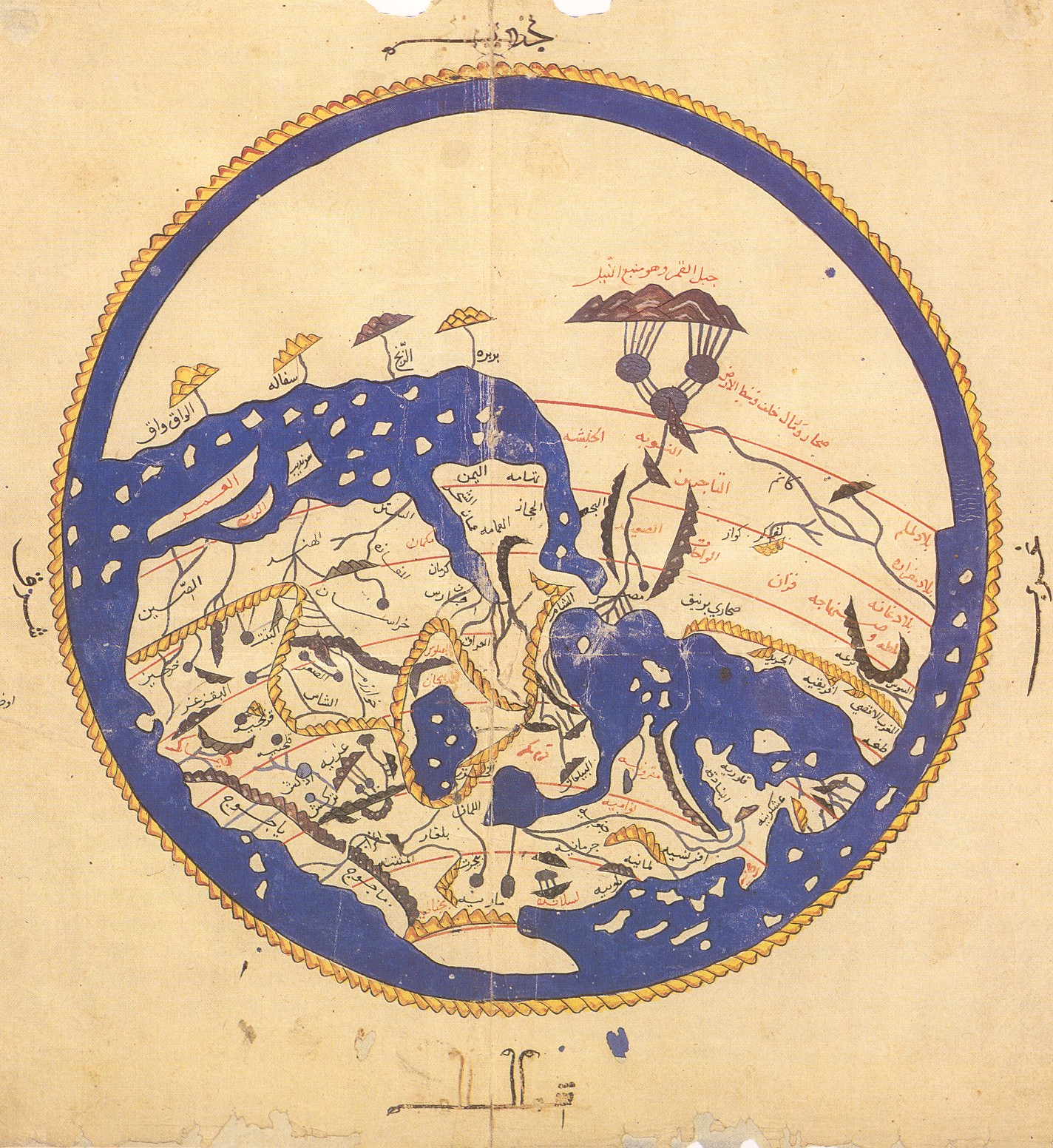
I have been fascinated by maps for as long as I can remember. I would spend hours staring at maps as a child. No matter how dull or poorly-constructed they were, I was always interested. So when one of my undergraduate classes had a field trip scheduled to the University of Minnesota Map Library I was ecstatic. When we got to the library we had a short presentation. At one point my professor put a slide up on the screen with an image of an ancient map and asked us to identify it. I immediately shouted out "it is the Middle East!". My classmates were shocked at how I could so quickly identify what it was. One of the reasons why they all had trouble recognizing it was because the map was "upside-down" with South being at the top and North at the bottom. Turns out that this was a reproduction of a map that is approximately 1000 years old. Westerners almost always put North at the top of the map and think of North as "up". This has been the standard for centuries, so challenging this idea seems strange to many of us. Why should we do something differently after doing it the same way for so long?

This was not always the case. As early Christian maps show, East was often put at the top of maps because Jerusalem, the holiest site for this religion was supposed to be in the center of the world and also higher than Europe. These 'T-O' maps as they are called today, depict a circular world with an ocean around it. Inside the 'O' of the world ocean are 3 continents, Europe on the lower left, Asia on the top, and Africa on the lower right. Bodies of water like the Mediterranean in the center and an unidentified river or passage (Perhaps the Red Sea) make up the "T". Jerusalem was at the center where the waters intersected with the 'T'. As the linked examples show, these maps were not very spatially accurate, although as this example shows, they were close enough where it is not so much of a stretch.

Crude T-O Map
Stylized T-O Map


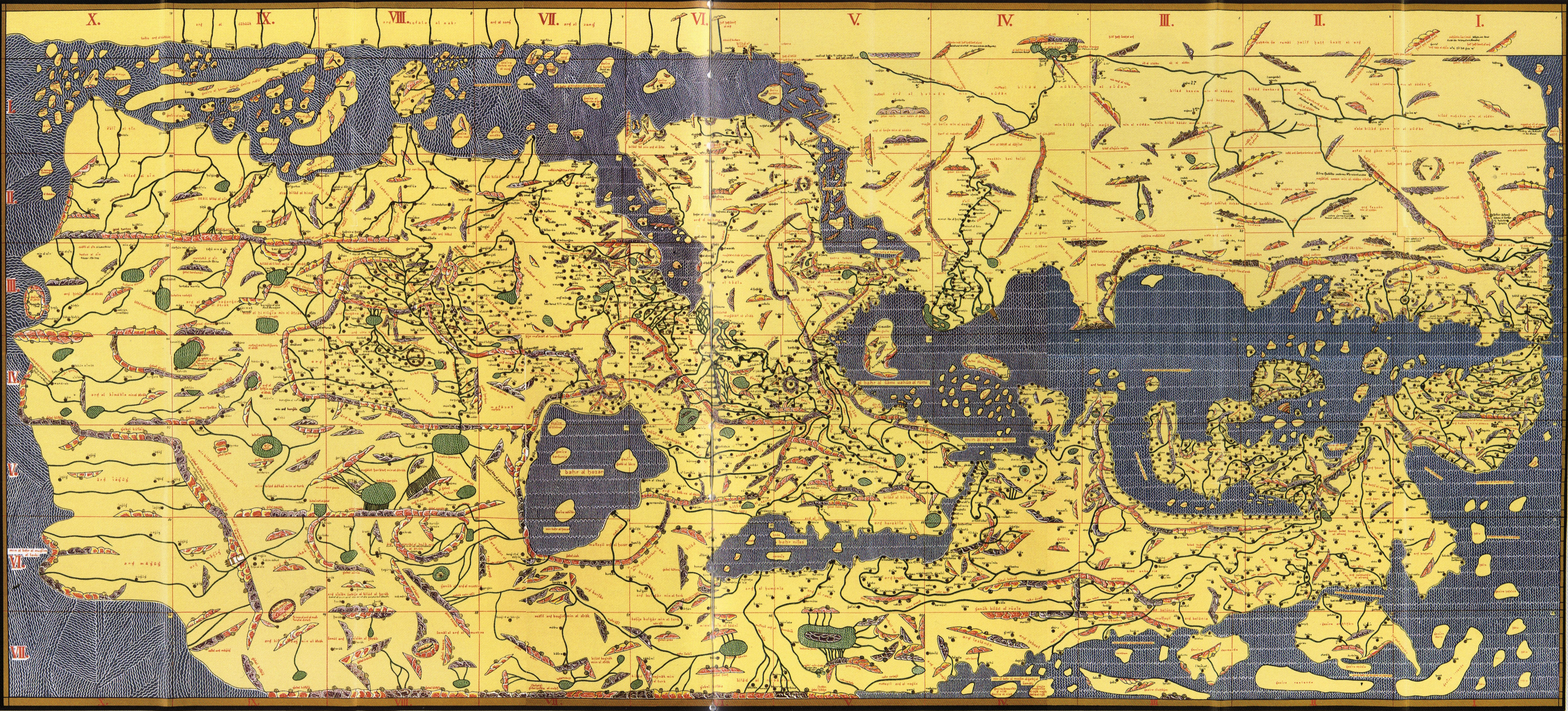
When the Western world began its descent following the collapse of the Roman Empire it left a void, physical and scientific. What may be surprising to some, is that it was the Islamic civilization which took up from where the West left off. For hundreds of years Islamic science ruled. Initially confined to a small space on the Arabian peninsula, the rapid expansion of Islam inspired multiculturalism as it came into contact with many different civilizations. One of the most important aspects of Islam is praying towards Mecca, which happens five times per day. When Islam was only on the Arabian Peninsula it was easy to tell which direction Mecca was because the physical distance was small. As Muslims moved further and further from Arabia it became much more difficult to be certain, so there was the necessity to always be able to orient oneself. Geographic knowledge was so important to them, that mapping "schools" were established in Baghdad by the Caliph Al Ma'mun. Initially the works produced here were based upon Hellenic works such as Ptolemy's Geographia, but over time they developed their own style through the Al-Balkhi and Al-Idrisi mapping schools. 

Following are some examples of early Islamic maps:
Al-Idrisi World Map (South is up)

Ibn al-Wardi Atlas (North is up)
Stylized Persian Gulf by unknown. East is up but I believe this was turned and South originally was up

Unknown
Al-Istakhri of the South Caucasus. Mountains are straight, I am unsure why this is different from others


They are distinct for a few reasons. First unlike many of the early Medieval European maps, there are no extraneous "details" such as fantastical sea creatures or angels. It is not exactly clear why this is the case, but a logical answer would be that it has something to do with the Islamic ban on creating representations of figures. The Ottomans did not have a problem with putting figures in their art so it is apparently not out of the question for all Muslims, but it does seem to make some sense that early Islamic works would be devoid of representations of humans or other animate objects. Secondly, the lines are more curved than in Western maps. There are no sharp angles, even the mountains are rounded. This again may be inspired by Islam or the Arabic script in some way, but the connection is unclear. Third, South is almost always at the top of the map. This again is perplexing as Mecca is put neither as the center or the top of the map. So why would this be the case? Mecca was clearly the most important place in Islamic civilization, why not put it at the top or at least at the center of the map? Occasionally it is towards the center of the map, but it is never emphasized as such like the Western maps did with Jerusalem. The Tabula Rogeriana by Al-Idrisi, a Spanish-Moroccan Muslim employed by Roger II of Sicily, shows a more advanced and improved version of most of the Islamic maps, yet it clearly was inspired by the earlier cartographers. It was made for a Western ruler, yet had all of the characteristics of an Islamic map. (here is the Saudi Arabia portion of the Tabula Rogeriana reoriented with North as up)

For several centuries Islamic science was incredibly important, but despite being far more advanced than the contemporary works of the West, the geographic knowledge of the Islamic civilization was discarded by Western scientists. Why was this the case? Why would superior works be ignored? Why would they regress from the emphasis on geographic accuracy and start adding extraneous details? Why would theTabula Rogeriana's groundbreaking work be ignored? Islamic maps had clearly made their way into Europe and as the example of Roger II commissioning the work, one would think there would be at least some interest in the work of the Islamic cartographers.

There are no comprehensive studies of this subject, and even some books wrongly claim that Islamic maps exclusively are oriented (yes this is a purposeful use of 'orient' as it also means 'East'), with East as up, despite there being virtually no evidence supporting this (there are a few maps like this, but the majority of the surviving map copies have South at the top). I find the Islamic cartographic practices to be fascinating. Why this subject has been ignored is beyond me.