Showing posts with label FRUS. Show all posts

Wednesday, December 27, 2017

Obama Appeasing Iran?

The Iran Deal has been litigated to death; mostly on social media, but also in the media. Recently, Politico published a new article by Josh Meyer with new allegations about the Obama administration appeasing Iran via lenience towards Hezbollah. The article is long, but can be summed up as such: the DEA had a task force targeting Hezbollah's drug trafficking operation and related activities and there was an unwritten order from the top down (the author insinuates from the very top) to let Hezbollah off the hook as the possibility of a deal with Iran was of greater concern.

As expected, this has led to the usual suspects re-litigating the Iran Deal, and, per usual, the ratio of substantive commentary to ad hominem attacks is unfavorable. This is not worth spending much time on, as the quality of arguments from both sides tend to be limited, though it should be noted that the allegedly mighty "echo chamber" has chimed in vociferously against their usual opponents.

As I noted in the past, the "echo chamber", portrayed by the right as a well-oiled and effective machine, was most active during a period when support for the Iran Deal dropped by 50%. The focus, unfortunately, has been based on the usual tired tropes rather than anything substantive.

One argument worth mentioning is from Ilan Goldenberg. A former Obama official and pro-JCPOA intellectual, he asked Meyer a simple question: 'do you have any proof that any of this is explicitly because of the Iran Deal'. Goldenberg acknowledges flaws in the Obama approach to Iran, and that Meyer's background investigative work is great, but points to this failure to produce anything explicitly linking the two. Meyer has not yet responded.

There is in fact evidence that Obama's administration appeased Iran specifically because of the Iran Deal negotiations. We have it on the record that Secretary of State John Kerry and/or President Obama himself blocked the release of the updated Iran 1951-1954 Foreign Relations of the United States (FRUS) up until the inauguration of President Trump in January 2017 (it was then discreetly released in the summer) The belief is that the ongoing nuclear negotiations were sensitive and releasing more information on the 1953 coup in Iran which the United States, Britain, and various Iranians were involved in, would be a literal deal breaker. For whatever reason this appeasement continued years after the deal was signed.

While it is unclear how far the administration went to facilitate the deal, how much leeway they gave Iran, Hezbollah, and Iran's other proxies, there is at the moment, little substantial and attributable evidence of appeasement aside from the FRUS incident.

Sunday, June 25, 2017

New CIA/State Department Docs on the 1953 Iran Coup (Part 7)

This is part 7 of my series on the new CIA and State Department docs on the 1953 Iran Coup. 

So many questions still remain about the successful and unsuccessful Iranian coups in August, 1953. Many of them may never be answered, including the curious question why John Kerry's State Department delayed the release of the updated FRUS collection.

It has been established that Kerry himself, heavily involved in the Iran nuclear talks, was vehemently opposed to the release, even up to the inauguration of President Trump. President Obama may have also been involved, but this isn't clear from the record.

In 2014 the delay was credited to the sensitivity of the ongoing nuclear talks, yet through 2017, almost two years after the nuclear agreement was finalized, they still worked to keep it from being released. What were they concerned about?

Others have theorized that this was because of the hidden British role in the 1953 coup attempts, or perhaps details over the United States role. I have argued that this doesn't make sense as (despite the reporting on this release) the role of the United States, and the UK has been well-known for decades. Two different American presidencies admitted a role (Clinton, and Obama), and the CIA formally acknowledged its role in 2013.

I asked:
What would be more infuriating for the regime, to show that the US was involved (which is what they are already furious about), or that major regime figures, or their direct influences played a role in fomenting the coup?

As the evidence shows, the role of Ayatollah Kashani, was exactly as I theorized, and perhaps even more damning than I expected. His work collaborating with key coup figures like Zahedi, encouraging quietist clerics to back the Shah, working to make his own coup as early as September 1952, hints that this is what Kerry (and Obama?) hoped to keep hidden from the Iranian public. There was backlash on Twitter especially from Iranian reformists who tweeted about the "Kashani Coup", demanding removing his name from a Tehrani street.

Others may still argue that the details of role of the United States and Britain are the reason why Kerry was so concerned about the release. However, the documents are still classified in key points, so these details are obscured. Additionally, the declassification review was completed in 2014, so there were no changes made to this latest edition. It would not have been the case that Kerry personally went in and classified British or American involvement in the coup.

Did Kerry not know what was in the documents? Was he mistaken in thinking parts that remain classified were to be released? Or was he protecting the Iranian regime, trying to keep them from being insulted by proving a direct connection to the coup which the regime and its apologists point to as the source of Iranian/American animosity?

There will be a part 8 and probably 9, but they won't happen until I thoroughly read sections 1, 2 and 4. 

Thursday, June 22, 2017

New CIA/State Department Docs on the 1953 Iran Coup (Part 6)

This is part 6 of my series on the new CIA and State Department docs on the 1953 Iran Coup. 

One of the problems I noticed when I was writing a term paper on Mossadeq and relations with the United States during my MA was how incomplete the record was. There were massive gaps at key moments, leaving so many questions unanswered. There were times when the FRUS collection skipped hundreds of cables, for example 3898 (April 4, 1953), to 4027 (April 15, 1953). It would be inconceivable for there to have been zero communications for 11 days, and the gap of 127 in the cable order seems to indicate that there were in fact a ton missing. 

When I visited the National Archives I was able to find a few important ones, yet still many gaps were left. The release fills more of the gaps, yet most of the relevant documents I found at the Archives are not included in the new release. There is one exception, cable #348, dated August 16. I wrote about it at the time, identifying it as the most interesting cable of those that I had found at Archives that weren't in FRUS. 


The number of documents withheld makes it nearly impossible to determine the precise nature of the events leading up to the coup. While we have a rough estimate, we do not know why the decision was made, how they did it, what else happened between the 16th and 19th of August, which third parties were involved and how involved they were.

The decision to overthrow Mossadeq appears to have been made April 2, 1953. Unfortunately there is no record of the meeting between Roosevelt and Dulles of this, yet an April 4th memo references the meeting. 


Moving forward, there are documents "released" yet entirely classified, namely those detailing the coup plans. The June 1st "Summary of Operational Plan" for example is completely classified, and no details are provided other than the date, location, classification, and where the copy of the file is located.


Other documents like monthly reports are also mostly redacted, 64 years after the fact.

Important files from the CIA have been published, yet we know there are also important pieces missing. The best example is as follows. Document 285, and 286, both dated 19 August, 1953. The file number for 285 is TEHE 737.1 and 286 is TEHE 742.1. The order again is sequential so TEHE 738-741 are not public. What is striking here is that the first one is almost despondent and scrambling to salvage the situation. The second is short and victorious. What happened between the two telegrams? 


Even the rundown of what happened after the coup is littered with classified material that hasn't been released. 


These details are vitally important, and yet still the full truth is withheld. The likelihood that the relevant parties are alive today is slim, why do they still wish to keep this information secret?


(I also highlighted the line about Communism. The Foreign Policy piece tried to make a big deal about the oil angle, yet as this document clearly shows, the Americans WERE interested in ideology. Whether what Roosevelt said is true or not, it is clear that Dulles/Roosevelt/etc wanted to hear about how this saved Iran from Communism.)


Tuesday, June 20, 2017

New CIA/State Department Docs on the 1953 Iran Coup (Part 5)

This is part 5 of my series on the new CIA and State Department docs on the 1953 Iran Coup. 

The role of clerics in the 1953 Iranian coup is both difficult to determine, and a sensitive topic. The regime has ties back to the Iranian clerics, and one of the myths they work to perpetuate is that foreigners meddled in Iranian affairs. This is helped by American (read CIA) incentives to claim omnipotence and competence in masterminding a coup. Both parties have reasons to minimize clerical involvement. While the events between 15 and 19 of August 1953 are difficult to determine for reasons I will discuss later, there are several important events involving clerics that bear mentioning.

Of the clerical elements, Ayatollah Kashani is the most relevant. He was the speaker of the Iranian Majles (parliament), and for a time an ally of Mohammad Mossadeq, before becoming a bitter enemy. His worldview bears striking similarities to Ayatollah Khomeini as I pointed out in part 3 of my series.


Behbehani. Boroujerdi was Ayatollah Khomeini's teacher, and forbade him or any others from political activities. This memo notes an "understanding" that they would "bolster the shah". While this sounds overtly political in nature, the difference is that historically the clergy had supported the monarchy, and in turn received protection. While it is a bit of a departure from the normal, it is more of an affirmation of the perceived threat to the Shah that Mossadeq posed.


Interestingly the documents leading up to the coup after April make less mention of Kashani. At the same time, key pieces are redacted or not included so there is no way to know how involved he would have been in the plans. It is entirely possible that he was a key piece, or that he was uninvolved.


Part 6 will be about the events leading up to the coup in August, and the problems resulting from incomplete records from both the State Department and CIA.

Monday, June 19, 2017

New CIA/State Department Docs on the 1953 Iran Coup (Part 4)

This is part 4 of my series on the new CIA and State Department docs on the 1953 Iran Coup. 

One of the most curious and difficult aspects of the Iran coup of 1953 is determining which parties were involved in the overthrow of Prime Minister Mossadeq, and to what extent they bear responsibility. The roles of the United States and Britain are undeniable, yet there are still inconsistencies and unknowns; primarily what happened between the first and second coup attempts, and when exactly they decided to try a coup. The following documents shed some light, but still many questions remain.

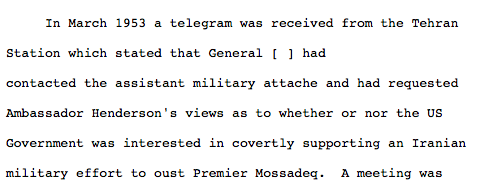
As I have previously noted (Myth 6), there were multiple contacts by IRANIANS in the months before the coup, trying to gauge the American interest in a coup. We know of at least two contacts made during March 1953, and perhaps as many as four. One referenced by Donald Wilber in his "Wilber Report" notes a General (name redacted), had contacted the "assistant military attache" and "requested Ambassador Henderson's views as to whether or nor the US government was interested in covertly supporting an Iranian military effort to oust Premier Mossadeq".
This is quite significant, as it establishes a precedent of Iranians approaching the United States to ask about a coup BEFORE the United States had decided to overthrow Mossadeq.

A previously released document (cable 3853 from Amb Henderson to Dulles dated March 31 and referring to a conversation from March 30th) has a record of former prime minister Hossein Ala' inquiring about the possibility of an American coup. Ala' was never a general so it is not possible that this request is from the same person. Henderson makes it quite clear to Ala' that the United States will not take a regime change policy, and will accept as head of the government whomever has the firman (edict) from the Shah establishing the individual as prime minister. 

A new CIA document dated March 31 indicates that Majles Deputy Haerizadeh, General Batmangelitch, and retired Generals Garzan, Bahadori, and Zahedi were planning a coup to take place within a few weeks. It also says that they claim that the US embassy approves (the footnote indicates that this appears to be "wishful thinking"). 

There may be overlap here, but it is quite clear that there were at least 3 instances in March 1953 of Iranians contacting United States officials about a coup. 

One of the next new documents is dated April 4th, and references an April 2nd conversation between Roosevelt and Dulles about initial plans to start TPAJAX (the code name of the coup attempt). It is unclear if these multiple attempts by Iranians to get the Americans on board for a coup had an effect, but given the proximity it seems as though there must be a connection of some sort. Also of note is the fact that TP AJAX was hand-written, as if it was either forgotten, or this is when they decided to name it. 

These documents are significant in establishing an Iranian interest in a coup before the United States had seriously considered regime change, and perhaps helps understand how the various American figures came to decide that a coup was worth exploring. Unfortunately there is not record of the April 2nd conversation, which would be much more useful in determining what motivated the change in policy. Kermit Roosevelt's "memoir" Countercoup—which is just as helpful as it is harmful—makes no note of this conversation, yet he mentions an additional meeting with an Iranian general who also wished to collaborate with the Americans on a coup. Again, because the name is redacted and other information is missing, we cannot be sure who exactly this was and if it was another Iranian who wished to overthrow Mossadeq, or the same one asking two different Americans the same thing.

Sunday, June 18, 2017

New CIA/State Department Docs on the 1953 Iran Coup (Part 3)

This is part 3 of my series on the new CIA and State Department docs on the 1953 Iran Coup. 

One of the most interesting and substantial documents newly released is an analysis of the nature of a potential Ayatollah Kashani run Iranian government by the Office of Intelligence and Research.

Kashani had been an ally of Mossadeq, before breaking with him and his National Front in early 1953. Kashani's role in Mossadeq's ouster has been downplayed in the traditional narrative of the events (which places most of the blame on the Americans), yet revisionists have noticed the extent of Kashani's influence, and how important he was in fomenting unrest against Mossadeq in the months leading up to the coup.

What is most striking about the document is how Kashani is described. If you took out his name, and other identifying information one might think that the authors are describing Ayatollah Khomeini or Khamenei. Kashani's sees "contemporary problems from a narrowly Moslem outlook, severely warped by many years of bitter conflict with British authority".

Mossadeq at the time had significant support and the authors deemed it unlikely that he would be replaced by Kashani, but they also note Kashani's influence, as the second largest bloc in the Majles (Iranian parliament). 
The authors point to a handful of negative characteristics of Kashani, ranging from conceit and ambition, to unscrupulousness and support of bigoted practices, and a lack of business and executive experience. 

Kashani was vehemently anti-British based upon his past experiences, he had experienced foreign meddling. This he shared with Mossadeq, though their motivations and approaches to addressing foreign interference was very different. 

The authors blame Kashani (like Mossadeq) for taking credit of others work to forward his own ambitions. He is likened to a "ward boss" and "gangster". His supporters are considered to be from a similar social class as Mossadeq (most appropriately described as middle-class), though with a distinct religious inclination.

Kashani, had disagreements with the Shah, the army, and starting in early 1953 Mossadeq as well. Shia clergy in Iran had historically been quietist, subservient to the monarchy. Kashani was outspoken, a break from tradition. He disapproved of the late Shah's work to sideline the clergy, and to uphold the mantle of Shiism, when the Shah wasn't even a theologian. This is virtually identical to Khomeini's approach years later. 

The authors noted that Kashani's relatively lower popularity and all of the enemies he had limited the prospects for a theocratic state. That they were considering it as a possibility is still quite telling.


Again the parallels to Khomeini, and even Khamenei here are striking. They believe that the West is engaging in plots to control weaker nations. He also is credited with having a disparaging attitude towards oil, and wanted to diversify the economy to create self-sufficiency and limit dependence.

The last section is also eerily reminiscent of Khomeini. It is acknowledged that Kashani wouldn't want to accept foreign funds because it would undermine him. The authors note that this makes cooperation with Kashani difficult, but they didn't rule it out. The last paragraph is also interesting as it directly points to a policy of neutrality from the Iranian government. The Dulles brothers in particular speak repetitively about the dangers of communism taking over, yet this memo, just months ahead of the coup explicitly notes neutrality as the Iranian government policy.

This analysis of Kashani is fascinating and apt and as I mentioned throughout, the similarities to Khomeini are significant.


Saturday, June 17, 2017

New CIA/State Department Docs on the 1953 Iran Coup (Part 2)


This is part 2 of my series on the new CIA and State Department docs on the 1953 Iran Coup. 

The third section of the new documents "Planning and Implementation of Operation TPAJAX, March–August 1953 (Documents 169-308)" and starts with a doozy; a CIA memo for the president dated March 1, 1953. While it is in fact an old document that was included in the 1989 original Iran FRUS, there are some additional sentences and clauses that are included as demonstrated in this screenshot of the two side by side.

Again as I've indicated in the past, the role of Ayatollah Kashani is dismissed by apologists and clerics alike. These documents make it quite clear that he had an immensely important role in the build up to the coup. 

The next document is also new to the FRUS collection and concerns the "Capabilities of the CIA Clandestine Services in Iran"
This is another very important document. It indicates that the propaganda outlets the CIA controlled were NOT capable of spreading anti-Mossadeq propaganda a mere five months before the coup.

Later parts of the memo include this damning passage: the CIA didn't have the capability of creating riots against Mossadeq.
Again there are still redactions in the new documents, a very frustrating reality for historians trying to better understand the events of and leading up to the coup.

Interestingly enough the Top Secret cable (2266, March 2, 1953) from John Foster Dulles to the Iran embassy is not included in the new FRUS, despite its undeniable relevance and importance. Perhaps they are only including ones with changes?

The next document is from the famous NSC 135. One can see the ellipses on the left document indicating a redaction, and the new version which has additional information. 

There is an editorial note following NSC 135 which discusses Foreign Minister Eden's trip to the United States from March 4-7, 1953. As I've previously noted, the CIA's chronology in Zendebad Shah! made a mistake in characterizing the nature of Eden's discussions, implying that negotiations broke down before the trip, when in fact they were, at the time, ongoing and were not dissolved until after Eden returned to the UK.

Three documents later, my work is confirmed. On March 10th, A memo from Byroade to JF Dulles references the potential breakdown of oil negotiations, and a recommendation (from Henderson) to not buy Iranian oil, to not encourage or discourage American firms from engaging in business, and to withhold some financial assistance from Iran. 

A March 11th CIA memo is helpful in outlining the situation as it was. It covers the various opposition groups, starting with Kashani. 


Even after big demonstrations in February and unrest, despite instability with the oil negotiations, the CIA thought Mossadeq had a lot going for him.


The analysis of what Mossadeq's choices were is very good and did a good job predicting what Mossadeq would do.

Friday, June 16, 2017

New CIA/State Department Docs on the 1953 Iran Coup (Part 1)

This is Part 1. In Part 2 I will discuss a few of the more interesting documents

Finally, after years of delays, the State Department released an update to the 1951-1954 Iran FRUS (Foreign Relations of the United States). The purpose of the series is to provide a better record of diplomatic events in the past. The previous edition, released in 1989, was widely criticized for failing to note the depth of US involvement in the 1953 Iran coup, and for leaving many documents classified despite the decades that had past since this time.

Generally FRUS does not contain everything, and there are many documents, some historically pertinent, that are stored at the National Archives in Maryland. I have annotated a few from this time: Part 1 Part 2. I have noted in the past how the record is incomplete; in some instances there are hundreds of cables in a row that are not in FRUS, and in many places there are missing documents. They could be completely mundane (as so many are), or they could be very revealing.

The release was also interesting because of how hard President Obama and Secretary of State John Kerry had worked to keep them from being released. It was reported that up to the last hours of Obama's presidency they were trying to keep them secret.
“As it expressed in last year’s annual report, the HAC was repeatedly frustrated–and disappointed–by Secretary Kerry’s refusal to allow the volume’s publication,” Prof. Immerman said yesterday. “In this regard the change in State’s perspective from the Obama to Trump administration is dramatic.”
This bothered State Department officials as noted here:
https://history.state.gov/about/hac/june-2016

I have speculated about the motivations for the two not wanting the documents to become public: http://persophilia.blogspot.com/2016/06/why-is-state-delaying-release-of.htmlhttp://persophilia.blogspot.com/2016/10/no-frus-doesnt-have-all-answers.html.

Obama and Kerry were worried about the reaction of the Iranians to the releases. I postulated that this would be due to revealing the nature of the participation of clerical elements. It is clear to the world that the United States and the UK tried to overthrow Mossadeq on the 16th of August 1953; no one denies this. What happened next, between then and the successful August 19th coup, and who was involved in addition to the United States is what could potentially be so inflammatory. Ayatollah Kashani, an inspiration for Ayatollah Khomeini and many other important clerics to come later, was a key player.

The release yesterday was particularly important because it also contains CIA documents. It was claimed that these documents were lost, yet they have reproduced some of them. There are also copies of old documents that have been public for over 25 years. They are mostly quite important, but their exact purpose in this collection is unclear. At the same time, many CIA documents are NOT included. The best example is here:

Sequentially there is document TEHE 737.1 and the next document is TEHE 742.1. Both have the same date, yet are clearly from different points in the day. In the first (737), there is almost a despair about the failure of the coup, and further efforts to commence damage control. In the second (742), there is a brief message of success. Did nothing happen in between these two moments? How did they go from potentially cancelling military aid, to a successful coup and an urgent need for 5 million dollars?! What do the four documents between 737 and 742 say?

While I have yet to read through the entire set of documents (there are over 500, and over 900 pages), I read the whole section on the coup (section 3, 272 pages), and the events leading up to the coup. My theories are almost uniformly supported, though there are still holes in the documentation.

  1.  CIA documentation is still contradictory (I've noted problems in the narrative and chronology http://nationalinterest.org/feature/six-myths-about-the-coup-against-irans-mossadegh-11173http://persophilia.blogspot.com/2013/11/relations-between-mossadeq-and-united.html)
  2. Roosevelt is unreliable (A lot of what he's said reads as though he is covering for his mistakes)
  3. Religious elements were KEY to the coup (They make this quite clear throughout)
  4. The "spontaneity" of the events of August 19 is emphasized throughout

While none of this exonerates the United States and the UK of course, the documents make quite clear that domestic actors must accept a not insignificant share of the blame.

I have noted multiple Iranian officials approached the United States asking about a coup in the months prior (last paragraph in myth #6). It was evident that while Mossadeq was undoubtedly a noble, well-intentioned individual, he was not capable of bringing Iran out of the crisis alone, and he made too many enemies, both foreign and domestic.

Part 2 will have more on specific documents

Monday, October 17, 2016

No, FRUS doesn't have all the answers

A recent article in Politico on the 1953 Iran Coup, while well intentioned, is unfortunately fundamentally flawed. Malcolm Byrne, who collaborated with Mark Gasiorowski to provide one of the most important academic books on the coup, writes in support of releasing the updated FRUS (Foreign Relations of the US). I too have argued for the same thing, but our reasons are very different.

Mr. Byrne makes a variety of mistakes in his assessment of the situation, ones that someone with his experience with archival documents, and with this episode in history should not make.

First he neglects to mention that the first coup attempt failed miserably, leading to the arrest of dozens of high-ranking officers and conspirators. There was no backup plan. Mr. Byrne does not state how one man, with zero knowledge of Persian managed to create a 2nd coup a mere three days later after his entire plan collapsed.

He also fails to account for competing interests, including Iranians who despised the Iranian Prime Minister, who wished to remove Mr. Mossadeq from power. He ends his introductory paragraph blaming the coup for feelings of anti-Americanism that endure to this day, ignoring once again, that clerics, including the direct spiritual predecessor of Ayatollah Khomeini (Ayatollah Kashani), was key in the attempts to remove Mossadeq from power.

His argument is based upon the core principle that the US, and the US alone (well including the UK), is guilty of overthrowing Mossadeq, rejecting the possibility of domestic (or other foreign) collaboration.

Mr. Byrne goes on to claim that the American public does not have full-access to the full historical record. This is partially true, as the CIA "lost" all of its files from the time in a suspicious fire, and some of the documents from the State Department remain classified. At the same time, the vast majority of these documents ARE available at the National Archives in Maryland.

Mr. Byrne also seems to not understand the point of the FRUS system. These are not complete records containing every single cable to and from an embassy or consulate. There are a small fraction that are included in FRUS collections. They are selected to be pertinent, not a complete data dump. There are many more documents from and to Tehran and other places that are in the National Archives, I have seen them myself. Most of them are mundane, but some are quite interesting. It would be nice to include these in a massive digital archive including every single document, but this is not how the FRUS system is set up.

Mr. Byrne claims that the US and UK role in the coup is covered up, and the documents the State Department refuses to release will prove the two parties guilty. In the Archives, the additional documents I have read myself, indicate otherwise as I have demonstrated here and here.

Mr. Byrne believes that US and UK guilt over the coup is the major reason to not release the documents, but his analysis falls far short. He does not account for the local efforts to remove the Shah, and their ties to the current regime. He additionally fails to mention the saga (covered by David Ignatius of the Washington Post), where BP (formerly AIOC) forced Kermit Roosevelt and his publishing company to pull the entire run, though he has written about it in the past.

What would be more infuriating for the regime, to show that the US was involved (which is what they are already furious about), or that major regime figures, or their direct influences played a role in fomenting the coup?

Given the sensitivity of the Iran nuclear talks which have been ongoing, this delay makes sense in that they do not want to upset the Iranians so that they completely withdraw, and years of diplomatic efforts are lost.

While I agree with Mr. Byrne that the updated FRUS should be released, I strongly disagree with his analysis and I am very disappointed with his failure to mention the most likely scenario: that documents will show involvement from the Iranian clergy.

There are classified documents out there, documents which have not undergone their 50 year declassification review. Why hasn't Mr. Byrne filed MDRs (Mandatory Declassification Review) for these documents? He spends his time working on archives, yet in his article he ignores this potentiality.

His argument does not stand up. It does not make any sense for him to claim that the documents are not available when they mostly are. For the few that are classified, he simply has to go to the Archives and find the sheet that says how there is a classified document missing and then file an MDR. Yet he refuses to mention this aspect in his article, instead making it about some conspiracy to hide the truth from the American people.

It is also quite disheartening that he is convinced that there are going to be documents giving us a definitive answer as to what happened, and who the guilty parties are. I have demonstrated how even the CIA's latest (known) internal history has at least one glaring mistake (see #5). If the CIA doesn't have the story straight, how would the State Department?

There may be documents proving Mr. Byrne right, yet his shoddy work, and misleading, baseless claims do not help shed a light on a complicated historical event.

In conclusion, this quote from Donald Wilber, the author of the CIA's first internal history of the coup sums up the entire situation: "The early accounts of various participants differed widely enough to make it impossible to follow the slender thread of truth through the dark night"

Wednesday, June 8, 2016

Why is State Delaying the Release of the Updated 1952-1954 Iran FRUS?

UPDATE #1 (March 7, 2017): Nate Jones from the National Security Archive tweeted a few cryptic tweets about the delay:

The initial reason for the delay was to keep the negotiations going, yet "until the final day" of Obama's term they fought to delay the FRUS edition. It is now delayed until 2018 or later. 

I tweeted the following about this: 

What doesn't the Obama admin want the public (US, or Iran), or the Iran regime, or the world to know?? This is very suspicious and illogical.

--


For all the strange and unprofessional behavior by the State Department over the last few years, something curiously ignored is the persistent delays in the scheduled re-release of the 1952-1954 Iran Foreign Relations of the United States (FRUS) collection.

FRUS is an invaluable tool for academics and researchers as it contains primary archival material hosted online by the University of Wisconsin in an organized and easily accessible form. All of this and much more is also available in the National Archives II in College Park Maryland, but the documents are not in any particular order, are not sorted and accessing them is inconvenient.

The 1953 Iran coup is fascinating for a number of reasons, and sensitive to many parties because of the injustice of overthrowing a legally appointed premier. As I've noted in the past, the full story is not evident from the documents that we have; there are too many inconsistencies and holes in the timeline. This has not stopped academics and pseudo-academics from pontificating and making grandiose judgements based upon such shoddy work as the "memoirs" of Kermit Roosevelt; a work that is known to have been at least partially edited by the CIA at the behest of BP and perhaps other unknown parties. It is unclear how the edits changed the story, but a cursory glance through the text shows how it is barely more than a dime novel.

FRUS, as the primary collection of archival documents from the Department of State, has a certain authority to it. Even though significant pieces of the archive are missing from the current edition of the Iran as I noted here and here, and an unknown number of cables and documents remain classified (well beyond the legally justified time period), there is a lot there.

At least a few of the top books on the coup were written by authors who apparently had never even been to the archives; the only State Department cables cited by them are also included in the existing FRUS. Given my personal experience digging through the boxes at Archives II, I know there are other cables there that have academic value to the study of this important event.

The Department of State announced years ago that there would be an updated version of the collection updated, yet in September 2014 announced that "the Department had decided to delay publication because of ongoing negotiations with Iran". It has now been almost a year since the nuclear deal was signed, yet the updated FRUS has not been released.

In December of 2015, the Office of the Historian held a meeting where the release of the collection was discussed. Principal Deputy Assistant Secretary of State for Public Affairs Valerie Fowler indicated that "the timeline was to release the volume at the earliest possible moment, but that external developments and considerations were important too".

What could these "external developments and considerations" entail? The National Security Archive believes that there could be documents confirming a British hand in the events. While in theory this should be plausible, it would not explain the early decision to release the updated version, before an abrupt about-face and decision to withhold the documents. The other problem with this theory is that the British had been kicked out of the country months earlier and so their intelligence apparatus was knee-capped by a closed embassy and limited access. This is partially why the US took the lead in conducting the first (planned) coup attempt.

Personally I think that the most likely possibility is that there are documents tying Iranians, potentially clerics associated with Ayatollah Kashani (or perhaps even Khomeini), to the coup and that this would infuriate the Iranians so much that they would have pulled out of negotiations. It is also possible that this could contain further details of United States involvement, but as the US is already blamed as the primary instigator and actor by Iran, it isn't like things could get much worse, is it?

Given the strange and inept way in which the State Department and the administration have handled public diplomacy regarding Iran (see Rhodes, Ben) I am deeply curious why they are not releasing the updated version. What are they trying to keep hidden?

Friday, August 15, 2014

The Mossadeq Coup: Misconceptions about the Role of the United States and the CIA

The United States government, namely the CIA, is often blamed for the August 1953 coup removing Iranian Prime Minister Mohammad Mossadeq from power, however a careful examination of older studies, in addition to newly accessible information, reveal that common conceptions of the events and chronology are flawed, despite their prevalence. 

One reason why these misconception exist is that many files from US government sources relating to this time period, and in particular to this event, remain classified or are otherwise inaccessible (most CIA documents regarding the events have allegedly been destroyed). Under United States law, special exceptions can be made allowing documents to be classified for 50 or 75 years rather than the normal 25 years. It has now been over 60 years since the events took place. This means that on at least two occasions, the documents have been determined to be too sensitive to release. 

More documents regarding this series of events will be revealed later this year (UPDATE: the release has been delayed due to fears that it could have an effect on ongoing nuclear negotiations), when the State Department’s FRUS (Foreign Relations of the United States) Iran 1952-54 is re-released including newly declassified documents. While imperfect, these documents are the most reliable and most accessible. It is important see these documents (as well as those previously released) in context, and to correct widespread misconceptions about the coup and the parties involved.

These misconceptions are problematic because of how they have engrained themselves into our understanding of the events. The preeminent scholar of Iran, Richard Cottam—who himself lived in Iran for many years and was an employee of the CIA as well as the State Department—wrote in the 1960s edition of ‘Nationalism in Iran” (also included in the 2nd edition published in 1979) that "The distortions of the Mossadeq era, both in the press and in academic studies, border on the grotesque.”

Since this time there have been many new accounts, ranging from Kermit Roosevelt’s fundamentally flawed yet influential memoir ‘Countercoup’, to the scholarly work of Mark Gasiorowski, to Stephen Kinzer’s highly popular “All the Shah’s Men” and the most recent revisionist histories of Dariush Bayandor and Ray Takeyh. Though the academic work is considerably more accurate than that of Roosevelt and Kinzer, there are still significant errors in both traditional and revisionist narratives, which have affected the mainstream understanding of this monumental event.

Misconception #1: The United States wanted Iran’s oil:
The United States had no oil interests in Iran (it was the British that did). The primary goal of the Americans was to prevent the spread of Communism, and to secondary was to resolve the dispute as quickly as possible (see National Security Council document NSC 136/1). This is not to say that the United States did not have a vested interest in Middle Eastern oil (e.g. Saudi Arabia), but rather that from the American side, co-opting Iran’s oil interests was not the motivation for a coup. Since at least 1943, US policy had been to develop Middle Eastern oil because North American and Caribbean oil would be easier to defend in war[i]. If anything, a quick resolution was the most important factor to the American; something clearly reflected in their efforts to reach a negotiated settlement.


Misconception #2: Mohammad Mossadeq was a democratically elected Prime Minister:
While Mossadeq was elected to the Majles (the Iranian Parliament) by democratic means (Iran at the time was not a democracy by any means, though some aspects of it were democratic in nature), the office of Prime Minister was nominated from amongst the Majles deputies by the Shah. In turn, the Majles members either voted for or against the nomination (In his initial appointment Mossadeq was approved by a tally of 79-12)
[ii]. Mossadeq enjoyed massive popularity at different times during his political career, but his position as Prime Minister was never due to a nationwide poll (he was PM on two separate occasions). 

This is not to say Mossadeq’s position was not legitimate. He was chosen by his constituency to be a Majles deputy, this is indisputable. He was not however, chosen by the Iranian people to be Prime Minister. This also does not account for the fact that the Majles was mostly comprised of feudal landowners, intrinsically opposed to Mossadeq and his populism[iii]. Before Mossadeq became Prime Minister, the Iranian public was unhappy with the state of affairs in Iran; Mossadeq with his sincere populism was seen by the Shah as a clever alternative to yet another feudal landowner or military officer[iv]. This is also a key factor in Misconception #6.

Misconception #3: The Eisenhower Administration was determined to remove Mossadeq from power from Day 1:
One of the fundamental misunderstandings concerns the Eisenhower Administration’s decision to remove Mossadeq from power. A cursory reading of the documents supplied in the FRUS volume concerning Iran, reveals that the President was most concerned with the specter of Communism above anything else. Eisenhower even said in a National Security Council meeting that if he had $500,000,000.00 to spare, he would have preferred to give $100,000,000.00 to Iran so that the financial troubles brought on by British sanctions could be alleviated[v]. Eisenhower was likely influenced by the Dulles brothers (Secretary of State and Director of the CIA), but for a considerable period of time the president opposed a coup. He was afraid of destabilizing Iran and the region, which in his estimation, would inevitably lead to a communist takeover.

Misconception #4: The CIA coup was successful:
It is clear from the record that the attempted coup (codenamed TPAJAX) which was undertaken on the night of August 15th, 1953, was a dismal failure. Not only did the Iranian military officers fail in their task to arrest Mossadeq, the CIA did not have a backup plan. Even though Kermit Roosevelt claimed to have magically turned the situation around in only 3 days, the circumstances of what really happened between the failed coup of August 15/16 and the successful one of the 19th is highly contentious. How did the situation turn around so quickly, despite the early setbacks including the arrest of pivotal Iranian conspirators such as Colonel Zand-Karimi, the conduit for communicating with Tehran-based commanders? Roosevelt’s version of events is difficult to accept without reservation, not only because of the style and substance of his writing, but also because of his well-known questionable reliability. 

Misconception #5: CIA documents corroborate each other:
There is an recurrent idea that the CIA is all-powerful, and that classified documents from the CIA are inherently truthful and accurate. Again this ignores the context of the documents. This was the CIA’s first attempted coup, and especially for those involved there was a strong incentive to downplay the failures of the plan and to exaggerate any potential successes. In the various accounts declassified by or leaked from the CIA there are several inconsistencies which calls into question to accuracy of the different accounts. 

Perhaps most striking (though ignored in historiographies) are those found in the most recent CIA history ‘Zendebad Shah’, published internally in 1998 and partially released following FOIA requests from George Washington University’s National Security Archive. In this document, it is written that British Foreign Minister Eden “found the Americans much more receptive to the British viewpoint than they had been under Truman and Acheson. The collapse of the Anglo-Iranian oil negotiations had changed the American’s attitude.” These events however, are taken out of chronological order; the negotiations did not in fact collapse until days after the meeting between Eden and the Americans. On the same page the author also wrote that the US administration ‘abandoned the search for a negotiated end to the crisis.’ Without context, this implies that the US broke off negotiations, while in fact it was Mossadeq that did so.

It is unclear if this is poorly researched document, if the person responsible for it made mistakes in his writing, or if the CIA truly does not have a comprehensive understanding of what happened. Of all the declassified CIA documents on the coup, this one is the most recent (there was another document declassified after this one, but it was written decades prior). Is it unrealistic to expect the newest one to be the most accurate? 

Misconception #6: Westerners and Royalists were the only ones who wished to remove Mossadeq from power:
This is perhaps the biggest misunderstanding of all. While Mossadeq had enjoyed great popularity earlier in his term, his coalition had come under great pressure, and former allies had begun to oppose him. Chief amongst these was Ayatollah Kashani, the speaker of the Majles, and a vital influence for the next generation of politicized clerics, significantly, Ayatollah Ruhollah Khomeini. I personally find it very interesting that the US has not made an effort to publicize these connections. Given the tensions between the governments of Iran and the United States since 1979, one would think that undermining the Iranian clerical leadership through showing the links to the coup would be in the interests of the United States.

During the oil crisis, Mossadeq became very unpopular. Things were so bad that when it was clear that his now fractured party would not gain a majority, he cancelled parliamentary elections. In February 1953 there were mass demonstrations against Mossadeq (possibly arranged for or instigated by foreign agents including the CIA); demonstrations of enough severity for Mossadeq to increase security measures in Iran. 

The tendency is to blame the CIA and Americans because we know from the record that there was an attempt to overthrow Mossadeq, but this does not absolve the other participants. There are instances in both the Wilber Report and FRUS where an Iranian general and the former Prime Minister of Iran (allegedly on behalf of a group of military officers) separately contacted US officials inquiring on their interest in conducting a coup d’etat. 

Other issues:
There are two additional issues which I have not addressed as a ‘misconceptions’, because neither of them are considered a key part of the narrative. The role of Ambassador Loy Henderson, who many believe worked with the CIA beyond the scope of his office, has been generally neglected by scholars and journalists. Henderson when interviewed for the Truman Library in 1973, said things which Roosevelt contradicted 6 years later in Countercoup. During this interview Henderson also said that the record would reflect his version of events, if the telegrams were ever declassified.

The other and perhaps most curious issue is the role of the Dulles brothers. The two of them were partners with the American firm (Sullivan & Cromwell) representing the AIOC interests in the United States before their positions as head of the CIA and State Department. The Dulles brothers’s firm had done work with United Fruit Company, one of the corporations which benefited the most from the CIA’s coup in Guatemala in 1954. Both brothers were also major shareholders in United Fruit. It may be difficult to determine if the Dulles brothers used their position to benefit them and their associates financially, and the lack of a comprehensive record from either the CIA or State Department, not to mention Eisenhower’s obsession with secrecy a difficult matter to ascertain. If this is a coincidence it is a truly remarkable one. 

What this means for the new FRUS release:
While there may be new details revealed with the updated release of the FRUS documents, it is likely that the biggest gaps in the record (determining when and why Eisenhower changed his mind and decided to support a coup, as well as what happened between August 16th and 19th) will remain unfilled. Furthermore, it is important to recognize that the contradictions between different versions still remain, and are likely to be even more convoluted by the pending release.

"The early accounts of various participants differed widely enough to make it impossible to follow the slender thread of truth through the dark night.”
—Donald Wilber in ‘The Wilber Report’

--

Sources:
[i] 1 December 1943, folder: ‘Petroleum Reserves Corporation Activities. 7/3/43-1/1/44’ box 1, Records of the Petroleum Division, RG 59 via Anderson, Irvine H. "The American Oil Industry and the Fifty-Fifty Agreement of 1950." Musaddiq, Iranian Nationalism, and Oil. By James A. Bill and William Roger Louis. 1988. 151


[ii] In the executive system of the time, Prime Minister was elected by the Parliament (Majles). Mossadeq was voted in by a 79-12 margin. See Foran, John. "Democratization, Separatism, Nationalization, Coup." Fragile Resistance: Social Transformation in Iran from 1500 to the Revolution., 1993. 285.


[iii] Cottam, Richard W. Nationalism in Iran. 1964. 49


[iv] Azimi, Fakhreddin. Iran: The Crisis of Democracy. New York: St. Martin's, 1989. 257

[v] Memorandum of discussion at the 135th meeting of the National Security Council, March 4, 1953, FRUS, 1953-1954, Vol. X:Iran, p. 691-701


Additional Resources:


Wilber Report (Mostly unredacted): http://cryptome.org/cia-iran-all.htm