Showing posts with label Shah. Show all posts

Tuesday, June 20, 2017

New CIA/State Department Docs on the 1953 Iran Coup (Part 5)

This is part 5 of my series on the new CIA and State Department docs on the 1953 Iran Coup. 

The role of clerics in the 1953 Iranian coup is both difficult to determine, and a sensitive topic. The regime has ties back to the Iranian clerics, and one of the myths they work to perpetuate is that foreigners meddled in Iranian affairs. This is helped by American (read CIA) incentives to claim omnipotence and competence in masterminding a coup. Both parties have reasons to minimize clerical involvement. While the events between 15 and 19 of August 1953 are difficult to determine for reasons I will discuss later, there are several important events involving clerics that bear mentioning.

Of the clerical elements, Ayatollah Kashani is the most relevant. He was the speaker of the Iranian Majles (parliament), and for a time an ally of Mohammad Mossadeq, before becoming a bitter enemy. His worldview bears striking similarities to Ayatollah Khomeini as I pointed out in part 3 of my series.


Behbehani. Boroujerdi was Ayatollah Khomeini's teacher, and forbade him or any others from political activities. This memo notes an "understanding" that they would "bolster the shah". While this sounds overtly political in nature, the difference is that historically the clergy had supported the monarchy, and in turn received protection. While it is a bit of a departure from the normal, it is more of an affirmation of the perceived threat to the Shah that Mossadeq posed.


Interestingly the documents leading up to the coup after April make less mention of Kashani. At the same time, key pieces are redacted or not included so there is no way to know how involved he would have been in the plans. It is entirely possible that he was a key piece, or that he was uninvolved.


Part 6 will be about the events leading up to the coup in August, and the problems resulting from incomplete records from both the State Department and CIA.

Monday, June 19, 2017

New CIA/State Department Docs on the 1953 Iran Coup (Part 4)

This is part 4 of my series on the new CIA and State Department docs on the 1953 Iran Coup. 

One of the most curious and difficult aspects of the Iran coup of 1953 is determining which parties were involved in the overthrow of Prime Minister Mossadeq, and to what extent they bear responsibility. The roles of the United States and Britain are undeniable, yet there are still inconsistencies and unknowns; primarily what happened between the first and second coup attempts, and when exactly they decided to try a coup. The following documents shed some light, but still many questions remain.

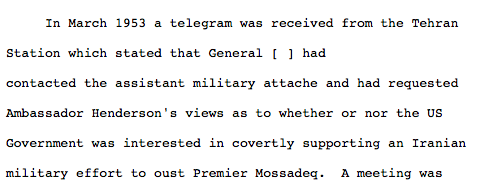
As I have previously noted (Myth 6), there were multiple contacts by IRANIANS in the months before the coup, trying to gauge the American interest in a coup. We know of at least two contacts made during March 1953, and perhaps as many as four. One referenced by Donald Wilber in his "Wilber Report" notes a General (name redacted), had contacted the "assistant military attache" and "requested Ambassador Henderson's views as to whether or nor the US government was interested in covertly supporting an Iranian military effort to oust Premier Mossadeq".
This is quite significant, as it establishes a precedent of Iranians approaching the United States to ask about a coup BEFORE the United States had decided to overthrow Mossadeq.

A previously released document (cable 3853 from Amb Henderson to Dulles dated March 31 and referring to a conversation from March 30th) has a record of former prime minister Hossein Ala' inquiring about the possibility of an American coup. Ala' was never a general so it is not possible that this request is from the same person. Henderson makes it quite clear to Ala' that the United States will not take a regime change policy, and will accept as head of the government whomever has the firman (edict) from the Shah establishing the individual as prime minister. 

A new CIA document dated March 31 indicates that Majles Deputy Haerizadeh, General Batmangelitch, and retired Generals Garzan, Bahadori, and Zahedi were planning a coup to take place within a few weeks. It also says that they claim that the US embassy approves (the footnote indicates that this appears to be "wishful thinking"). 

There may be overlap here, but it is quite clear that there were at least 3 instances in March 1953 of Iranians contacting United States officials about a coup. 

One of the next new documents is dated April 4th, and references an April 2nd conversation between Roosevelt and Dulles about initial plans to start TPAJAX (the code name of the coup attempt). It is unclear if these multiple attempts by Iranians to get the Americans on board for a coup had an effect, but given the proximity it seems as though there must be a connection of some sort. Also of note is the fact that TP AJAX was hand-written, as if it was either forgotten, or this is when they decided to name it. 

These documents are significant in establishing an Iranian interest in a coup before the United States had seriously considered regime change, and perhaps helps understand how the various American figures came to decide that a coup was worth exploring. Unfortunately there is not record of the April 2nd conversation, which would be much more useful in determining what motivated the change in policy. Kermit Roosevelt's "memoir" Countercoup—which is just as helpful as it is harmful—makes no note of this conversation, yet he mentions an additional meeting with an Iranian general who also wished to collaborate with the Americans on a coup. Again, because the name is redacted and other information is missing, we cannot be sure who exactly this was and if it was another Iranian who wished to overthrow Mossadeq, or the same one asking two different Americans the same thing.

Sunday, June 18, 2017

New CIA/State Department Docs on the 1953 Iran Coup (Part 3)

This is part 3 of my series on the new CIA and State Department docs on the 1953 Iran Coup. 

One of the most interesting and substantial documents newly released is an analysis of the nature of a potential Ayatollah Kashani run Iranian government by the Office of Intelligence and Research.

Kashani had been an ally of Mossadeq, before breaking with him and his National Front in early 1953. Kashani's role in Mossadeq's ouster has been downplayed in the traditional narrative of the events (which places most of the blame on the Americans), yet revisionists have noticed the extent of Kashani's influence, and how important he was in fomenting unrest against Mossadeq in the months leading up to the coup.

What is most striking about the document is how Kashani is described. If you took out his name, and other identifying information one might think that the authors are describing Ayatollah Khomeini or Khamenei. Kashani's sees "contemporary problems from a narrowly Moslem outlook, severely warped by many years of bitter conflict with British authority".

Mossadeq at the time had significant support and the authors deemed it unlikely that he would be replaced by Kashani, but they also note Kashani's influence, as the second largest bloc in the Majles (Iranian parliament). 
The authors point to a handful of negative characteristics of Kashani, ranging from conceit and ambition, to unscrupulousness and support of bigoted practices, and a lack of business and executive experience. 

Kashani was vehemently anti-British based upon his past experiences, he had experienced foreign meddling. This he shared with Mossadeq, though their motivations and approaches to addressing foreign interference was very different. 

The authors blame Kashani (like Mossadeq) for taking credit of others work to forward his own ambitions. He is likened to a "ward boss" and "gangster". His supporters are considered to be from a similar social class as Mossadeq (most appropriately described as middle-class), though with a distinct religious inclination.

Kashani, had disagreements with the Shah, the army, and starting in early 1953 Mossadeq as well. Shia clergy in Iran had historically been quietist, subservient to the monarchy. Kashani was outspoken, a break from tradition. He disapproved of the late Shah's work to sideline the clergy, and to uphold the mantle of Shiism, when the Shah wasn't even a theologian. This is virtually identical to Khomeini's approach years later. 

The authors noted that Kashani's relatively lower popularity and all of the enemies he had limited the prospects for a theocratic state. That they were considering it as a possibility is still quite telling.


Again the parallels to Khomeini, and even Khamenei here are striking. They believe that the West is engaging in plots to control weaker nations. He also is credited with having a disparaging attitude towards oil, and wanted to diversify the economy to create self-sufficiency and limit dependence.

The last section is also eerily reminiscent of Khomeini. It is acknowledged that Kashani wouldn't want to accept foreign funds because it would undermine him. The authors note that this makes cooperation with Kashani difficult, but they didn't rule it out. The last paragraph is also interesting as it directly points to a policy of neutrality from the Iranian government. The Dulles brothers in particular speak repetitively about the dangers of communism taking over, yet this memo, just months ahead of the coup explicitly notes neutrality as the Iranian government policy.

This analysis of Kashani is fascinating and apt and as I mentioned throughout, the similarities to Khomeini are significant.


Saturday, June 17, 2017

New CIA/State Department Docs on the 1953 Iran Coup (Part 2)


This is part 2 of my series on the new CIA and State Department docs on the 1953 Iran Coup. 

The third section of the new documents "Planning and Implementation of Operation TPAJAX, March–August 1953 (Documents 169-308)" and starts with a doozy; a CIA memo for the president dated March 1, 1953. While it is in fact an old document that was included in the 1989 original Iran FRUS, there are some additional sentences and clauses that are included as demonstrated in this screenshot of the two side by side.

Again as I've indicated in the past, the role of Ayatollah Kashani is dismissed by apologists and clerics alike. These documents make it quite clear that he had an immensely important role in the build up to the coup. 

The next document is also new to the FRUS collection and concerns the "Capabilities of the CIA Clandestine Services in Iran"
This is another very important document. It indicates that the propaganda outlets the CIA controlled were NOT capable of spreading anti-Mossadeq propaganda a mere five months before the coup.

Later parts of the memo include this damning passage: the CIA didn't have the capability of creating riots against Mossadeq.
Again there are still redactions in the new documents, a very frustrating reality for historians trying to better understand the events of and leading up to the coup.

Interestingly enough the Top Secret cable (2266, March 2, 1953) from John Foster Dulles to the Iran embassy is not included in the new FRUS, despite its undeniable relevance and importance. Perhaps they are only including ones with changes?

The next document is from the famous NSC 135. One can see the ellipses on the left document indicating a redaction, and the new version which has additional information. 

There is an editorial note following NSC 135 which discusses Foreign Minister Eden's trip to the United States from March 4-7, 1953. As I've previously noted, the CIA's chronology in Zendebad Shah! made a mistake in characterizing the nature of Eden's discussions, implying that negotiations broke down before the trip, when in fact they were, at the time, ongoing and were not dissolved until after Eden returned to the UK.

Three documents later, my work is confirmed. On March 10th, A memo from Byroade to JF Dulles references the potential breakdown of oil negotiations, and a recommendation (from Henderson) to not buy Iranian oil, to not encourage or discourage American firms from engaging in business, and to withhold some financial assistance from Iran. 

A March 11th CIA memo is helpful in outlining the situation as it was. It covers the various opposition groups, starting with Kashani. 


Even after big demonstrations in February and unrest, despite instability with the oil negotiations, the CIA thought Mossadeq had a lot going for him.


The analysis of what Mossadeq's choices were is very good and did a good job predicting what Mossadeq would do.

Friday, June 16, 2017

New CIA/State Department Docs on the 1953 Iran Coup (Part 1)

This is Part 1. In Part 2 I will discuss a few of the more interesting documents

Finally, after years of delays, the State Department released an update to the 1951-1954 Iran FRUS (Foreign Relations of the United States). The purpose of the series is to provide a better record of diplomatic events in the past. The previous edition, released in 1989, was widely criticized for failing to note the depth of US involvement in the 1953 Iran coup, and for leaving many documents classified despite the decades that had past since this time.

Generally FRUS does not contain everything, and there are many documents, some historically pertinent, that are stored at the National Archives in Maryland. I have annotated a few from this time: Part 1 Part 2. I have noted in the past how the record is incomplete; in some instances there are hundreds of cables in a row that are not in FRUS, and in many places there are missing documents. They could be completely mundane (as so many are), or they could be very revealing.

The release was also interesting because of how hard President Obama and Secretary of State John Kerry had worked to keep them from being released. It was reported that up to the last hours of Obama's presidency they were trying to keep them secret.
“As it expressed in last year’s annual report, the HAC was repeatedly frustrated–and disappointed–by Secretary Kerry’s refusal to allow the volume’s publication,” Prof. Immerman said yesterday. “In this regard the change in State’s perspective from the Obama to Trump administration is dramatic.”
This bothered State Department officials as noted here:
https://history.state.gov/about/hac/june-2016

I have speculated about the motivations for the two not wanting the documents to become public: http://persophilia.blogspot.com/2016/06/why-is-state-delaying-release-of.htmlhttp://persophilia.blogspot.com/2016/10/no-frus-doesnt-have-all-answers.html.

Obama and Kerry were worried about the reaction of the Iranians to the releases. I postulated that this would be due to revealing the nature of the participation of clerical elements. It is clear to the world that the United States and the UK tried to overthrow Mossadeq on the 16th of August 1953; no one denies this. What happened next, between then and the successful August 19th coup, and who was involved in addition to the United States is what could potentially be so inflammatory. Ayatollah Kashani, an inspiration for Ayatollah Khomeini and many other important clerics to come later, was a key player.

The release yesterday was particularly important because it also contains CIA documents. It was claimed that these documents were lost, yet they have reproduced some of them. There are also copies of old documents that have been public for over 25 years. They are mostly quite important, but their exact purpose in this collection is unclear. At the same time, many CIA documents are NOT included. The best example is here:

Sequentially there is document TEHE 737.1 and the next document is TEHE 742.1. Both have the same date, yet are clearly from different points in the day. In the first (737), there is almost a despair about the failure of the coup, and further efforts to commence damage control. In the second (742), there is a brief message of success. Did nothing happen in between these two moments? How did they go from potentially cancelling military aid, to a successful coup and an urgent need for 5 million dollars?! What do the four documents between 737 and 742 say?

While I have yet to read through the entire set of documents (there are over 500, and over 900 pages), I read the whole section on the coup (section 3, 272 pages), and the events leading up to the coup. My theories are almost uniformly supported, though there are still holes in the documentation.

  1.  CIA documentation is still contradictory (I've noted problems in the narrative and chronology http://nationalinterest.org/feature/six-myths-about-the-coup-against-irans-mossadegh-11173http://persophilia.blogspot.com/2013/11/relations-between-mossadeq-and-united.html)
  2. Roosevelt is unreliable (A lot of what he's said reads as though he is covering for his mistakes)
  3. Religious elements were KEY to the coup (They make this quite clear throughout)
  4. The "spontaneity" of the events of August 19 is emphasized throughout

While none of this exonerates the United States and the UK of course, the documents make quite clear that domestic actors must accept a not insignificant share of the blame.

I have noted multiple Iranian officials approached the United States asking about a coup in the months prior (last paragraph in myth #6). It was evident that while Mossadeq was undoubtedly a noble, well-intentioned individual, he was not capable of bringing Iran out of the crisis alone, and he made too many enemies, both foreign and domestic.

Part 2 will have more on specific documents

Sunday, November 29, 2015

More 1953 Coup Cables (part 2)

This is part 2 of 2 (though I expect to return to National Archives in the near future and find some more documents). Part 1

All of these documents are NOT included in the FRUS, yet are declassified. This is very interesting considering the second coup happened on the 19th and there are zero cables from this day in the collection. There may be more classified documents from this day, but the contents of the boxes at National Archives are horribly mixed up so it is very difficult to get an accurate account of what is there.

This may all change when the long-delayed revision is finally released. This was initially scheduled for Summer 2014, but was delayed due to the Iranian nuclear talks. This has been delayed once again and is now not expected until sometime in 2016.


Again format is Cable #, Month, Day, Time sent (Tehran time unless it is noted as rcvd which means DC time)

388 Aug 19 644 am
Street unrest Tehran continued through 18 August.

In morning Pan-Iranist HQ near Majlis wrecked by Tudehists. Small groups Pan-Islamists roamed city throughout day, taking revenge on all Tudehists encountered. Approximately 7:30 p.m. larger groups Pan-Iranists and Tudehists, some armed with clubs, clashed bringing total injured during day to estimated 15. Clash halted by police and army using night sticks and rifle butts. Numerous arrests made.

Pro-Shah army officers and men also active on small scale, attacking individuals who posted anti-Shah slogans.

Unrest CONTINUED as in there had been unrest on previous days. I believe the 'Pan-Islamists' is a typo of mine or possibly an autocorrect. This unrest seems to be not have been limited to one ideological conflict. Additionally the last sentence provides support to the theory that there were multiple distinct groups of coup plotters (as I have postulated in the past). After the first coup failed, scores of officers were arrested as is acknowledged by the various accounts, how could they possibly have captured so many and interrogated them yet still enough remained to conduct a second coup? This is a huge hole in the narrative from the groups who blame the US exclusively. 


390 Aug 19 609 am
Pro-Shah demonstrators in vicinity Majlis being reinforced by bazaar elements of type identified with Kashani and lesser religious leaders. Major pro-Shah crowd just reported heading toward bazaar.

More evidence of Kashani and Islamist involvement in the coup. It is unclear how 'major' the pro-Shah crowd is, and what this means exactly. Are they army officers? The 'party' type? The paid thugs?


392 Aug 19 1 pm
Embassy believes key to eventual Mosadeq control of pro-Shah elements armed only with sticks and stones at time public made restless by uncertainty situation remains in hands general staff which headed by loyal Mosadeq lieutenant.

General staff headed by a man loyal to Mossadeq. If this man is loyal, why did he not uncover the other disloyal officers? It was known that there was an attempted coup, and various press had insisted there would be a coup in the days weeks and months leading up to the events. Incompetence or what?


400 Aug 19 4 pm
PTT and press and propaganda offices occupied. Telegrams reportedly being sent provinces urging pro-Shah action similar that of Tehran.

Unclear who was sending the telegrams, and to whom. Did they mean for everyone to come to Tehran? Or to protest in the streets? And to what extent? Roosevelt had claimed to convinced a colonel in Kermanshah to come to Tehran with his troops, though given the distance (400 miles) and the relatively slow speed of transit, the logistics seem near impossible. Additionally it was claimed by Roosevelt that Hamedan was a Tudeh stronghold and was located halfway between Kermanshah and Tehran so how would the colonel and his troops traverse this?


404 Aug 19 5 pm
According various reports including Embassy and American officials, holiday atmosphere prevails in city. All vehicles have lights on as symbol Shah victory. Pedestrians applaud truckloads pro-Shah soldiers and civilians passing by.

'Holiday atmosphere' isn't exactly what one would expect for an unpopular coup. It is unclear where the 'truckloads'  of soldiers came from, were they from a local garrison or from other cities?


408 Aug 19 (rcvd 1132 am)
No attacks on foreigners any nationality reported Embassy so far, with exception burning shop identified as Russian seen by Embassy Officer. Pro-Shah demonstrators ignore or friendly toward obviously foreign passersby

One of the major complaints of Ambassador Henderson when he met with Mossadeq on the 18th, was that Americans had been attacked by Iranians. The apathy towards foreigners is interesting.


409 Aug 19 7 pm
Pro-Shah demonstrations spread throughout Tehran during day with truckloads Shah partisans touring streets to applause bystanders. Apparent overwhelming Royalist majority seems have silenced Leftists groups in evidence early in day. Non-Tudeh pro-Government papers wrecked or burned by mob. 


Attitude security forces initially ambiguous with increasing numbers individual soldiers, officers, policemen taking part pro-Shah demonstrations. Numerous truckloads soldiers at least 6 tanks touring streets sheering Shah in afternoon.


The Leftists groups were out earlier in the day but the Royalists silenced them. Earlier cables refer to Royalists without much mention of Leftists. The 'ambiguous' attitude of security forces is also of note as is the presence of tanks. Tanks move quite slowly, where did they come from? 

Thursday, November 26, 2015

More 1953 Coup Cables (part 1)

Recently I went to the National Archives to go through some of the State Department documents relating to the 1953 Iran coup. There are still quite a few classified documents (Which is illegal as they should have been declassified in 2003, but were last reviewed in the 1990s), but there were also many interesting documents not contained in the FRUS account of the coup. Additionally personal correspondences, letters, and photographs were included. I have collected some here and have annotated them (italics). This is part 1 of 2 (part 2).

With a few exceptions, format is Cable #, Month, Day, Time sent (Tehran time unless it is noted as rcvd which means DC time)

Dulles (week before July 17 1953)
“Any Iranian government, other than a Communist one, would be better for us than the present government. We have found it impossible to deal with Mossadegh” 

In the March 1953 National Security Council meeting (NSC 135) Dulles expressed a fear that removing Mossadeq would make a communist takeover probable. It is unclear what changed in these 4 months. 


109 July 16 3 pm
Newspaper editors tell Embassy that under title “State Department Preparing Coup d’etat in Iran” Soviet Embassy July 15 issued as special news release pinned to its daily bulletin a Tass Agency dispatch quoting purported NEW YORK POST story effect Mosadeq Government to fall this year in army coup and this army equipped trained by US advisers.

I have been unable to locate this article. The NY Post's online archives do not go back this far. The author of this article is a very interesting individual who spied for the Soviets in 1933, but turned very conservative and was a syndicated columnist for decades. An earlier article of his claimed that Mossadeq was controlled by Kashani and Kashani was planning to use Mossadeq to kick out the Shah.


Air Pouch Aug 15 Desp No 107
Evidence continued during the past week to pile up in support of the theory that slowly the Mosadeq Government was making headway in controlling information media. Radio is already Government-owned now newspapers are being told to get into step.

The police, acting under Article Five of the Martial Law Act— instigation of public disturbance— in a raid a week ago confiscated the equipment of ATESH, a strongly anti-Mosadeq daily. More recently agents of the Prime Minister have made threats toward unfriendly editors and given orders to the friendly.

The narrative is that Mossadeq was a liberal populist, yet he did have some autocratic tendencies, especially in times of great pressure. This shows how he was willing to act in a repressive manner when he felt threatened.


325 Aug 15 (rcvd 828 am)
With two distractions Baluchistan unreported official figures referendum vote give 2043389 for dissolution; against 1207.

Mossadeq had called an illegal referendum to dissolve the parliament just weeks before the coup. He had previously tampered with the Majles when in 1952 he stopped voting after enough MPs were selected to form a quorum. The referendum on dissolution passed in a landslide. It is unclear if there was tampering with the results as they were so one sided, but it is feasible.


339 Aug 16 (rcvd 641 am)
Radio Tehran made following announcement Noon today: “According to will of Iranian people, expressed by the referendum, dissolution of 17th Majlis declared. Elections for 18th Majlis will be announced after amendments to electoral law effected and after reallocation electoral districts. Dr. Mohammad Mosadeq” 

It is unclear what changes were to be made, or if Mossadeq was planning on tampering with the election as he had done 2 years prior.


348 Aug 16 8 pm
Flight by Shah and uncertainty Zahedi actions presumably leave Mosadeq victor in protracted and Persian-mannered campaign eliminate Shah as political force in country. Embassy considered quite possible Mosadeq may establish regency to provide needed interim before eventual proclamation Iranian republic. 

I think this is probably the most interesting short cable that is not in the FRUS collection. The regency followed by a republic sounds fantastic in hindsight, though this is probably an optimistic view. 


355 Aug 17 8 am
Government clearly in control situation this morning. Suggest you proceed immediately. Would appreciate quickest possible advice ETA as Prime Minister on several occasions has specifically requested earliest possible notification time your arrival.

Ambassador Henderson had been out of country.


367 Aug 17 (rcvd 1143 am)
14 army officers arrested in plot

One part of the narrative that has never made sense is the claim that the second coup was conducted by army officers. It is known that many officers of all different ranks from lowest lieutenant to generals were arrested. If there was only one plot, how is it that these officers did not break under interrogation and reveal the identities of the other officers? In my estimation it seems most likely that there were two (possibly completely separate from each other) factions that wished to overthrow Mossadeq and the second took advantage of the civil unrest to create a second coup. 


387 Aug 17 11 am
Reported religious societies planning petition Mosadeq for Shah’s return.

More evidence of Kashani and his followers being involved in the two coup attempts. It is important to remember that the State Department was NOT intimately involved with the coup and they would be unaware of potential collaboration between Kashani, the Shah and the CIA/MI6 etc. Also important to remember that Kashani was an inspiration if not much more than this for Khomeini and those who followed. Iranian clergy was almost exclusively quietist with Kashani as an exception. Khomeini followed in Kashani's footsteps.