Showing posts with label Politics. Show all posts

Sunday, June 25, 2017

New CIA/State Department Docs on the 1953 Iran Coup (Part 7)

This is part 7 of my series on the new CIA and State Department docs on the 1953 Iran Coup. 

So many questions still remain about the successful and unsuccessful Iranian coups in August, 1953. Many of them may never be answered, including the curious question why John Kerry's State Department delayed the release of the updated FRUS collection.

It has been established that Kerry himself, heavily involved in the Iran nuclear talks, was vehemently opposed to the release, even up to the inauguration of President Trump. President Obama may have also been involved, but this isn't clear from the record.

In 2014 the delay was credited to the sensitivity of the ongoing nuclear talks, yet through 2017, almost two years after the nuclear agreement was finalized, they still worked to keep it from being released. What were they concerned about?

Others have theorized that this was because of the hidden British role in the 1953 coup attempts, or perhaps details over the United States role. I have argued that this doesn't make sense as (despite the reporting on this release) the role of the United States, and the UK has been well-known for decades. Two different American presidencies admitted a role (Clinton, and Obama), and the CIA formally acknowledged its role in 2013.

I asked:
What would be more infuriating for the regime, to show that the US was involved (which is what they are already furious about), or that major regime figures, or their direct influences played a role in fomenting the coup?

As the evidence shows, the role of Ayatollah Kashani, was exactly as I theorized, and perhaps even more damning than I expected. His work collaborating with key coup figures like Zahedi, encouraging quietist clerics to back the Shah, working to make his own coup as early as September 1952, hints that this is what Kerry (and Obama?) hoped to keep hidden from the Iranian public. There was backlash on Twitter especially from Iranian reformists who tweeted about the "Kashani Coup", demanding removing his name from a Tehrani street.

Others may still argue that the details of role of the United States and Britain are the reason why Kerry was so concerned about the release. However, the documents are still classified in key points, so these details are obscured. Additionally, the declassification review was completed in 2014, so there were no changes made to this latest edition. It would not have been the case that Kerry personally went in and classified British or American involvement in the coup.

Did Kerry not know what was in the documents? Was he mistaken in thinking parts that remain classified were to be released? Or was he protecting the Iranian regime, trying to keep them from being insulted by proving a direct connection to the coup which the regime and its apologists point to as the source of Iranian/American animosity?

There will be a part 8 and probably 9, but they won't happen until I thoroughly read sections 1, 2 and 4. 

Thursday, June 22, 2017

New CIA/State Department Docs on the 1953 Iran Coup (Part 6)

This is part 6 of my series on the new CIA and State Department docs on the 1953 Iran Coup. 

One of the problems I noticed when I was writing a term paper on Mossadeq and relations with the United States during my MA was how incomplete the record was. There were massive gaps at key moments, leaving so many questions unanswered. There were times when the FRUS collection skipped hundreds of cables, for example 3898 (April 4, 1953), to 4027 (April 15, 1953). It would be inconceivable for there to have been zero communications for 11 days, and the gap of 127 in the cable order seems to indicate that there were in fact a ton missing. 

When I visited the National Archives I was able to find a few important ones, yet still many gaps were left. The release fills more of the gaps, yet most of the relevant documents I found at the Archives are not included in the new release. There is one exception, cable #348, dated August 16. I wrote about it at the time, identifying it as the most interesting cable of those that I had found at Archives that weren't in FRUS. 


The number of documents withheld makes it nearly impossible to determine the precise nature of the events leading up to the coup. While we have a rough estimate, we do not know why the decision was made, how they did it, what else happened between the 16th and 19th of August, which third parties were involved and how involved they were.

The decision to overthrow Mossadeq appears to have been made April 2, 1953. Unfortunately there is no record of the meeting between Roosevelt and Dulles of this, yet an April 4th memo references the meeting. 


Moving forward, there are documents "released" yet entirely classified, namely those detailing the coup plans. The June 1st "Summary of Operational Plan" for example is completely classified, and no details are provided other than the date, location, classification, and where the copy of the file is located.


Other documents like monthly reports are also mostly redacted, 64 years after the fact.

Important files from the CIA have been published, yet we know there are also important pieces missing. The best example is as follows. Document 285, and 286, both dated 19 August, 1953. The file number for 285 is TEHE 737.1 and 286 is TEHE 742.1. The order again is sequential so TEHE 738-741 are not public. What is striking here is that the first one is almost despondent and scrambling to salvage the situation. The second is short and victorious. What happened between the two telegrams? 


Even the rundown of what happened after the coup is littered with classified material that hasn't been released. 


These details are vitally important, and yet still the full truth is withheld. The likelihood that the relevant parties are alive today is slim, why do they still wish to keep this information secret?


(I also highlighted the line about Communism. The Foreign Policy piece tried to make a big deal about the oil angle, yet as this document clearly shows, the Americans WERE interested in ideology. Whether what Roosevelt said is true or not, it is clear that Dulles/Roosevelt/etc wanted to hear about how this saved Iran from Communism.)


Tuesday, June 20, 2017

New CIA/State Department Docs on the 1953 Iran Coup (Part 5)

This is part 5 of my series on the new CIA and State Department docs on the 1953 Iran Coup. 

The role of clerics in the 1953 Iranian coup is both difficult to determine, and a sensitive topic. The regime has ties back to the Iranian clerics, and one of the myths they work to perpetuate is that foreigners meddled in Iranian affairs. This is helped by American (read CIA) incentives to claim omnipotence and competence in masterminding a coup. Both parties have reasons to minimize clerical involvement. While the events between 15 and 19 of August 1953 are difficult to determine for reasons I will discuss later, there are several important events involving clerics that bear mentioning.

Of the clerical elements, Ayatollah Kashani is the most relevant. He was the speaker of the Iranian Majles (parliament), and for a time an ally of Mohammad Mossadeq, before becoming a bitter enemy. His worldview bears striking similarities to Ayatollah Khomeini as I pointed out in part 3 of my series.


Behbehani. Boroujerdi was Ayatollah Khomeini's teacher, and forbade him or any others from political activities. This memo notes an "understanding" that they would "bolster the shah". While this sounds overtly political in nature, the difference is that historically the clergy had supported the monarchy, and in turn received protection. While it is a bit of a departure from the normal, it is more of an affirmation of the perceived threat to the Shah that Mossadeq posed.


Interestingly the documents leading up to the coup after April make less mention of Kashani. At the same time, key pieces are redacted or not included so there is no way to know how involved he would have been in the plans. It is entirely possible that he was a key piece, or that he was uninvolved.


Part 6 will be about the events leading up to the coup in August, and the problems resulting from incomplete records from both the State Department and CIA.

Monday, June 19, 2017

New CIA/State Department Docs on the 1953 Iran Coup (Part 4)

This is part 4 of my series on the new CIA and State Department docs on the 1953 Iran Coup. 

One of the most curious and difficult aspects of the Iran coup of 1953 is determining which parties were involved in the overthrow of Prime Minister Mossadeq, and to what extent they bear responsibility. The roles of the United States and Britain are undeniable, yet there are still inconsistencies and unknowns; primarily what happened between the first and second coup attempts, and when exactly they decided to try a coup. The following documents shed some light, but still many questions remain.

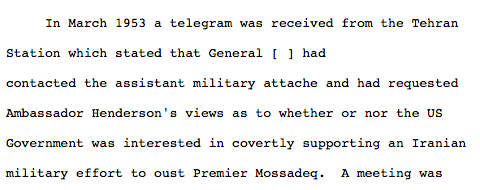
As I have previously noted (Myth 6), there were multiple contacts by IRANIANS in the months before the coup, trying to gauge the American interest in a coup. We know of at least two contacts made during March 1953, and perhaps as many as four. One referenced by Donald Wilber in his "Wilber Report" notes a General (name redacted), had contacted the "assistant military attache" and "requested Ambassador Henderson's views as to whether or nor the US government was interested in covertly supporting an Iranian military effort to oust Premier Mossadeq".
This is quite significant, as it establishes a precedent of Iranians approaching the United States to ask about a coup BEFORE the United States had decided to overthrow Mossadeq.

A previously released document (cable 3853 from Amb Henderson to Dulles dated March 31 and referring to a conversation from March 30th) has a record of former prime minister Hossein Ala' inquiring about the possibility of an American coup. Ala' was never a general so it is not possible that this request is from the same person. Henderson makes it quite clear to Ala' that the United States will not take a regime change policy, and will accept as head of the government whomever has the firman (edict) from the Shah establishing the individual as prime minister. 

A new CIA document dated March 31 indicates that Majles Deputy Haerizadeh, General Batmangelitch, and retired Generals Garzan, Bahadori, and Zahedi were planning a coup to take place within a few weeks. It also says that they claim that the US embassy approves (the footnote indicates that this appears to be "wishful thinking"). 

There may be overlap here, but it is quite clear that there were at least 3 instances in March 1953 of Iranians contacting United States officials about a coup. 

One of the next new documents is dated April 4th, and references an April 2nd conversation between Roosevelt and Dulles about initial plans to start TPAJAX (the code name of the coup attempt). It is unclear if these multiple attempts by Iranians to get the Americans on board for a coup had an effect, but given the proximity it seems as though there must be a connection of some sort. Also of note is the fact that TP AJAX was hand-written, as if it was either forgotten, or this is when they decided to name it. 

These documents are significant in establishing an Iranian interest in a coup before the United States had seriously considered regime change, and perhaps helps understand how the various American figures came to decide that a coup was worth exploring. Unfortunately there is not record of the April 2nd conversation, which would be much more useful in determining what motivated the change in policy. Kermit Roosevelt's "memoir" Countercoup—which is just as helpful as it is harmful—makes no note of this conversation, yet he mentions an additional meeting with an Iranian general who also wished to collaborate with the Americans on a coup. Again, because the name is redacted and other information is missing, we cannot be sure who exactly this was and if it was another Iranian who wished to overthrow Mossadeq, or the same one asking two different Americans the same thing.

Sunday, June 18, 2017

New CIA/State Department Docs on the 1953 Iran Coup (Part 3)

This is part 3 of my series on the new CIA and State Department docs on the 1953 Iran Coup. 

One of the most interesting and substantial documents newly released is an analysis of the nature of a potential Ayatollah Kashani run Iranian government by the Office of Intelligence and Research.

Kashani had been an ally of Mossadeq, before breaking with him and his National Front in early 1953. Kashani's role in Mossadeq's ouster has been downplayed in the traditional narrative of the events (which places most of the blame on the Americans), yet revisionists have noticed the extent of Kashani's influence, and how important he was in fomenting unrest against Mossadeq in the months leading up to the coup.

What is most striking about the document is how Kashani is described. If you took out his name, and other identifying information one might think that the authors are describing Ayatollah Khomeini or Khamenei. Kashani's sees "contemporary problems from a narrowly Moslem outlook, severely warped by many years of bitter conflict with British authority".

Mossadeq at the time had significant support and the authors deemed it unlikely that he would be replaced by Kashani, but they also note Kashani's influence, as the second largest bloc in the Majles (Iranian parliament). 
The authors point to a handful of negative characteristics of Kashani, ranging from conceit and ambition, to unscrupulousness and support of bigoted practices, and a lack of business and executive experience. 

Kashani was vehemently anti-British based upon his past experiences, he had experienced foreign meddling. This he shared with Mossadeq, though their motivations and approaches to addressing foreign interference was very different. 

The authors blame Kashani (like Mossadeq) for taking credit of others work to forward his own ambitions. He is likened to a "ward boss" and "gangster". His supporters are considered to be from a similar social class as Mossadeq (most appropriately described as middle-class), though with a distinct religious inclination.

Kashani, had disagreements with the Shah, the army, and starting in early 1953 Mossadeq as well. Shia clergy in Iran had historically been quietist, subservient to the monarchy. Kashani was outspoken, a break from tradition. He disapproved of the late Shah's work to sideline the clergy, and to uphold the mantle of Shiism, when the Shah wasn't even a theologian. This is virtually identical to Khomeini's approach years later. 

The authors noted that Kashani's relatively lower popularity and all of the enemies he had limited the prospects for a theocratic state. That they were considering it as a possibility is still quite telling.


Again the parallels to Khomeini, and even Khamenei here are striking. They believe that the West is engaging in plots to control weaker nations. He also is credited with having a disparaging attitude towards oil, and wanted to diversify the economy to create self-sufficiency and limit dependence.

The last section is also eerily reminiscent of Khomeini. It is acknowledged that Kashani wouldn't want to accept foreign funds because it would undermine him. The authors note that this makes cooperation with Kashani difficult, but they didn't rule it out. The last paragraph is also interesting as it directly points to a policy of neutrality from the Iranian government. The Dulles brothers in particular speak repetitively about the dangers of communism taking over, yet this memo, just months ahead of the coup explicitly notes neutrality as the Iranian government policy.

This analysis of Kashani is fascinating and apt and as I mentioned throughout, the similarities to Khomeini are significant.


Saturday, June 17, 2017

New CIA/State Department Docs on the 1953 Iran Coup (Part 2)


This is part 2 of my series on the new CIA and State Department docs on the 1953 Iran Coup. 

The third section of the new documents "Planning and Implementation of Operation TPAJAX, March–August 1953 (Documents 169-308)" and starts with a doozy; a CIA memo for the president dated March 1, 1953. While it is in fact an old document that was included in the 1989 original Iran FRUS, there are some additional sentences and clauses that are included as demonstrated in this screenshot of the two side by side.

Again as I've indicated in the past, the role of Ayatollah Kashani is dismissed by apologists and clerics alike. These documents make it quite clear that he had an immensely important role in the build up to the coup. 

The next document is also new to the FRUS collection and concerns the "Capabilities of the CIA Clandestine Services in Iran"
This is another very important document. It indicates that the propaganda outlets the CIA controlled were NOT capable of spreading anti-Mossadeq propaganda a mere five months before the coup.

Later parts of the memo include this damning passage: the CIA didn't have the capability of creating riots against Mossadeq.
Again there are still redactions in the new documents, a very frustrating reality for historians trying to better understand the events of and leading up to the coup.

Interestingly enough the Top Secret cable (2266, March 2, 1953) from John Foster Dulles to the Iran embassy is not included in the new FRUS, despite its undeniable relevance and importance. Perhaps they are only including ones with changes?

The next document is from the famous NSC 135. One can see the ellipses on the left document indicating a redaction, and the new version which has additional information. 

There is an editorial note following NSC 135 which discusses Foreign Minister Eden's trip to the United States from March 4-7, 1953. As I've previously noted, the CIA's chronology in Zendebad Shah! made a mistake in characterizing the nature of Eden's discussions, implying that negotiations broke down before the trip, when in fact they were, at the time, ongoing and were not dissolved until after Eden returned to the UK.

Three documents later, my work is confirmed. On March 10th, A memo from Byroade to JF Dulles references the potential breakdown of oil negotiations, and a recommendation (from Henderson) to not buy Iranian oil, to not encourage or discourage American firms from engaging in business, and to withhold some financial assistance from Iran. 

A March 11th CIA memo is helpful in outlining the situation as it was. It covers the various opposition groups, starting with Kashani. 


Even after big demonstrations in February and unrest, despite instability with the oil negotiations, the CIA thought Mossadeq had a lot going for him.


The analysis of what Mossadeq's choices were is very good and did a good job predicting what Mossadeq would do.

Friday, June 16, 2017

New CIA/State Department Docs on the 1953 Iran Coup (Part 1)

This is Part 1. In Part 2 I will discuss a few of the more interesting documents

Finally, after years of delays, the State Department released an update to the 1951-1954 Iran FRUS (Foreign Relations of the United States). The purpose of the series is to provide a better record of diplomatic events in the past. The previous edition, released in 1989, was widely criticized for failing to note the depth of US involvement in the 1953 Iran coup, and for leaving many documents classified despite the decades that had past since this time.

Generally FRUS does not contain everything, and there are many documents, some historically pertinent, that are stored at the National Archives in Maryland. I have annotated a few from this time: Part 1 Part 2. I have noted in the past how the record is incomplete; in some instances there are hundreds of cables in a row that are not in FRUS, and in many places there are missing documents. They could be completely mundane (as so many are), or they could be very revealing.

The release was also interesting because of how hard President Obama and Secretary of State John Kerry had worked to keep them from being released. It was reported that up to the last hours of Obama's presidency they were trying to keep them secret.
“As it expressed in last year’s annual report, the HAC was repeatedly frustrated–and disappointed–by Secretary Kerry’s refusal to allow the volume’s publication,” Prof. Immerman said yesterday. “In this regard the change in State’s perspective from the Obama to Trump administration is dramatic.”
This bothered State Department officials as noted here:
https://history.state.gov/about/hac/june-2016

I have speculated about the motivations for the two not wanting the documents to become public: http://persophilia.blogspot.com/2016/06/why-is-state-delaying-release-of.html, http://persophilia.blogspot.com/2016/10/no-frus-doesnt-have-all-answers.html.

Obama and Kerry were worried about the reaction of the Iranians to the releases. I postulated that this would be due to revealing the nature of the participation of clerical elements. It is clear to the world that the United States and the UK tried to overthrow Mossadeq on the 16th of August 1953; no one denies this. What happened next, between then and the successful August 19th coup, and who was involved in addition to the United States is what could potentially be so inflammatory. Ayatollah Kashani, an inspiration for Ayatollah Khomeini and many other important clerics to come later, was a key player.

The release yesterday was particularly important because it also contains CIA documents. It was claimed that these documents were lost, yet they have reproduced some of them. There are also copies of old documents that have been public for over 25 years. They are mostly quite important, but their exact purpose in this collection is unclear. At the same time, many CIA documents are NOT included. The best example is here:

Sequentially there is document TEHE 737.1 and the next document is TEHE 742.1. Both have the same date, yet are clearly from different points in the day. In the first (737), there is almost a despair about the failure of the coup, and further efforts to commence damage control. In the second (742), there is a brief message of success. Did nothing happen in between these two moments? How did they go from potentially cancelling military aid, to a successful coup and an urgent need for 5 million dollars?! What do the four documents between 737 and 742 say?

While I have yet to read through the entire set of documents (there are over 500, and over 900 pages), I read the whole section on the coup (section 3, 272 pages), and the events leading up to the coup. My theories are almost uniformly supported, though there are still holes in the documentation.

  1.  CIA documentation is still contradictory (I've noted problems in the narrative and chronology http://nationalinterest.org/feature/six-myths-about-the-coup-against-irans-mossadegh-11173, http://persophilia.blogspot.com/2013/11/relations-between-mossadeq-and-united.html)
  2. Roosevelt is unreliable (A lot of what he's said reads as though he is covering for his mistakes)
  3. Religious elements were KEY to the coup (They make this quite clear throughout)
  4. The "spontaneity" of the events of August 19 is emphasized throughout

While none of this exonerates the United States and the UK of course, the documents make quite clear that domestic actors must accept a not insignificant share of the blame.

I have noted multiple Iranian officials approached the United States asking about a coup in the months prior (last paragraph in myth #6). It was evident that while Mossadeq was undoubtedly a noble, well-intentioned individual, he was not capable of bringing Iran out of the crisis alone, and he made too many enemies, both foreign and domestic.

Part 2 will have more on specific documents

Tuesday, June 16, 2015

Hashemi Jailed, Ahmadi-Nezhad Hoping for a Comeback?

Two significant events occurred this past week concerning Iranian domestic politics.

1) Mehdi Hashemi, the son of Akbar Hashemi Rafsanjani (former president and former head of the Assembly of Experts, and current head of the Expediency Council), was sentenced to 10 years in prison for his role in corruption and other associated crimes

2) Mahmoud Ahmadi-Nezhad (another former president) attempted to create a new political party for his followers (YEKTA) which evidently has been banned the day after formation.

Both of these events show attempts to reinforce the status quo among the Iranian governing elite. Hashemi's family has suffered intense persecution since the 2009 election when the former president gave nominal support to the Green Movement. He has since lost his position as head of the Assembly of Experts (and failed in his 2015 re-election bid), though his protégé Hassan Rouhani's surprising election to the Iranian presidency in 2013 shows that he and his ideology has at least some public support.

Ahmadi-Nezhad's comeback has been quiet, though his position in the Expediency Council (a body appointed by the Supreme Leader) shows that he is not necessarily out of the picture indefinitely.

These events show the power and conservatism of the Iranian political system and how difficult 'change' can be. The upcoming legislative elections are sure to be very interesting as reformists will feel empowered by the relatively moderate Rouhani election, and conservatives will be desperate to stamp out this reemerging threat.

Despite this, a person like Ahmadi-Nezhad could turn the situation on its head if he manages to gain enough momentum to pose a threat to the established conservative factions. Iranian domestic politics are so multi-faceted any power shifts can lead to unprecedented and indeterminate changes.

Sunday, January 25, 2015

Spinning the Syria Strike

This week the Israeli military allegedly struck a convoy in Southern Syria, killing Jihad Mughniyeh, the son of the infamous Imad Mughnieyh, as well as an Iranian IRGC general, several other Hezbollah fighters, and several other Iranian soldiers. This event has been a hot topic in the press, though the information released by the Israelis and the Hezbollah/Syria/Iran/Lebanon axis has proven contradictory, incoherent and nonsensical.

Initial reports indicated that helicopters had carried out the attack, and this claim has been repeated by all sides; Lebanese, Israeli and even Iranian. It would be strange for the Israelis to risk helicopters and the pilots/gunners/whoever else when they possess a large number of drones, not to mention their advanced fighter jets, and artillery capabilities. A drone strike makes a lot more sense, especially when the target was a group of individuals and it appears as though there were no Israelis on the ground inside Syria (the other possible reason why helicopters could have been used).

The Syrian media claimed that the strike was located within the Quneitra Governorate. This area is mostly located inside the Israeli-controlled Golan Heights and bordered by the Rif Dimashq Governorate (Damascus countryside) on the other side, so the remaining areas where the strike could have occurred are extremely limited. Additionally, a portion of the governorate controlled by Syria is the UNDOF DMZ.
Quneitra Governorate (Wikipedia)

The UNDOF stated that they had observed Israeli drones flying over their base at position 30 (Jabata al Khashab) which is slightly north of the mostly abandoned town of Quneitra, and is located closer to the Mount Hermon mountain range.
UNDOF Deployment (Wikipedia)
Jabata al Khashab is the town just to the left (West) of the quarries. Hermon is in the background

The UNDOF also claimed to observe smoke rising slightly after the drones flew past. Given the location of this observation post and the terrain in the area, this once again limits the possiblities. Footage from al-Manar, while inconclusive, seems to hint that the strike happened very close to the Hermon mountain range.

As of yet, the precise location of the strike has yet to be determined, but it appears as though the strike would have occurred on the Syrian side of the DMZ, leaving a tiny sliver of terrain where the strike would have had to happened if it truly was inside Quneitra Governorate.

This leads to the next question, which is why the Israelis chose to attack this particular convoy. Initially it was claimed that the reason for the strike was that the targeted individuals had been planning an attack on Northern Israel. Later however, an Israeli official leaked that they did not intend to kill the Iranian general, and that 'it believed it was attacking only low-level guerillas'. So why would they attack this particular group, and why would they bother with 'low-level guerillas'? An article in the Jerusalem Post stated that this attack was intended to 'thwart an attack on Israel', but this seems disingenuous.

Israel has struck Syria several times over the last few years, most times it was thought that the strikes were intended to prevent Hezbollah and/or Syria from crossing a 'red-line' (usually transferring advanced weapons to the terror group). There have been a few instances where the IDF has returned fire after facing fire from the Syrian side, but this is not something that happens every time munitions land in Israel. Dozens, if not hundreds of mortars have landed beyond the DMZ, inside the Israeli-controlled Golan, without an Israeli armed response. Mortars are of limited range, and to miss a target by miles is hardly 'accidental'. There have also been instances of "stray" gunfire hitting IDF troops, as well as purposeful attacks.

What made this convoy such an important target to attack? Recent Israeli actions in Syria have been limited and selective, despite the ongoing hostilities in and around Quneitra. Would they risk an attack on a convoy without knowing who was in it? I would imagine that they must have had some ideas who was there, and they'd determined that the targets were high-value. Otherwise, why would they attack a small convoy? Was the strike a response to the bombastic speech from Hassan Nasrallah three days prior?

A few weeks ago Hezbollah admitted that the head of their Unit 910 (tasked with 'external operations') was in fact an Israeli asset. He and his accomplices had given information to Israel on a variety of subjects, most notably, the identities of the Burgas Bombing suspects. Given the timing of this, I wonder if the Israelis felt pressure to act on whatever remaining intel they had from the burned asset. The actions by the Israelis seem rash, was there a limited amount of time to act on the information? Why else would they risk aggravating the Iranians and Hezbollah so soon after the last summer's war in Gaza?

Yesterday a Lebanese paper claimed that according to Hezbollah, the strike took place because the Iranian general had not turned off his cell phone, which allowed the Israelis to locate him. Does this statement mean anything or is Hezbollah trying to distract from a massive intelligence and logistical failure? Hezbollah implied that the normal procedure is for cell phones to be turned off, and because the phone was on, the Israelis were able to realize who it was.

Why is a cell phone able to identify the place as a target or was it this particular cell phone which was incriminating? Did the Iranian general have a standard mobile phone with an Iranian SIM card inside? How else could this information be of any use to Israeli intelligence? Do Syrians (military, civilians or rebels) normally travel with their cell phones turned off in this part of the country? If it was the actual phone, would this indicate that the Israelis have managed to infiltrate either the Syrian or Iranian or Lebanese mobile networks and identified the phones used by military officials?

This entire affair is chock full of misinformation, illogical claims and subterfuge. Other analysts like Yossi Melman and Dan Raviv have similarly questioned the Israeli claims. There are so many problems with the narrative from both sides, and the actions and reactions of the parties involved seem atypical. I expect a further set of leaks in the near future.

Tuesday, January 13, 2015

Syrian Nuclear Aspirations?

Der Spiegel this week alleged that Syria is attempting to work towards a nuclear weapon, with varying types of assistance from Iran, Hezbollah and North Korea. If true, this would be a massive story, with significant geopolitical ramifications. Syria has denied the allegations.

Syria is party to the Nuclear Non-Proliferation Treaty, as is Iran, while North Korea is not. Under this treaty, states are prohibited from developing nuclear weapons and from helping others develop these technologies.

In 2006, the IAEA ruled that Iran is in "non-compliance" with the NPT, namely, Iran's safeguards agreement. If these new allegations are true, Iran would be in blatant violation of this treaty. Given the attempted rapprochement between Iran and the West, primarily regarding its nuclear program, a discovery of this nature would almost certainly cause irreparable damage to ongoing nuclear negotiations. Iran would also face new, harsh sanctions.

The report from Der Spiegel however, is poorly sourced, and experts have claimed that the information contained in the report is in fact, incorrect. The report cites "Western intelligence agencies" as the source for this information, and indicates that Der Spiegel has documents from these sources showing that Syria is working to build a nuclear weapon.

As is the case with any anonymous source, a proper vetting of the information is necessary, yet in this instance near impossible. It would be very difficult to have two separate sources able to confirm this information. Information regarding Iran's nuclear program is notoriously hard to come by. While there have been cases when new and valid information was revealed, there are also many instances of false and misleading information released by the same sources.

It is best to take this report with a grain of salt. It is unclear if the documents held by Der Spiegel are legitimate, or an attempt by the hawkish members of the Western coalition who wish to avoid any reconciliation between Iran and the West, to falsify documents to push their agenda.

Wednesday, June 4, 2014

Head of Assembly of Experts Mahdavi-Kani in coma

With the Ayatollah Mahdavi-Kani reportedly in a coma following a heart attack, a new head of the Assembly of Experts will likely have to be selected at some point in the near future. 

The Assembly of Experts is a body of Mujtahids that are responsible for electing and removing the Supreme Leader. As I have written before, Iran’s governmental structure is complicated at best, and while in theory this group has these powers, there is virtually no chance of them removing the Supreme Leader at any point (and even if they wanted to, the Supreme Leader has other powers, including complete control of the judiciary and armed forces, which would make this near impossible). That being said, they do have the authority to select the next Supreme Leader when the time comes. 

The chairmanship of this group is of particular importance. Ayatollah Akbar Hashemi Rafsanjani had been the chairman prior to his decision to express some support for the Green Movement of 2009, but was forced out and replaced by Ayatollah Mahdavi-Kani. Mahdavi-Kani is less hardline than some of the alternatives so this was actually seen as a minor victory for Rafsanjani who stood to lose a lot more. 


Rafsanjani’s family has been heavily persecuted by the state as well as his domestic rivals which I have also written about in the past, and I would be very surprised if Rafsanjani was reinstated. And even though the Supreme Leader recently delegated additional constitutional powers to the body which Rafsanjani is still the chair of (the Expediency Council), it seems unlikely that there would be another significant move to benefit Rafsanjani. Khamenei and Rafsanjani are still rivals and the Supreme Leader does not want to empower him.

UPDATE 1: A list of folks who have reportedly visited the Ayatollah include the Supreme Leader, the President, the head of the Basij, Khomeini's grandson and others.

UPDATE 2: Ahmed Khatami, the hardline cleric evidently cancelled the upcoming elections to replace Ayatollah Mahdavi-Kani. Ayatollah Rafsanjani was a (the?) favorite to replace the comatose Mahdavi-Kani, despite habitual and continuing persecution against Rafsanjani and his family from regime insiders.

UPDATE 3: Ayatollah Mahdavi-Kani has died according to multiple sources (PressTV, Fars etc). It is unclear what steps will be taken to replace him, if the acting chairman (Shahroudi) will be promoted, or if there will be elections. 

Thursday, April 10, 2014

Iran and the Convention on Nuclear Safety


  1. to achieve and maintain a high level of nuclear safety worldwide through the enhancement of national measures and international co-operation including, where appropriate, safety-related technical co-operation
  2. to establish and maintain effective defences in nuclear installations against potential radiological hazards in order to protect individuals, society and the environment from harmful effects of ionizing radiation from such installations; 
  3. to prevent accidents with radiological consequences and to mitigate such consequences should they occur.


After the disaster at Chernobyl in 1986, it became clear that there needed to be better international cooperation in establishing safety standards for nuclear facilities, especially power plants. A series of international treaties aimed at reducing the risk of a nuclear accident were established following this catastrophe. One of the most significant of these is the Convention on Nuclear Safety (CNS). The Convention on Nuclear Safety was adopted in 1994, and like many other nuclear treaties is governed by the IAEA. There are 76 parties to the convention, including Belarus, Egypt, India, Israel, Pakistan, Saudi Arabia and Syria. Unlike many other international treaties, the CNS is set up as an incentive-based program. This convention is aimed at sharing safety techniques and protocols among the international community so that the risk of a nuclear accident decreases, and in the event of an accident, the effects are mitigated by increased awareness and preparedness. This treaty has been signed or ratified by every country with a nuclear power plant (there are 34 countries with nuclear power plants), with one exception.


Iran, despite it's insistence that its nuclear program is civilian, and entirely without military capability, has not signed or ratified the CNS. Even though in early 2013 the Iranian ambassador to the United Nations indicated that his country has been working to join the treaty, this has still not happened. While Chernobyl is now a distant memory for many, the Fukushima nuclear accident is a recent reminder of the importance of proper nuclear safety standards, and international cooperation to prevent catastrophic damage to the environment and to civilization.

Iran is one of the more prominent members of the Non-Aligned Movement, and does not always fully embrace the international community, especially the Western-dominated institutions. However, with others in a similar situation being a part of the CNS (Belarus and Syria are perhaps the best examples), Iran’s absence is even more curious. If Iran is trying to make a point and not conform to Western hegemony, why have these other countries acquiesced?

Iran may be concerned with spies taking information shared through a treaty such as the CNS, especially relating to the facilities at Arak, Fordow, and Natanz (some believe that the IAEA serves Western intelligence). However, the CNS is ONLY applicable to land-based civilian nuclear power plants, which does not include enrichment facilities, or other sensitive nuclear installations. Additionally, the CNS has clauses included in the text protecting information including: “personal data; information protected by intellectual property rights or by industrial or commercial confidentiality; and information relating to national security or to the physical protection of nuclear materials or nuclear installations”. 

The only reason that I can imagine why Iran would not want to sign the Convention on Nuclear Safety has to do with Article 6, which is as follows: '…the Contracting Party shall ensure that all reasonably practicable improvements are made as a matter of urgency to upgrade the safety of the nuclear installation. If such upgrading cannot be achieved, plans should be implemented to shut down the nuclear installation as soon as practically possible. The timing of the shut-down may take into account the whole energy context and possible alternatives as well as the social, environmental and economic impact.' From this, one can see the potential problem for Iran if the plant at Bushehr would have to be shut-down (temporarily or permanently). This would be both a significant blow to the prestige of the country and its scientists, and would also severely undermine the state’s PR campaign trying to assert it’s right to peaceful nuclear technologies. 


So why exactly has Iran not signed the CNS? What possible reasons do they have for not joining this treaty? Or on the other hand, what reasons does Iran have to join the treaty? Politics is about perception, why isn’t Iran taking advantage of a situation where they could get an easy win, deflecting criticism of their nuclear program? Are they saving this as an option for later?


The reasoning behind Iran’s refusal to join the Convention on Nuclear Safety remain unclear. The simple act of joining this treaty would allay fears that Iran’s stated desire for a civilian nuclear program is not genuine. It would also increase the possibilities for Iran to reintegrate itself into the international community. There are plenty of issues to argue over in the United Nations General Assembly, disaster prevention and relief should be a given.