Today Israeli intelligence analyst Yossi Melman tweeted:
Rockets summary: 3361fired 584 intercepted 115 landed in populated areas 2542 in open zones 120 disintegrated in #Gaza. daily average 120
— Yossi Melman (@yossi_melman) August 5, 2014
As Update 10 in my previous blog post explained, this equates to an approximate Iron Dome success rate of 83.5%. As of yet it is unclear where the "failures" occurred. Some may have been due to a lack of coverage in the area (the rocket attack which resulted in the death of a Bedouin was partially due to the area not being protected), while others were due to technical malfunctions. The location of strikes are not publicly available, so it is hard to map the exact locations where rockets landed (the IDF has released an image of a map of the locations where rockets were allegedly launched from, but as my next blog will explain, this is of questionable accuracy).
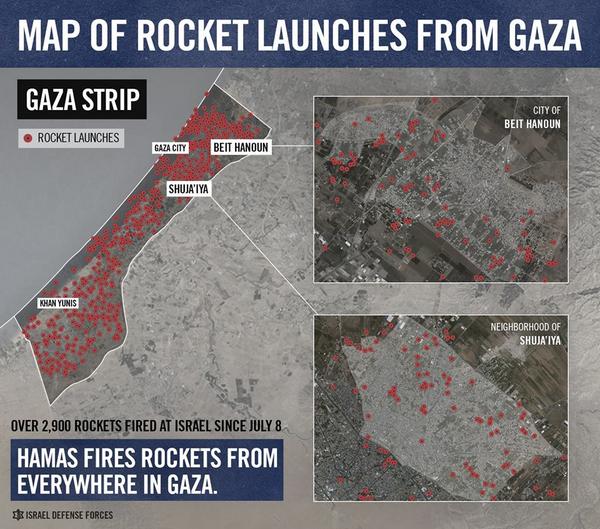
I would imagine that many of the rockets which were not intercepted landed primarily in Sderot, and Ashkelon, while Beer Sheva and Ashdod also experienced a few failures. While not much more than theory, this would again lend credence to my earlier guess from my previous Iron Dome blog that there is a difference in success from the different types of rockets. As far as I know there were no failures in Tel Aviv, so the logical assumption would be that the smaller cities (subject to a different quantity and type of rocket) experienced the failed intercepts. There is a slight possibility that there were failures in Tel Aviv, but given the high number of sirens and corresponding explosions heard by Tel Avivians during this last conflict, it seems unlikely. It would not be easy to hide the results of the explosion of a 175 pound warhead in an urban center.
At the same time, it is interesting that with a success rate of just over 4/5 that there were no catastrophic events in Tel Aviv or Jerusalem during the last few weeks. It seems as though the Iron Dome may be operating at a different efficiency rate in different areas which are subject to different types of rocket attacks.
UPDATE 1:
Uzi Rubin wrote a new blog for Reuters on the Iron Dome. Key points not covered already in his previous critiques
1) Postol and Lloyd used the same data, yet Lloyd's assessment is that the Iron Dome's success rate is 6-8 times greater than Postol theorizes.
2) Hundreds of rockets were fired at Ashdod, yet only 12 hit residential areas
3) There have been around 135 rockets fired at Tel Aviv, yet not a single one has landed within the city (intercepted rocket debris has, but that of course isn't the point).
UPDATE 2:
Theodore Postol was given a chance to respond to Rubin's criticism which he did so here: http://blogs.reuters.com/great-debate/2014/08/06/two-views-of-iron-domes-success-in-israel/
I am not a scientist so I cannot comment on the first refutation, the rest of them I can, however.
2) Arguing that someone's argument is wrong, doesn't automatically prove the thesis of the other person (unless it is a binary argument) so this is not a valid argument.
3) Postol keeps talking about his data that he collected, though in all of his papers, memos and articles he has NEVER actually shared this data.
4) If Postol doesn't know what system was in place before, then how can he say that the system didn't work before and it suddenly works now? The warning siren system has been installed in various locations in Israel since at least 2005. In 2006 Human Rights Watch credited the warning and sheltering system with saving lives. Again Postol's argument is not a good one.
Finally Postol said that "There will certainly be impact craters in the areas where Iron Dome is reputedly defending against the rockets. In fact, the number should be nearly the same number as if Iron Dome didn’t exist." Unfortunately this is a terrible argument again. There were approximately 135 rockets sent to Tel Aviv. WHERE ARE THE 135 IMPACT CRATERS?! The rockets which targeted Tel Aviv are Fajr-5 (called M-75 by Hamas and Palestinian Islamic Jihad), and carry a 100-175 pound warhead depending on variety. The Israelis, in general, put a special emphasis on intelligence matters and are careful to not divulge locations of rocket strikes unless necessary. At the same time, I cannot imagine that 135 warheads each measuring 175 pounds struck Israel's 2nd largest city and no one noticed. Tel Aviv is a hyper-connected city; everyone has smartphones, why aren't there tweets, and Facebook posts with these impact craters? Is Postol alleging that the entire nation of Israel is conspiring to hide massive bombs going off in their city? What about all the foreigners in Tel Aviv, are they in on the plot?
Postol's analysis again is awful, but he has put all of his eggs in the basket, so I cannot see him backing down any time soon. I have heard stories of Postol's obstinance and unwillingness to see other points of view and it appears as though these stories are repeating themselves.
UPDATE 3:
Richard Lloyd posted a .pdf with his calculations and illustrations. It is clear from the illustrations on pages 9-12 that he and Theodore Postol are working together in some capacity, because the illustrations nearly exactly match ones used previous by Postol (figures 5-8).
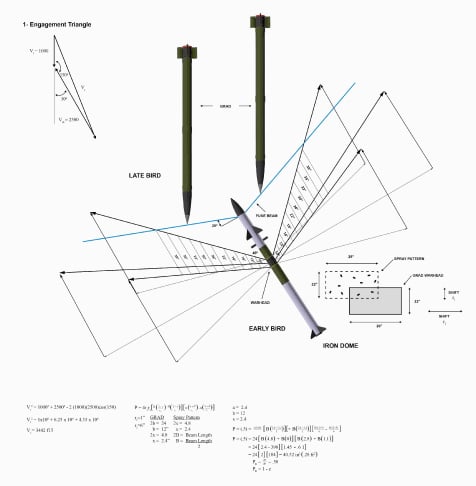
This again brings to mind Rubin's critique that if they used the same information why are their estimates so different. It appears to me as though Lloyd has a better understanding of how an intercept works because he explicitly writes about the distance between the intercepting Tamir missile and the oncoming rocket, while Postol is more concerned with angles. It is important to consider the simple fact that the intercepting explosions theorized by both Postol and Lloyd are conical in nature and therefore will expand more, the further it moves away from the Tamir missile.
Finally Postol said that "There will certainly be impact craters in the areas where Iron Dome is reputedly defending against the rockets. In fact, the number should be nearly the same number as if Iron Dome didn’t exist." Unfortunately this is a terrible argument again. There were approximately 135 rockets sent to Tel Aviv. WHERE ARE THE 135 IMPACT CRATERS?! The rockets which targeted Tel Aviv are Fajr-5 (called M-75 by Hamas and Palestinian Islamic Jihad), and carry a 100-175 pound warhead depending on variety. The Israelis, in general, put a special emphasis on intelligence matters and are careful to not divulge locations of rocket strikes unless necessary. At the same time, I cannot imagine that 135 warheads each measuring 175 pounds struck Israel's 2nd largest city and no one noticed. Tel Aviv is a hyper-connected city; everyone has smartphones, why aren't there tweets, and Facebook posts with these impact craters? Is Postol alleging that the entire nation of Israel is conspiring to hide massive bombs going off in their city? What about all the foreigners in Tel Aviv, are they in on the plot?
Postol's analysis again is awful, but he has put all of his eggs in the basket, so I cannot see him backing down any time soon. I have heard stories of Postol's obstinance and unwillingness to see other points of view and it appears as though these stories are repeating themselves.
UPDATE 3:
Richard Lloyd posted a .pdf with his calculations and illustrations. It is clear from the illustrations on pages 9-12 that he and Theodore Postol are working together in some capacity, because the illustrations nearly exactly match ones used previous by Postol (figures 5-8).
This again brings to mind Rubin's critique that if they used the same information why are their estimates so different. It appears to me as though Lloyd has a better understanding of how an intercept works because he explicitly writes about the distance between the intercepting Tamir missile and the oncoming rocket, while Postol is more concerned with angles. It is important to consider the simple fact that the intercepting explosions theorized by both Postol and Lloyd are conical in nature and therefore will expand more, the further it moves away from the Tamir missile.
 |
| A explosion would cover a wider area less densely from further away |
This situation would also result in less intercepting steel rods (or whatever the Tamir missile uses for interception) per unit of space which could explain why the intercept rate is higher for the larger rockets sent to Tel Aviv and Jerusalem (and possibly could account for differences between those sent to Sderot vs Ashdod and Beer Sheva). A larger size warhead presents more of a target, while a smaller warhead is more difficult to hit. This could be especially true if Postol and Lloyd are underestimating the distance from the interceptor to the oncoming rocket. This would also partially explain why the Iron Dome is unable to intercept mortar bombs which have a relatively small volume of explosive material (the other reason is time allowed for intercept).
These scientists are using publicly available videos instead of raw data. This leaves a lot of room for error. While their models are not terrible (though Lloyd's clearly superior to Postol's), a lack of access on their part to the obviously classified Israeli data severely undermines their work.
The more I learn about the methodologies of the two, the more I believe the Israeli side, and not just because of my personal experience in Tel Aviv during Operation Pillar of Freedom.
UPDATE 4:
The IDF has reportedly claimed that an upgraded version of the Iron Dome intercepted at least 10 mortars during the last round of violence. I find this hard to believe but I am not the expert here. I would think that because the size of the warhead is small, and the flight time of the projectile is short, hitting it in less time would prove more difficult than a rocket sent to a city further away.
UPDATE 5:
This took me a while to notice, but earlier today when I was reviewing the (Hebrew) totals of damage claims from 2012's conflict I noticed that 40 of the claims were agricultural, and over 1000 were vehicles. Only ~2/3rds of the damage claims were relating to structures. The point of the Iron Dome is to defend structures and people (I have discussed this topic previously and it is not worth repeating), and since we know people are not plants, and people are also not cars (and no people in cars were killed), the number of damage claims in places that were primary objectives was even fewer than the number which Pedatzur, Postol and Lloyd referenced as a larger than expected value. There is the chance that quite a few of these cars were parked outside homes, but there is also the chance that they were in other places far from structures. There is also the possibility that these vehicles were agricultural in nature. Again this method of taking damage claims and extrapolating to mean something far greater is cumbersome, and as I have demonstrated, prone to misinterpretation. Even if these figures were in some way troubling, the fact remains that they are in fact not nearly as high as one would expect.
UPDATE 6:
I've been spending the last few weeks trying to figure out the motivations for the 3 main anti-Iron Dome people; Ted Postol, Richard Lloyd and Reuven Pedatzur. I have found some very interesting, and revealing information about a few of them and the reasons for their vociferous opposition to the system.
Reuven Pedatzur was a primary supporter of the THEL (Tactical High Energy Laser) system which was jointly developed by Israel and the United States. It was known as Nautilus at the time, and is now known as SkyGuard. For those interested in defensive systems, it is similar to the system has been publicized a few times recently following successful tests by the US Navy. The General Accounting Office (now know as the Government Accountability Office) found significant problems in the manufacturing of the system. There were also problems with the size, vulnerability, and performance in acclimate weather. The model intended for Israel was large, approximately the size of 6 school buses. This would provide an easy target for terrorists, something especially dangerous given the chemicals involved in creating the laser beam. The system also faired very poorly in cloudy or dusty situations, rendering it nearly useless in the arid regions of Israel, as well as the areas with heavy precipitation or cloud cover. It had some additional problems, though they could likely have been overcome with time. The two main arguments by Mr. Pedatzur against the Iron Dome was that each interceptor cost between 10 and 20 times more money than a similar result (destroyed rocket) by the THEL, and that Iron Dome was incapable of defending Sderot. We all know now that Sderot is and has been defended by Iron Dome for years so this is not an issue. As far as the money is concerned, it was estimated that DOZENS of THEL systems would need to be purchased to properly cover Israel (at the time the threat was only very short range projectiles, so it is unclear if this number would be increased even further with the new types of rockets employed by Palestinian militants) and each THEL system would cost hundreds of millions of dollars. With both of Pedatzur's main points now irrelevant, the most important factor distinguishing the two is Iron Dome's ability to operate in any climate.
Richard Lloyd previously worked for Raytheon, where he devised many new products such as this one, a wide area dispersal warhead. In all of Lloyd and Postol's diagrams they show an interceptor with a conical dispersal (radial-pattern warhead), while the warhead designed by Lloyd covers a much greater area (in essence half of a sphere). If Lloyd was hoping to use this warhead for the Iron Dome rather than the one that they settled on, I could see why he would be quite upset with a different model being used instead.
I also managed to find a very interesting patent from Rafael Advanced Defense Systems, titled "Warhead for Intercepting System". It is clear from the "FIELD AND BACKGROUND OF THE INVENTION" that this warhead was developed with the Iron Dome in mind. What was most interesting was the following sentences from the patent:
AviationWeek's Bill Sweetman recently wrote a great succinct blog about how Postol's methodologies are problematic from a technical perspective. He states that Postol's claims about access to specific information is false, and many of Postol's assumptions are false, and/or highly unlikely. Sweetman also notes the possibility that Iron Dome's Tamir interceptors use 'explosively formed projectiles' like the Trophy system which protects Israel tanks. (For what it is worth, Trophy has been billed as the 'Iron Dome' of Israeli tanks, so this assumption makes sense). Is it a coincidence that 'explosively formed projectiles' is a MAJOR part of the patent I mentioned several paragraphs ago? Perhaps this is the entire basis of this technical achievement which Postol either doesn't care to admit, or is too lazy to research?
Mr. Sweetman also notes (just as Uzi Rubin and I have) that Postol's entire argument is based upon cell phone and low-quality hand held camera footage. He does not have ANY spatial reference in the videos and he does not have a 3D modeling of the trajectory and intercept of the rockets. He has however, made assumptions about the way things are, both related to the system, as well as other factors. If you recall UPDATE 2 of this blog where I talk about Postol's claim that the shelter and warning system saved lives, while he also acknowledged that he had no clue what systems were in place in 2006. I demonstrated why this assertion (among others) was foolish, and why it seems as though Postol is blindly pursuing some goal of his, while creating his own invalid evidence. This is not the scientific method. Similarly if the patent that I mentioned has anything to do with the warhead used by the Tamir interceptors, I would think that Postol's entire conception of how this intercept works is incorrect. Uzi Rubin alluded to this in the blog hosted by ACRS-ME. If Postol doesn't understand how something works, AND his evidence is bad, AND his reasoning is problematic, how can he consider himself an expert? How come no one is questioning him? How can he get away with this? Once the whole house of cards collapses, what is left?
As far as I can tell Postol does not own any patents (though he is quoted in a few), so his interest in this does not appear to be financial. He did argue in a New York Times op-ed for his own proposal to intercept North Korean and Iranian ICBMs with drones just after the missiles were launched. Postol claims that all launch sites are known, though the ability to conceal something from an enemy should NEVER be underestimated. There are a lot of reasons why this proposal is foolish, but it is not worth my time. They are rather simple problems, that most college students with an iota of critical thinking ability could come up with.
UPDATE 7:
In recent weeks there have been numerous announcements of new Israeli defense tech, often referred to as 'the Iron Dome of xxxxxxx'. In most cases, it seems to be just branding, as most of them are not similar to Iron Dome in any way, except for being a defensive shield.
Earlier today however, it was announced that there are plans to make a ship-based version of Iron Dome, called C-Dome (I assume this is a play on words), which uses the same intercepting missiles (TAMIR). This is significant because many other forms of intercepting defensive systems are not like the Iron Dome, and shows the possibility of adapting this technology to a new environment. Israel has reportedly had problems selling the Iron Dome to others (mostly because there are very few that face the same type of asymmetric threat as short-range unguided rockets), and this would be a possibly massive breakthrough.
The obstacle is that so far Iron Dome has only defended against unguided rockets, and a ship at sea is not likely to be a reasonable target for an unguided projectile traveling more than a few miles. A ship is a small target relatively, so unless the projectile is a guided missile, it would be near impossible for the rocket to hit the target. If the new C-Dome is intended to defend against guided missiles then this would be a huge step forward for the technology. As of yet, the Iron Dome has only been used against unguided rockets, and even if there have been tests defending against guided missiles, Rafael has yet to disclose this.
If this technology is possible it could be very important, but it is unclear what exactly this would be used to defend against, and therefore if there are other navies with the same or similar needs.
UPDATE 8:
More details about the C-Dome were revealed in the last two days. Russia Today's article mentions that the system is expected to be capable of intercepting guided missiles. Ynet confirmed that the interceptors used by C-Dome will also be of the 'Tamir' variety, quoting Rafael's spokesman who said that the missiles are more than 99.5% comparable to those used in the Iron Dome system.
The ability to intercept guided missiles is very important, and it is interesting that they intend to use Tamir interceptors and the 'special warhead' which has been specially designed to avoid the scalability problems I previously mentioned (UPDATE 6 relating to the Rafael patent). Assuming this product works as planned, there would undoubtedly be a huge market to fill. Iron Dome and/or C-Dome have the advantage over laser and rail gun type defensive systems as they are able to engage multiple targets simultaneously, but there already are two potential competitors: Raytheon's RAM (Rolling Airframe Missile), and MBDA's VL-Mica. Rafael's system however has the advantage of the brand of the battle-tested Iron Dome and Tamir.
UPDATE 9:
Despite many claims that Rafael is incapable of finding foreign buyers of Iron Dome, Israel National News (Israeli far-right settler news organization) reported that the US Army will be purchasing a battery.
—More to come—
The more I learn about the methodologies of the two, the more I believe the Israeli side, and not just because of my personal experience in Tel Aviv during Operation Pillar of Freedom.
UPDATE 4:
The IDF has reportedly claimed that an upgraded version of the Iron Dome intercepted at least 10 mortars during the last round of violence. I find this hard to believe but I am not the expert here. I would think that because the size of the warhead is small, and the flight time of the projectile is short, hitting it in less time would prove more difficult than a rocket sent to a city further away.
UPDATE 5:
This took me a while to notice, but earlier today when I was reviewing the (Hebrew) totals of damage claims from 2012's conflict I noticed that 40 of the claims were agricultural, and over 1000 were vehicles. Only ~2/3rds of the damage claims were relating to structures. The point of the Iron Dome is to defend structures and people (I have discussed this topic previously and it is not worth repeating), and since we know people are not plants, and people are also not cars (and no people in cars were killed), the number of damage claims in places that were primary objectives was even fewer than the number which Pedatzur, Postol and Lloyd referenced as a larger than expected value. There is the chance that quite a few of these cars were parked outside homes, but there is also the chance that they were in other places far from structures. There is also the possibility that these vehicles were agricultural in nature. Again this method of taking damage claims and extrapolating to mean something far greater is cumbersome, and as I have demonstrated, prone to misinterpretation. Even if these figures were in some way troubling, the fact remains that they are in fact not nearly as high as one would expect.
UPDATE 6:
I've been spending the last few weeks trying to figure out the motivations for the 3 main anti-Iron Dome people; Ted Postol, Richard Lloyd and Reuven Pedatzur. I have found some very interesting, and revealing information about a few of them and the reasons for their vociferous opposition to the system.
Reuven Pedatzur was a primary supporter of the THEL (Tactical High Energy Laser) system which was jointly developed by Israel and the United States. It was known as Nautilus at the time, and is now known as SkyGuard. For those interested in defensive systems, it is similar to the system has been publicized a few times recently following successful tests by the US Navy. The General Accounting Office (now know as the Government Accountability Office) found significant problems in the manufacturing of the system. There were also problems with the size, vulnerability, and performance in acclimate weather. The model intended for Israel was large, approximately the size of 6 school buses. This would provide an easy target for terrorists, something especially dangerous given the chemicals involved in creating the laser beam. The system also faired very poorly in cloudy or dusty situations, rendering it nearly useless in the arid regions of Israel, as well as the areas with heavy precipitation or cloud cover. It had some additional problems, though they could likely have been overcome with time. The two main arguments by Mr. Pedatzur against the Iron Dome was that each interceptor cost between 10 and 20 times more money than a similar result (destroyed rocket) by the THEL, and that Iron Dome was incapable of defending Sderot. We all know now that Sderot is and has been defended by Iron Dome for years so this is not an issue. As far as the money is concerned, it was estimated that DOZENS of THEL systems would need to be purchased to properly cover Israel (at the time the threat was only very short range projectiles, so it is unclear if this number would be increased even further with the new types of rockets employed by Palestinian militants) and each THEL system would cost hundreds of millions of dollars. With both of Pedatzur's main points now irrelevant, the most important factor distinguishing the two is Iron Dome's ability to operate in any climate.
Richard Lloyd previously worked for Raytheon, where he devised many new products such as this one, a wide area dispersal warhead. In all of Lloyd and Postol's diagrams they show an interceptor with a conical dispersal (radial-pattern warhead), while the warhead designed by Lloyd covers a much greater area (in essence half of a sphere). If Lloyd was hoping to use this warhead for the Iron Dome rather than the one that they settled on, I could see why he would be quite upset with a different model being used instead.
I also managed to find a very interesting patent from Rafael Advanced Defense Systems, titled "Warhead for Intercepting System". It is clear from the "FIELD AND BACKGROUND OF THE INVENTION" that this warhead was developed with the Iron Dome in mind. What was most interesting was the following sentences from the patent:
"The approach used by larger systems designed for intercepting medium-range or long-range ballistic missiles is not readily scaled down for application to short range rockets of the types described above. Specifically, the relatively low velocity of the target rocket itself renders collision with small low velocity particles ineffective to defeat the rocket. Instead, a high velocity impact is required to reliably defeat the rocket. Although such a high velocity impact could in principle be produced by a fragmentation warhead, classical fragmentation warheads of suitable dimensions are typically not sufficient."This indicates that the Israeli scientists realized that the approach for larger systems (like Patriot) DID NOT WORK, so something NEW was required. They go on to describe a "projectile blade" which I do not quite understand myself, but appears to be something new enough where a patent would be necessary to protect the invention. This patent was first filed in 2007, so while it may not be the final product used, it almost certainly is related in some way. There were also quite a few patents from Rafael dealing with 3D modeling, and trajectory tracking of projectiles and optimization of current processes. These patents while very interesting and almost certainly intended to track rocket fire originating from Gaza.
AviationWeek's Bill Sweetman recently wrote a great succinct blog about how Postol's methodologies are problematic from a technical perspective. He states that Postol's claims about access to specific information is false, and many of Postol's assumptions are false, and/or highly unlikely. Sweetman also notes the possibility that Iron Dome's Tamir interceptors use 'explosively formed projectiles' like the Trophy system which protects Israel tanks. (For what it is worth, Trophy has been billed as the 'Iron Dome' of Israeli tanks, so this assumption makes sense). Is it a coincidence that 'explosively formed projectiles' is a MAJOR part of the patent I mentioned several paragraphs ago? Perhaps this is the entire basis of this technical achievement which Postol either doesn't care to admit, or is too lazy to research?
Mr. Sweetman also notes (just as Uzi Rubin and I have) that Postol's entire argument is based upon cell phone and low-quality hand held camera footage. He does not have ANY spatial reference in the videos and he does not have a 3D modeling of the trajectory and intercept of the rockets. He has however, made assumptions about the way things are, both related to the system, as well as other factors. If you recall UPDATE 2 of this blog where I talk about Postol's claim that the shelter and warning system saved lives, while he also acknowledged that he had no clue what systems were in place in 2006. I demonstrated why this assertion (among others) was foolish, and why it seems as though Postol is blindly pursuing some goal of his, while creating his own invalid evidence. This is not the scientific method. Similarly if the patent that I mentioned has anything to do with the warhead used by the Tamir interceptors, I would think that Postol's entire conception of how this intercept works is incorrect. Uzi Rubin alluded to this in the blog hosted by ACRS-ME. If Postol doesn't understand how something works, AND his evidence is bad, AND his reasoning is problematic, how can he consider himself an expert? How come no one is questioning him? How can he get away with this? Once the whole house of cards collapses, what is left?
As far as I can tell Postol does not own any patents (though he is quoted in a few), so his interest in this does not appear to be financial. He did argue in a New York Times op-ed for his own proposal to intercept North Korean and Iranian ICBMs with drones just after the missiles were launched. Postol claims that all launch sites are known, though the ability to conceal something from an enemy should NEVER be underestimated. There are a lot of reasons why this proposal is foolish, but it is not worth my time. They are rather simple problems, that most college students with an iota of critical thinking ability could come up with.
UPDATE 7:
In recent weeks there have been numerous announcements of new Israeli defense tech, often referred to as 'the Iron Dome of xxxxxxx'. In most cases, it seems to be just branding, as most of them are not similar to Iron Dome in any way, except for being a defensive shield.
Earlier today however, it was announced that there are plans to make a ship-based version of Iron Dome, called C-Dome (I assume this is a play on words), which uses the same intercepting missiles (TAMIR). This is significant because many other forms of intercepting defensive systems are not like the Iron Dome, and shows the possibility of adapting this technology to a new environment. Israel has reportedly had problems selling the Iron Dome to others (mostly because there are very few that face the same type of asymmetric threat as short-range unguided rockets), and this would be a possibly massive breakthrough.
The obstacle is that so far Iron Dome has only defended against unguided rockets, and a ship at sea is not likely to be a reasonable target for an unguided projectile traveling more than a few miles. A ship is a small target relatively, so unless the projectile is a guided missile, it would be near impossible for the rocket to hit the target. If the new C-Dome is intended to defend against guided missiles then this would be a huge step forward for the technology. As of yet, the Iron Dome has only been used against unguided rockets, and even if there have been tests defending against guided missiles, Rafael has yet to disclose this.
If this technology is possible it could be very important, but it is unclear what exactly this would be used to defend against, and therefore if there are other navies with the same or similar needs.
UPDATE 8:
More details about the C-Dome were revealed in the last two days. Russia Today's article mentions that the system is expected to be capable of intercepting guided missiles. Ynet confirmed that the interceptors used by C-Dome will also be of the 'Tamir' variety, quoting Rafael's spokesman who said that the missiles are more than 99.5% comparable to those used in the Iron Dome system.
The ability to intercept guided missiles is very important, and it is interesting that they intend to use Tamir interceptors and the 'special warhead' which has been specially designed to avoid the scalability problems I previously mentioned (UPDATE 6 relating to the Rafael patent). Assuming this product works as planned, there would undoubtedly be a huge market to fill. Iron Dome and/or C-Dome have the advantage over laser and rail gun type defensive systems as they are able to engage multiple targets simultaneously, but there already are two potential competitors: Raytheon's RAM (Rolling Airframe Missile), and MBDA's VL-Mica. Rafael's system however has the advantage of the brand of the battle-tested Iron Dome and Tamir.
UPDATE 9:
Despite many claims that Rafael is incapable of finding foreign buyers of Iron Dome, Israel National News (Israeli far-right settler news organization) reported that the US Army will be purchasing a battery.
—More to come—


