Showing posts with label Israel. Show all posts

Tuesday, May 1, 2018

Questions about the Iranian Nuclear Weapons Archive

Yesterday, Israeli Prime Minister Benjamin Netanyahu made a dramatic announcement about a daring Israeli intelligence operation to steal over 100,000 documents from a secret Iranian nuclear weapons archive. The documents confirm what we have known for years, and what the IAEA has known since 2011 - that Iran had a nuclear weapons program. Netanyahu did not provide a straight answer on whether Iran continues to have an active nuclear weapons program—something that would clearly violate the JCPOA—or if Iran paused the program at some time. The IAEA has said that Iran's program is not active.

The reaction to Netanyahu's press conference was predictable. Once again, I find myself disappointed as the good questions, the PMD agreement questions, remain an afterthought.

The IAEA, in their report about Iran's PMDs, stated that "all the activities contained in the "Road-map" were implemented in accordance with the agreed schedule". The organization effectively gave a thumbs up to Iran, saying that things are ok from the past, and that we can move forward. The new documents raise questions about what the IAEA okayed, what they knew about Iran's nuclear weapons research, and what the separate agreements referenced in the Road-map include. Did the IAEA agree to let Iran store its previous work? Was the IAEA aware that work had been saved? Did the IAEA order Iran to destroy their research? The PMD report, released in 2015, is very detailed, but without the original documents (from both the IAEA and Iran), it is nearly impossible to compare the report to what Netanyahu revealed yesterday.

While the focus of the JCPOA critics rancor about PMDs has mostly revolved around the Parchin agreement, all of these issues are important, and any obfuscation by Iran and/or the IAEA would be of interest. As I noted in 2015, the IAEA is facing a crisis of confidence; if they cannot be trusted to do their job, what is their utility?

It does not help that many critics are either lazy or deceitful. Then Representative and current Secretary of State Mike Pompeo, along with Senator Tom Cotton, claimed that they had not heard about side deals when they met with IAEA Director-General Yukiya Amano days after the accord was signed. The "Road-map" containing the reference to these side deals is noted explicitly in the text of the JCPOA, and they were all announced and made public on days before this meeting.

There are real and serious questions to ask, but instead, superficial questions, gross insinuations, politicking, and deceptive bombast are all the critics seem able to come up with.

Thursday, October 15, 2015

GCC to buy Iron Dome?

Two days ago Sky News reported that the GCC has plans to buy the Israeli defense system the Iron Dome in addition to other missile defense systems including David's Sling and Arrow to protect against Iran. These reports are interesting, yet misleading; Iron Dome protects against a very narrow band of threats, and Iran (not including proxies) does not provide this type of threat towards any Gulf state except perhaps Kuwait.

The story emphasizes the Iron Dome (in the headline as well as the text), while downplaying the other systems potentially for sale. This is probably due to a multitude of reasons including the name recognition; Iron Dome is widely credited with successfully intercepting hundreds of rockets from Gaza and maintaining a high success rate while doing so. There are those who doubt the efficacy, but as I've pointed out here and here (and have another piece in the works), these accusations are baseless and fraudulent. The other systems are known to be less successful, but given the higher degree of difficulty in intercepting a much faster moving threat this is logical.

The Iron Dome's maximum range was initially stated to be around 70 kilometers (just about the distance from Gaza to Tel Aviv and Jerusalem), though this is believed to be a slight underestimate and it may be as high as 100 km. Iran (with a few exceptions) is more than 70 km away from the GCC states, therefore Iron Dome would not be tasked with intercepting any potential Iranian rockets and missiles. The only locations that are within 70 km are the very tip of the UAE, and parts of Kuwait.
Light blue=70 km buffer
Purple=100 km buffer
It is clear that the Iron Dome with a few exceptions has absolutely not business defending against Iranian weapons; even if Iran attacked from the coast of Iran, almost all GCC territory is far beyond 70 or even 100 km. The only way for 'Iran' to attack from inside a defensible range would be for them to attack from the sea, or for them to have somehow infiltrated borders elsewhere. 

Weapons have been provided to the Houthis, and these weapons have been used to attack Saudi Arabia, but as the map below shows, the range factor makes the possible locations which 'Iran' could attack from quite limited. Additionally, Saudi already has the Patriot missile defense system which it has used against Houthi SCUDs. A deal to upgrade the system from PAC-2 to PAC-3 was just finalized. Iron Dome interceptors are cheaper than Patriot missiles by approximately a factor of 10, but when considering the number of batteries needed to defend the entire border area this is infeasible.

Light blue=70 km buffer
Purple=100 km buffer

The other way that Iran could attack a GCC country with extremely short-range rockets or missiles would be for them to launch these from the Persian Gulf. This is unrealistic because Iran's navy is set up to be asymmetrical and the 'asymmetrical' method of attacking with rockets would be to set up a rocket on a small speedboat; something which isn't going to happen for a number of reasons. Lastly even if 'Iran' was able to infiltrate a country and attack from within, the Iron Dome has had trouble with smaller mortars and wouldn't be able to defend against them. Larger rockets would be incredibly difficult to smuggle in to a country, though Iran could potentially arm terror groups this way. This wouldn't technically be an 'Iranian' attack. It is unclear if by 'Iran', Sky's source was also including proxies. 

Israel spent a lot of money on the development and production of this system, and they would love to recoup some of the expenditures. Potential sales to Asian countries (India, South Korea and Singapore) have fallen through or been false rumors. There remain a handful of countries that could use the system, though they are few and far between. These include Poland, Ukraine, Taiwan, Afghanistan, Iraq and the 3 countries previously mentioned. Iraq and Afghanistan would be under US supervision and both parties are hesitant to place the sensitive system in a location so vulnerable.

The United States gives a lot of aid to various countries, often with the stipulation that this money MUST be spent with US defense manufacturers. Raytheon is now producing Iron Dome missiles in this fashion. It is possible that the money spent on Iron Dome by GCC states would be from the US. A more likely scenario would be that the Iron Dome was included as some sort of package deal with the longer range and therefore more useful defense systems (David's Sling and Arrow).

I myself believe that this is not an accurate story and that this is disinformation spread for a political or economic agenda. It makes almost no sense for the GCC to buy the Iron Dome, even for the psychological purpose of making their citizens feel more safe. It is possible that this will be sold no matter, but I find it highly doubtful. 

Bilal Saab from the Atlantic Council's Scowcroft Center agrees with me, the reports of GCC attempting to buy Iron Dome are 'total BS' 

Wednesday, July 8, 2015

Will the Iranian Arms Embargo Remain?

For me, one of the most interesting aspects of the Iranian nuclear negotiations is the sanctions, their meanings and classifications, and the circumstances under which they may be removed. For months, or perhaps even years, Iranian officials have unanimously and unequivocally stated that 'all' sanctions must be removed, and removed immediately. The P5+1, especially the Americans have stated that nuclear sanctions are a part of the negotiations, while 'non-nuclear' sanctions are not. Recently, Iranian rhetoric softened slightly when Ayatollah Khamenei stated that there will be a time-table for the removal of sanctions rather than immediate and complete reversal. The latest statement from the Iranian negotiating team in Vienna however, insists on removing an arms embargo placed on Iran.

They are, as far as I can tell, referring to the UN Security Council Resolution 1747, unanimously supported in 2007, punishing Iran for proliferation concerns and not fully complying with the IAEA. The sanctions clearly have a nuclear connection, but at the same time, explicitly mention ballistic missiles. The factsheet released by the White House in April in the JCPOA (Joint Comprehensive Plan of Action) emphatically states that while nuclear sanctions will be removed, "U.S. sanctions on Iran for terrorism, human rights abuses, and ballistic missiles will remain in place under the deal." The following excerpt from the JCPOA indicates that there is a plan to create a new resolution reaffirming the embargo on "conventional arms and ballistic missiles".


Given the inconsistencies here, there are a few important questions to be asked: 

  1. Will the arms embargo remain or be renewed in some way?
  2. Is Iran reneging on previously agreed terms?
  3. Did the White House put this in the JCPOA while it was still up for negotiation?
  4. Is this appeasement of hardline constituencies? Is one side trying to take advantage of the other? Does Iran not want a nuclear deal after all?
These questions are incredibly important, not only for understanding the contributions made by the different sides, but also because there are legitimate concerns over weaponry going to and coming from Iran. Hezbollah and other terror groups are armed by Iran, and easing restrictions on the Iran's armaments is bound to create further instability. Israel has not been afraid to bomb Syria, Lebanon and Sudan when they feel threatened by a possible arms transfer, usually of more advanced weaponry. The likelihood of this happening again would be much higher with this arms embargo removed. Iran may change its behavior towards its terror clients in the long-term, but a radical reduction in the scope and frequency of its covert actions is unlikely in the short term.

Sunday, January 25, 2015

Spinning the Syria Strike

This week the Israeli military allegedly struck a convoy in Southern Syria, killing Jihad Mughniyeh, the son of the infamous Imad Mughnieyh, as well as an Iranian IRGC general, several other Hezbollah fighters, and several other Iranian soldiers. This event has been a hot topic in the press, though the information released by the Israelis and the Hezbollah/Syria/Iran/Lebanon axis has proven contradictory, incoherent and nonsensical.

Initial reports indicated that helicopters had carried out the attack, and this claim has been repeated by all sides; Lebanese, Israeli and even Iranian. It would be strange for the Israelis to risk helicopters and the pilots/gunners/whoever else when they possess a large number of drones, not to mention their advanced fighter jets, and artillery capabilities. A drone strike makes a lot more sense, especially when the target was a group of individuals and it appears as though there were no Israelis on the ground inside Syria (the other possible reason why helicopters could have been used).

The Syrian media claimed that the strike was located within the Quneitra Governorate. This area is mostly located inside the Israeli-controlled Golan Heights and bordered by the Rif Dimashq Governorate (Damascus countryside) on the other side, so the remaining areas where the strike could have occurred are extremely limited. Additionally, a portion of the governorate controlled by Syria is the UNDOF DMZ.
Quneitra Governorate (Wikipedia)

The UNDOF stated that they had observed Israeli drones flying over their base at position 30 (Jabata al Khashab) which is slightly north of the mostly abandoned town of Quneitra, and is located closer to the Mount Hermon mountain range.
UNDOF Deployment (Wikipedia)
Jabata al Khashab is the town just to the left (West) of the quarries. Hermon is in the background

The UNDOF also claimed to observe smoke rising slightly after the drones flew past. Given the location of this observation post and the terrain in the area, this once again limits the possiblities. Footage from al-Manar, while inconclusive, seems to hint that the strike happened very close to the Hermon mountain range.

As of yet, the precise location of the strike has yet to be determined, but it appears as though the strike would have occurred on the Syrian side of the DMZ, leaving a tiny sliver of terrain where the strike would have had to happened if it truly was inside Quneitra Governorate.

This leads to the next question, which is why the Israelis chose to attack this particular convoy. Initially it was claimed that the reason for the strike was that the targeted individuals had been planning an attack on Northern Israel. Later however, an Israeli official leaked that they did not intend to kill the Iranian general, and that 'it believed it was attacking only low-level guerillas'. So why would they attack this particular group, and why would they bother with 'low-level guerillas'? An article in the Jerusalem Post stated that this attack was intended to 'thwart an attack on Israel', but this seems disingenuous.

Israel has struck Syria several times over the last few years, most times it was thought that the strikes were intended to prevent Hezbollah and/or Syria from crossing a 'red-line' (usually transferring advanced weapons to the terror group). There have been a few instances where the IDF has returned fire after facing fire from the Syrian side, but this is not something that happens every time munitions land in Israel. Dozens, if not hundreds of mortars have landed beyond the DMZ, inside the Israeli-controlled Golan, without an Israeli armed response. Mortars are of limited range, and to miss a target by miles is hardly 'accidental'. There have also been instances of "stray" gunfire hitting IDF troops, as well as purposeful attacks.

What made this convoy such an important target to attack? Recent Israeli actions in Syria have been limited and selective, despite the ongoing hostilities in and around Quneitra. Would they risk an attack on a convoy without knowing who was in it? I would imagine that they must have had some ideas who was there, and they'd determined that the targets were high-value. Otherwise, why would they attack a small convoy? Was the strike a response to the bombastic speech from Hassan Nasrallah three days prior?

A few weeks ago Hezbollah admitted that the head of their Unit 910 (tasked with 'external operations') was in fact an Israeli asset. He and his accomplices had given information to Israel on a variety of subjects, most notably, the identities of the Burgas Bombing suspects. Given the timing of this, I wonder if the Israelis felt pressure to act on whatever remaining intel they had from the burned asset. The actions by the Israelis seem rash, was there a limited amount of time to act on the information? Why else would they risk aggravating the Iranians and Hezbollah so soon after the last summer's war in Gaza?

Yesterday a Lebanese paper claimed that according to Hezbollah, the strike took place because the Iranian general had not turned off his cell phone, which allowed the Israelis to locate him. Does this statement mean anything or is Hezbollah trying to distract from a massive intelligence and logistical failure? Hezbollah implied that the normal procedure is for cell phones to be turned off, and because the phone was on, the Israelis were able to realize who it was.

Why is a cell phone able to identify the place as a target or was it this particular cell phone which was incriminating? Did the Iranian general have a standard mobile phone with an Iranian SIM card inside? How else could this information be of any use to Israeli intelligence? Do Syrians (military, civilians or rebels) normally travel with their cell phones turned off in this part of the country? If it was the actual phone, would this indicate that the Israelis have managed to infiltrate either the Syrian or Iranian or Lebanese mobile networks and identified the phones used by military officials?

This entire affair is chock full of misinformation, illogical claims and subterfuge. Other analysts like Yossi Melman and Dan Raviv have similarly questioned the Israeli claims. There are so many problems with the narrative from both sides, and the actions and reactions of the parties involved seem atypical. I expect a further set of leaks in the near future.

Tuesday, November 11, 2014

Iranian-Russian Nuclear Plant Cooperation

Today it was announced that Russia and Iran intend to build two additional nuclear reactors in Iran with the possibility of building six more. Iran has long stated its intentions to pursue nuclear power as an alternative to fossil fuels, yet despite this commitment, serious safety concerns persist. As I've written several times (here, here, here and here), Iran has yet to sign the Convention on Nuclear Safety, an incentive-based program intended to improve safety standards at nuclear power facilities. Iran, in fact, is the ONLY country in the world with a nuclear power plant that has not joined the convention. Even Israel, which is not a member of the Nuclear Non-Proliferation Treaty, is party to the convention. Iran is located in a seismically sensitive part of the world, and the decision to build further nuclear plants given the safety concerns is troubling.

There are a few reasons why Iran has chosen to work with Russia again. Russia took over the Bushehr project from a German company after the 1979 Islamic Revolution, and even though the project was delayed many times and problematic, it has finally been completed. Russia is also one of the leaders from the anti-Western camp, and Iran values this position. There may be better, cheaper alternatives for cooperation on a nuclear power facility, yet for now Russia is the logical partner.

Personally I am still very worried about nuclear power facilities in Iran. The safety issues are well-documented, yet no one is paying attention to the potential environmental hazards. A whistleblower from the Atomic Energy Organization of Iran provided a document to The Times which stated that:
...Bushehr, which began operating last month after 35 years of intermittent construction, was built by "second-class engineers" who bolted together Russian and German technology from different eras; that it sits in one of the world's most seismically active areas but could not withstand a major earthquake; and that it has "no serious training program" or a contingency plan for accidents.
This corroborates other claims about problems including cracks resulting from earthquakes, and a broken cooling pump which forced a shutdown of the plant. The plant is designed to sustain up to a magnitude 8 earthquake without serious damage, yet the several meter long cracks mentioned in the previous sentence were the result of a mere 6.4 earthquake.

Even though there are many problems with Iran's nuclear power plants, the Iranians are continuing to build. I hope that they take steps to address these issues, especially the ones relating to safety. The Iranian ambassador to the UN promised that Iran would be working to join the Convention on Nuclear Safety in January 2013, yet this has not happened yet. The world does not need another nuclear disaster, especially so soon after Fukushima.

Monday, August 11, 2014

Israel's Hasbara Machine Misfiring or Overhyped?

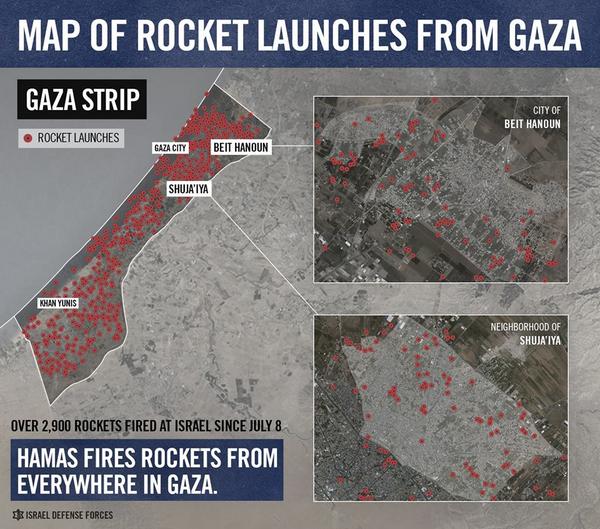
Israel expends a lot of effort and spends a lot of money on 'Hasbara', literally 'explaining', but understood by most to be a euphemism for 'propaganda'. Despite this, the recent conflict between Israel and Hamas has produced in a series of crude and seemingly carelessly designed graphics.
I first noticed this when the IDF published this aerial or satellite photo of a property where rockets were alleged to have come from.
Source: IDF's Facebook page. July 23, 2014

Strangely enough there are two overlapping property or lot outlines depicted here. I spent many of my school breaks working at my local municipality with aerial photography and I have quite a bit of experience with tracing building outlines or designating property outlines. I also know that hiding one or the other from this image is a quick task that takes less than a minute, even if one was unfamiliar with basic GIS (geographic information systems, a way of storing spatial data digitally) and mapping software. 

I figured this was nothing more than a slip-up until I remembered the maps from the IDF and Israel's Foreign Ministry showing the range of the various rockets employed by Hamas. These rockets have an estimated maximum range. To show this, for some reason the Israelis decided that they would use a circular outline. This is illogical because not every rocket will leave from the same location, so a rocket with a 30 km range will not be able to travel 30 km north into Israel if it is launched from the southern Gaza Strip.
Source: IDFblog.com
In GIS programs there is a function called "buffering" where a line is drawn at a specific distance from another line (in this case the Gaza-Israel border). This results in a line that is nor perfectly curved.
This is what the buffer function looks like. SOURCE: flatworldknowledge.com
A properly buffered map of the range of the various rockets used by Gaza-based militants looks like this (it is possible to do this in a 2D photo as well)
Source: NY Times
It is clear here that the range of the rockets is based upon the boundary of Gaza rather than a specific point. In reality it doesn't change anything, but it is still strange that such amateurish efforts would be accepted.

Buffering and property outlines are not the only mapping problems that the IDF has had. They've also published a few strange maps.

The first is a map of tunnels built by Hamas for the purposes of attacking Israel. For someone who is not as familiar with cartography this may not look like a bad map, but for someone from this background, the level of clutter, the amount of extraneous color and information, as well as the lack of a compass arrow or a proper legend is striking.

Source: IDF's Facebook page
The following tweet by the IDF's Spokesperson was probably the most surprising instance for me; it was so clearly flawed I am not sure how they approved it in the first place:

It doesn't take a Cartography or GIS major to notice that it appears as though a lot of the red dots on the left side of the larger image are coming from the Mediterranean Sea. Strangely enough, the IDF later corrected the image, shifting the dots, aligning the drawn western border with the ocean.


The IDF's recent hasbara efforts, especially related to maps and images appear crude and half-hearted. For a program that is considered by many to be slick and monolithic, it is producing some fairly low-quality work.

Tuesday, August 5, 2014

A Successful Operation for the Iron Dome?

After a 10th update to my original Iron Dome blog from March 2013, I've decided to start a new blog post related to the system and its coverage in the media. This should hopefully make new information easier to access.


Today Israeli intelligence analyst Yossi Melman tweeted:
Rockets summary: 3361fired 584 intercepted 115 landed in populated areas 2542 in open zones 120 disintegrated in #Gaza. daily average 120
— Yossi Melman (@yossi_melman) August 5, 2014


As Update 10 in my previous blog post explained, this equates to an approximate Iron Dome success rate of 83.5%. As of yet it is unclear where the "failures" occurred. Some may have been due to a lack of coverage in the area (the rocket attack which resulted in the death of a Bedouin was partially due to the area not being protected), while others were due to technical malfunctions. The location of strikes are not publicly available, so it is hard to map the exact locations where rockets landed (the IDF has released an image of a map of the locations where rockets were allegedly launched from, but as my next blog will explain, this is of questionable accuracy).


I would imagine that many of the rockets which were not intercepted landed primarily in Sderot, and Ashkelon, while Beer Sheva and Ashdod also experienced a few failures. While not much more than theory, this would again lend credence to my earlier guess from my previous Iron Dome blog that there is a difference in success from the different types of rockets. As far as I know there were no failures in Tel Aviv, so the logical assumption would be that the smaller cities (subject to a different quantity and type of rocket) experienced the failed intercepts. There is a slight possibility that there were failures in Tel Aviv, but given the high number of sirens and corresponding explosions heard by Tel Avivians during this last conflict, it seems unlikely. It would not be easy to hide the results of the explosion of a 175 pound warhead in an urban center.


At the same time, it is interesting that with a success rate of just over 4/5 that there were no catastrophic events in Tel Aviv or Jerusalem during the last few weeks. It seems as though the Iron Dome may be operating at a different efficiency rate in different areas which are subject to different types of rocket attacks.


UPDATE 1:
Uzi Rubin wrote a new blog for Reuters on the Iron Dome. Key points not covered already in his previous critiques
1) Postol and Lloyd used the same data, yet Lloyd's assessment is that the Iron Dome's success rate is 6-8 times greater than Postol theorizes.
2) Hundreds of rockets were fired at Ashdod, yet only 12 hit residential areas
3) There have been around 135 rockets fired at Tel Aviv, yet not a single one has landed within the city (intercepted rocket debris has, but that of course isn't the point).


UPDATE 2:
Theodore Postol was given a chance to respond to Rubin's criticism which he did so here: http://blogs.reuters.com/great-debate/2014/08/06/two-views-of-iron-domes-success-in-israel/

I am not a scientist so I cannot comment on the first refutation, the rest of them I can, however.

2) Arguing that someone's argument is wrong, doesn't automatically prove the thesis of the other person (unless it is a binary argument) so this is not a valid argument.

3) Postol keeps talking about his data that he collected, though in all of his papers, memos and articles he has NEVER actually shared this data.

4) If Postol doesn't know what system was in place before, then how can he say that the system didn't work before and it suddenly works now? The warning siren system has been installed in various locations in Israel since at least 2005. In 2006 Human Rights Watch credited the warning and sheltering system with saving lives. Again Postol's argument is not a good one.

Finally Postol said that "There will certainly be impact craters in the areas where Iron Dome is reputedly defending against the rockets. In fact, the number should be nearly the same number as if Iron Dome didn’t exist." Unfortunately this is a terrible argument again. There were approximately 135 rockets sent to Tel Aviv. WHERE ARE THE 135 IMPACT CRATERS?! The rockets which targeted Tel Aviv are Fajr-5 (called M-75 by Hamas and Palestinian Islamic Jihad), and carry a 100-175 pound warhead depending on variety. The Israelis, in general, put a special emphasis on intelligence matters and are careful to not divulge locations of rocket strikes unless necessary. At the same time, I cannot imagine that 135 warheads each measuring 175 pounds struck Israel's 2nd largest city and no one noticed. Tel Aviv is a hyper-connected city; everyone has smartphones, why aren't there tweets, and Facebook posts with these impact craters? Is Postol alleging that the entire nation of Israel is conspiring to hide massive bombs going off in their city? What about all the foreigners in Tel Aviv, are they in on the plot?

Postol's analysis again is awful, but he has put all of his eggs in the basket, so I cannot see him backing down any time soon. I have heard stories of Postol's obstinance and unwillingness to see other points of view and it appears as though these stories are repeating themselves.


UPDATE 3:
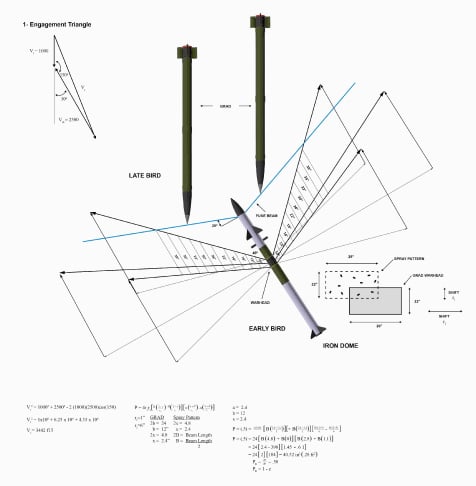
Richard Lloyd posted a .pdf with his calculations and illustrations. It is clear from the illustrations on pages 9-12 that he and Theodore Postol are working together in some capacity, because the illustrations nearly exactly match ones used previous by Postol (figures 5-8).


This again brings to mind Rubin's critique that if they used the same information why are their estimates so different. It appears to me as though Lloyd has a better understanding of how an intercept works because he explicitly writes about the distance between the intercepting Tamir missile and the oncoming rocket, while Postol is more concerned with angles. It is important to consider the simple fact that the intercepting explosions theorized by both Postol and Lloyd are conical in nature and therefore will expand more, the further it moves away from the Tamir missile.
A explosion would cover a wider area less densely from further away
This situation would also result in less intercepting steel rods (or whatever the Tamir missile uses for interception) per unit of space which could explain why the intercept rate is higher for the larger rockets sent to Tel Aviv and Jerusalem (and possibly could account for differences between those sent to Sderot vs Ashdod and Beer Sheva). A larger size warhead presents more of a target, while a smaller warhead is more difficult to hit. This could be especially true if Postol and Lloyd are underestimating the distance from the interceptor to the oncoming rocket. This would also partially explain why the Iron Dome is unable to intercept mortar bombs which have a relatively small volume of explosive material (the other reason is time allowed for intercept). 

These scientists are using publicly available videos instead of raw data. This leaves a lot of room for error. While their models are not terrible (though Lloyd's clearly superior to Postol's), a lack of access on their part to the obviously classified Israeli data severely undermines their work.

The more I learn about the methodologies of the two, the more I believe the Israeli side, and not just because of my personal experience in Tel Aviv during Operation Pillar of Freedom.


UPDATE 4:
The IDF has reportedly claimed that an upgraded version of the Iron Dome intercepted at least 10 mortars during the last round of violence. I find this hard to believe but I am not the expert here. I would think that because the size of the warhead is small, and the flight time of the projectile is short, hitting it in less time would prove more difficult than a rocket sent to a city further away.


UPDATE 5:
This took me a while to notice, but earlier today when I was reviewing the (Hebrew) totals of damage claims from 2012's conflict I noticed that 40 of the claims were agricultural, and over 1000 were vehicles. Only ~2/3rds of the damage claims were relating to structures. The point of the Iron Dome is to defend structures and people (I have discussed this topic previously and it is not worth repeating), and since we know people are not plants, and people are also not cars (and no people in cars were killed), the number of damage claims in places that were primary objectives was even fewer than the number which Pedatzur, Postol and Lloyd referenced as a larger than expected value. There is the chance that quite a few of these cars were parked outside homes, but there is also the chance that they were in other places far from structures. There is also the possibility that these vehicles were agricultural in nature. Again this method of taking damage claims and extrapolating to mean something far greater is cumbersome, and as I have demonstrated, prone to misinterpretation. Even if these figures were in some way troubling, the fact remains that they are in fact not nearly as high as one would expect.


UPDATE 6:
I've been spending the last few weeks trying to figure out the motivations for the 3 main anti-Iron Dome people; Ted Postol, Richard Lloyd and Reuven Pedatzur. I have found some very interesting, and revealing information about a few of them and the reasons for their vociferous opposition to the system.

Reuven Pedatzur was a primary supporter of the THEL (Tactical High Energy Laser) system which was jointly developed by Israel and the United States. It was known as Nautilus at the time, and is now known as SkyGuard. For those interested in defensive systems, it is similar to the system has been publicized a few times recently following successful tests by the US Navy. The General Accounting Office (now know as the Government Accountability Office) found significant problems in the manufacturing of the system. There were also problems with the size, vulnerability, and performance in acclimate weather. The model intended for Israel was large, approximately the size of 6 school buses. This would provide an easy target for terrorists, something especially dangerous given the chemicals involved in creating the laser beam. The system also faired very poorly in cloudy or dusty situations, rendering it nearly useless in the arid regions of Israel, as well as the areas with heavy precipitation or cloud cover. It had some additional problems, though they could likely have been overcome with time. The two main arguments by Mr. Pedatzur against the Iron Dome was that each interceptor cost between 10 and 20 times more money than a similar result (destroyed rocket) by the THEL, and that Iron Dome was incapable of defending Sderot. We all know now that Sderot is and has been defended by Iron Dome for years so this is not an issue. As far as the money is concerned, it was estimated that DOZENS of THEL systems would need to be purchased to properly cover Israel (at the time the threat was only very short range projectiles, so it is unclear if this number would be increased even further with the new types of rockets employed by Palestinian militants) and each THEL system would cost hundreds of millions of dollars. With both of Pedatzur's main points now irrelevant, the most important factor distinguishing the two is Iron Dome's ability to operate in any climate.

Richard Lloyd previously worked for Raytheon, where he devised many new products such as this one, a wide area dispersal warhead. In all of Lloyd and Postol's diagrams they show an interceptor with a conical dispersal (radial-pattern warhead), while the warhead designed by Lloyd covers a much greater area (in essence half of a sphere). If Lloyd was hoping to use this warhead for the Iron Dome rather than the one that they settled on, I could see why he would be quite upset with a different model being used instead.

I also managed to find a very interesting patent from Rafael Advanced Defense Systems, titled "Warhead for Intercepting System". It is clear from the "FIELD AND BACKGROUND OF THE INVENTION" that this warhead was developed with the Iron Dome in mind. What was most interesting was the following sentences from the patent:
"The approach used by larger systems designed for intercepting medium-range or long-range ballistic missiles is not readily scaled down for application to short range rockets of the types described above. Specifically, the relatively low velocity of the target rocket itself renders collision with small low velocity particles ineffective to defeat the rocket. Instead, a high velocity impact is required to reliably defeat the rocket. Although such a high velocity impact could in principle be produced by a fragmentation warhead, classical fragmentation warheads of suitable dimensions are typically not sufficient."
This indicates that the Israeli scientists realized that the approach for larger systems (like Patriot) DID NOT WORK, so something NEW was required. They go on to describe a "projectile blade" which I do not quite understand myself, but appears to be something new enough where a patent would be necessary to protect the invention. This patent was first filed in 2007, so while it may not be the final product used, it almost certainly is related in some way. There were also quite a few patents from Rafael dealing with 3D modeling, and trajectory tracking of projectiles and optimization of current processes. These patents while very interesting and almost certainly intended to track rocket fire originating from Gaza.

AviationWeek's Bill Sweetman recently wrote a great succinct blog about how Postol's methodologies are problematic from a technical perspective. He states that Postol's claims about access to specific information is false, and many of Postol's assumptions are false, and/or highly unlikely. Sweetman also notes the possibility that Iron Dome's Tamir interceptors use 'explosively formed projectiles' like the Trophy system which protects Israel tanks. (For what it is worth, Trophy has been billed as the 'Iron Dome' of Israeli tanks, so this assumption makes sense). Is it a coincidence that 'explosively formed projectiles' is a MAJOR part of the patent I mentioned several paragraphs ago? Perhaps this is the entire basis of this technical achievement which Postol either doesn't care to admit, or is too lazy to research?

Mr. Sweetman also notes (just as Uzi Rubin and I have) that Postol's entire argument is based upon cell phone and low-quality hand held camera footage. He does not have ANY spatial reference in the videos and he does not have a 3D modeling of the trajectory and intercept of the rockets. He has however, made assumptions about the way things are, both related to the system, as well as other factors. If you recall UPDATE 2 of this blog where I talk about Postol's claim that the shelter and warning system saved lives, while he also acknowledged that he had no clue what systems were in place in 2006. I demonstrated why this assertion (among others) was foolish, and why it seems as though Postol is blindly pursuing some goal of his, while creating his own invalid evidence. This is not the scientific method. Similarly if the patent that I mentioned has anything to do with the warhead used by the Tamir interceptors, I would think that Postol's entire conception of how this intercept works is incorrect. Uzi Rubin alluded to this in the blog hosted by ACRS-ME. If Postol doesn't understand how something works, AND his evidence is bad, AND his reasoning is problematic, how can he consider himself an expert? How come no one is questioning him? How can he get away with this? Once the whole house of cards collapses, what is left?

As far as I can tell Postol does not own any patents (though he is quoted in a few), so his interest in this does not appear to be financial. He did argue in a New York Times op-ed for his own proposal to intercept North Korean and Iranian ICBMs with drones just after the missiles were launched. Postol claims that all launch sites are known, though the ability to conceal something from an enemy should NEVER be underestimated. There are a lot of reasons why this proposal is foolish, but it is not worth my time. They are rather simple problems, that most college students with an iota of critical thinking ability could come up with.


UPDATE 7:
In recent weeks there have been numerous announcements of new Israeli defense tech, often referred to as 'the Iron Dome of xxxxxxx'. In most cases, it seems to be just branding, as most of them are not similar to Iron Dome in any way, except for being a defensive shield.

Earlier today however, it was announced that there are plans to make a ship-based version of Iron Dome, called C-Dome (I assume this is a play on words), which uses the same intercepting missiles (TAMIR). This is significant because many other forms of intercepting defensive systems are not like the Iron Dome, and shows the possibility of adapting this technology to a new environment. Israel has reportedly had problems selling the Iron Dome to others (mostly because there are very few that face the same type of asymmetric threat as short-range unguided rockets), and this would be a possibly massive breakthrough.

The obstacle is that so far Iron Dome has only defended against unguided rockets, and a ship at sea is not likely to be a reasonable target for an unguided projectile traveling more than a few miles. A ship is a small target relatively, so unless the projectile is a guided missile, it would be near impossible for the rocket to hit the target. If the new C-Dome is intended to defend against guided missiles then this would be a huge step forward for the technology. As of yet, the Iron Dome has only been used against unguided rockets, and even if there have been tests defending against guided missiles, Rafael has yet to disclose this.

If this technology is possible it could be very important, but it is unclear what exactly this would be used to defend against, and therefore if there are other navies with the same or similar needs.


UPDATE 8:
More details about the C-Dome were revealed in the last two days. Russia Today's article mentions that the system is expected to be capable of intercepting guided missiles. Ynet confirmed that the interceptors used by C-Dome will also be of the 'Tamir' variety, quoting Rafael's spokesman who said that the missiles are more than 99.5% comparable to those used in the Iron Dome system.

The ability to intercept guided missiles is very important, and it is interesting that they intend to use Tamir interceptors and the 'special warhead' which has been specially designed to avoid the scalability problems I previously mentioned (UPDATE 6 relating to the Rafael patent). Assuming this product works as planned, there would undoubtedly be a huge market to fill. Iron Dome and/or C-Dome have the advantage over laser and rail gun type defensive systems as they are able to engage multiple targets simultaneously, but there already are two potential competitors: Raytheon's RAM (Rolling Airframe Missile), and MBDA's VL-Mica. Rafael's system however has the advantage of the brand of the battle-tested Iron Dome and Tamir.

UPDATE 9:
Despite many claims that Rafael is incapable of finding foreign buyers of Iron Dome, Israel National News (Israeli far-right settler news organization) reported that the US Army will be purchasing a battery.
—More to come—

Monday, July 21, 2014

The Iranian government doesn't care about Syrians

Earlier today the President of Iran, Hassan Rouhani tweeted the following:

While what is happening in Gaza and Israel today is clearly a tragedy, it is far from one of the 'biggest tragedies of our time'. For example: MILLIONS in Syria are now displaced, and hundreds of thousands are dead, and at the same time Iranian support for Assad and Hezbollah continues unabated. The hypocrisy is self-evident so it is not worth writing much about. I hope that Iranians realize what their government is doing in Syria and are just as upset about that, as they may be with the situation in Gaza.

For an excellent review of Iranian-Syrian relations I recommend this IranPrimer article: Iran and Syria

(This is no way is meant to excuse misdeeds or hypocrisies of other governments. I spend most of my time focusing on Iran rather than other places)

Thursday, April 10, 2014

Iran and the Convention on Nuclear Safety


  1. to achieve and maintain a high level of nuclear safety worldwide through the enhancement of national measures and international co-operation including, where appropriate, safety-related technical co-operation
  2. to establish and maintain effective defences in nuclear installations against potential radiological hazards in order to protect individuals, society and the environment from harmful effects of ionizing radiation from such installations; 
  3. to prevent accidents with radiological consequences and to mitigate such consequences should they occur.


After the disaster at Chernobyl in 1986, it became clear that there needed to be better international cooperation in establishing safety standards for nuclear facilities, especially power plants. A series of international treaties aimed at reducing the risk of a nuclear accident were established following this catastrophe. One of the most significant of these is the Convention on Nuclear Safety (CNS). The Convention on Nuclear Safety was adopted in 1994, and like many other nuclear treaties is governed by the IAEA. There are 76 parties to the convention, including Belarus, Egypt, India, Israel, Pakistan, Saudi Arabia and Syria. Unlike many other international treaties, the CNS is set up as an incentive-based program. This convention is aimed at sharing safety techniques and protocols among the international community so that the risk of a nuclear accident decreases, and in the event of an accident, the effects are mitigated by increased awareness and preparedness. This treaty has been signed or ratified by every country with a nuclear power plant (there are 34 countries with nuclear power plants), with one exception.


Iran, despite it's insistence that its nuclear program is civilian, and entirely without military capability, has not signed or ratified the CNS. Even though in early 2013 the Iranian ambassador to the United Nations indicated that his country has been working to join the treaty, this has still not happened. While Chernobyl is now a distant memory for many, the Fukushima nuclear accident is a recent reminder of the importance of proper nuclear safety standards, and international cooperation to prevent catastrophic damage to the environment and to civilization.

Iran is one of the more prominent members of the Non-Aligned Movement, and does not always fully embrace the international community, especially the Western-dominated institutions. However, with others in a similar situation being a part of the CNS (Belarus and Syria are perhaps the best examples), Iran’s absence is even more curious. If Iran is trying to make a point and not conform to Western hegemony, why have these other countries acquiesced?

Iran may be concerned with spies taking information shared through a treaty such as the CNS, especially relating to the facilities at Arak, Fordow, and Natanz (some believe that the IAEA serves Western intelligence). However, the CNS is ONLY applicable to land-based civilian nuclear power plants, which does not include enrichment facilities, or other sensitive nuclear installations. Additionally, the CNS has clauses included in the text protecting information including: “personal data; information protected by intellectual property rights or by industrial or commercial confidentiality; and information relating to national security or to the physical protection of nuclear materials or nuclear installations”. 

The only reason that I can imagine why Iran would not want to sign the Convention on Nuclear Safety has to do with Article 6, which is as follows: '…the Contracting Party shall ensure that all reasonably practicable improvements are made as a matter of urgency to upgrade the safety of the nuclear installation. If such upgrading cannot be achieved, plans should be implemented to shut down the nuclear installation as soon as practically possible. The timing of the shut-down may take into account the whole energy context and possible alternatives as well as the social, environmental and economic impact.' From this, one can see the potential problem for Iran if the plant at Bushehr would have to be shut-down (temporarily or permanently). This would be both a significant blow to the prestige of the country and its scientists, and would also severely undermine the state’s PR campaign trying to assert it’s right to peaceful nuclear technologies. 


So why exactly has Iran not signed the CNS? What possible reasons do they have for not joining this treaty? Or on the other hand, what reasons does Iran have to join the treaty? Politics is about perception, why isn’t Iran taking advantage of a situation where they could get an easy win, deflecting criticism of their nuclear program? Are they saving this as an option for later?


The reasoning behind Iran’s refusal to join the Convention on Nuclear Safety remain unclear. The simple act of joining this treaty would allay fears that Iran’s stated desire for a civilian nuclear program is not genuine. It would also increase the possibilities for Iran to reintegrate itself into the international community. There are plenty of issues to argue over in the United Nations General Assembly, disaster prevention and relief should be a given. 

Sunday, February 9, 2014

Iranian military threats provide fodder for US/Israel Iran hawks

Apologies for the lengthy absence. Work has been very busy and I hope to have a more substantial post up soon, but for now this will have to do.


There have been quite a few strange stories coming involving Iran over the last few weeks. First there was the gem of a story involving Edward Snowden, Nazis, and space aliens, and now we have another pair of ridiculous bellicose statements coming from Iran. 

Evidently Supreme Leader Khamenei decided that now is as good a time as any to try and get the attention of the West and to demonstrate the power of Iran's navy by sending several ships towards the Atlantic Ocean. Iranian State TV on Friday aired a simulated video of an Iranian counterattack on Tel Aviv, Haifa and Dimona following a hypothetical strike by Israel and/or the United States. So what is to be made of these events?

Other than the typical attempts to gain regional or global attention/recognition, the timing of this is interesting as it comes just after the failed attempt by Iran hawks in the Senate to force another sanctions bill through. Khamenei and the regime are likely emboldened by this, and see an opportunity to exploit an advantageous situation. Because serious nuclear negotiations are ongoing, this provides a perfect opportunity to appease the Supreme Leader's arch-conservative base. Iran by now has realized that the United States is in fact serious about negotiations, and that this can be utilized to the regime's advantage. While in the future Iran may become a world naval power (I would bet my life on this never happening), this looks to be another meaningless gesture, not unlike the claim that Iran was about to build nuclear powered submarines. The computer simulation should be treated the same way, although the real-life capabilities of Iranian missiles and rockets are certainly much more threatening than a few ships floating around the Atlantic Ocean.

Unfortunately, hawks in both Israel and the United States are undoubtedly going to point to these instances as 'proof' that nuclear negotiations are disingenuous. On the bright side, it looks as though this is once again nothing more than a bit of clever politics by the Iranian leader. 

UPDATE: as this EA Worldview post shows, the flotilla was and continues to be a non-story 

Tuesday, December 10, 2013

Israel/Palestine and Mandela

I wrote this for my local paper following a series of negative, thoughtless op-eds by a variety of local citizens. Unfortunately they decided to not publish this, which is too bad since it is something which more people should be paying attention to. It would have been much longer but there is a 200 word limit so this is what I was left with:


"What never ceases to amaze me in the submissions of 'Let the Public Speak' regarding Israel/Palestine is the lack of sensitivity to others and the repeated usage of inaccurate propagandistic buzzwords best suited to the state-sponsored news media of a Third World dictatorship. 

It is foolish to deny that Israel has continued to build in a manner internationally recognized as illegal, while also detaining minors and treating Palestinians poorly. It is foolish to deny that violent terrorist acts have been and continue to be perpetrated by Palestinians and their sympathizers. 

The recent passing of Nelson Mandela, a man who initially used violent resistance before transitioning to more peaceful means should be a reminder of the possibility of solving seemingly intractable quandaries. The success of the South African Truth and Reconciliation Committee show that the path to reconciliation is not through forced capitulation, but dialogue. The vitriolic hate I see in the Press Democrat, the flagship paper of one of the most liberal places in the US, is discouraging. It is important to be self-critical, and to understand WHY someone else has a different point of view. Calling names and slinging mud never brought anyone closer to a peaceful resolution."


UPDATE: They actually did publish it today

Tuesday, October 1, 2013

What to Expect from Netanyahu's UNGA Speech

What to expect from Netanyahu's speech tomorrow:

More of the same. His political situation at home is not very good, his diverse ruling coalition is fragmented on serious issues such as the economy, the ultra-orthodox, and everything involving Palestinians. As long as Iran is on everyone's mind, the real existential issues for Israel will not be debated, and he will continue with the status quo (which while not optimal for anyone, includes him as the Prime Minister's home). 

Repeated references to Iran's naughty behavior. This will likely focus on terrorism (IRGC and Hezbollah) and Syria, with a special emphasis on Burgas, and the attempted attacks in Thailand, India, Georgia and Cyprus. He is also likely to bring up Iran's non-compliance with the IAEA in providing full access to Parchin (where some, including the IAEA, believe some nuclear weaponization testing has occurred), and its 'deception' (the legality of Iran's actions is disputed by the various parties) in not disclosing the existence of Natanz and Arak until the MeK revealed it in 2003. Lastly he will mention the attempts to infiltrate and target the country through Ali Mansouri. The timing of the release of this information by the Israeli press was certainly not coincidental (corroborated by an unnamed Israeli police official). Israel's press is subject to strict censorship laws on national security issues (on other topics it is quite open) and revealing this episode just after the United States and Iran seem on the edge of a diplomatic 'breakthrough' (quotations because at this point even agreeing to talk is 'progress') and just before his own speech is likely intended to sour the goodwill. 

Fiery rhetoric. I am probably not the only one who looks forward to Netanyahu's speeches. He is eloquent, and comes up with very interesting phrases. While I usually disagree with him, I very much enjoy his clever turns of phrase such as the 'insatiable crocodile of militant Islam' from the 2011 UNGA speech.

No matter what Mr. Netanyahu ends up saying, it is certain to be a major news item because of the importance of Israel and Iran to the American news media. There seems to be some flexibility from Israel on Iran's nuclear program, but I am hesitant to state unequivocally that Netanyahu's speech will contain the same malleability. Netanyahu's Israel has long been the 'bad cop' in the relationship with the US/EU against Iran and I do not think that this is likely to change too much in the near future.

Thursday, September 26, 2013

Iran and Nuclear Safety (or lack thereof)

Belarus, Cuba, India, Israel, Libya, Pakistan, Sudan, Syria. Most would think that being on this list is a bad thing, however, in this particular instance, it is not. These countries have all signed (and most have also acceded to or ratified) the Convention on Nuclear Safety. Notably missing, Iran and North Korea. While I've written on why Iran and North Korea should not be compared, in this one case I feel as though showing that both of these countries are absent from a certain international treaty is important.

The Convention on Nuclear Safety was adopted in 1994 after several years of work. 'Its aim is to legally commit participating States operating land-based nuclear power plants to maintain a high level of safety by setting international benchmarks to which States would subscribe.' As this clearly describes, the treaty is intended to ensure that nuclear power plants are kept at a reasonable safety level. Nuclear accidents can affect many (see Chernobyl and Fukushima, not to mention 3 Mile Island), and regulating and ensuring the safety of these facilities is in the interests of all. 

Of all the states with nuclear power plants, Iran is the ONLY one that has not signed the CNS (they have also not signed other important nuclear treaties including 'the Convention on the Physical Protection of Nuclear Material (CPPNM), the Convention for the Suppression of Acts of Nuclear Terrorism, and the Joint Convention on the Safety of Spent Fuel Management and on the Safety of Radioactive Waste Management.'). Why is it that a country whose expressed reason for developing nuclear technologies is only power and medical uses, has refused to sign this incentive-based treaty, which ONLY concerns safety and the protection of civilians? 

Iran keeps yammering on and on about how Israel has not signed the NPT (and yes they are right in this case). However after President Rouhani's speech criticizing the double standards of the West in being anti-terrorism yet conducting drone strikes which have killed innocents, doesn't this affair itself also demonstrate an incredibly disheartening example of double standards? 

Iran may claim that the West is imposing an agenda upon them, and that they are trying to force Iran to bend to the will of the West, but this argument is a problematic one. If Iran is so worried about the will of the West, why bother with the UN, or why be a member of any international treaty at all? Even more troubling is the fact that the CNS is purely incentive-based; it applies to safety at nuclear power plants so that nuclear accidents are less likely to occur. It has nothing to do with stopping or limiting enrichment (one of Iran's primary concerns and arguments with both the IAEA and the P5+1), or preventing countries from operating nuclear facilities.

This section of the preamble of the CNS provides important context: 
'…this Convention entails a commitment to the application of fundamental safety principles for nuclear installations rather than of detailed safety standards and that there are internationally formulated safety guidelines which are updated from time to time and so can provide guidance on contemporary means of achieving a high level of safety;'

If I had the ear of Iran (or any environmentalist groups anywhere) I would strongly urge them to commit the government of Iran to this important legislation. It could be an important confidence boosting step for both the P5+1 and Iran. The P5+1 would be encouraged by the fact that Iran is agreeing to an important civilian safety regulation, while Iran would be protecting its own citizens and scientists, and also those of the states near to earthquake-prone Bushehr, the site of Iran's nuclear power station. 


NOTE: I've written about this in the past as well. The blog can be accessed here: http://persophilia.blogspot.com/2013/04/earthquake-danger-at-bushehr.html 

Ali Vaez has written about Iran and nuclear safety, this publication with Charles Ferguson I find particularly compelling.

Mark Fitzpatrick, the director of the IISS's Non-Proliferation and Disarmament Programme also has an important paper on non-proliferation and nuclear safety which mentions Iran and the CNS. Access here:  http://www.nonproliferation.eu/documents/backgroundpapers/fitzpatrick2.pdf