Saturday, September 21, 2013

The Complexities of the Iranian Government and Nuclear Negotiations

With the impending annual UN General Assembly slated for this coming week, and the anticipation of important political developments, a common story in the news is the potentiality of a diplomatic breakthrough regarding Iran's nuclear program. Much has been made of Iran's new President Hassan Rouhani's increasingly friendly tone towards America and the West and his stated desire for dialogue. From what many have written, it seems an almost foregone conclusion that for the first time in what seems like an eternity, the heads of government for the United States and Iran may meet face to face. For now, this is nothing but blind speculation; no matter how friendly the words of both sides are, no real 'progress' has been made as of yet. 

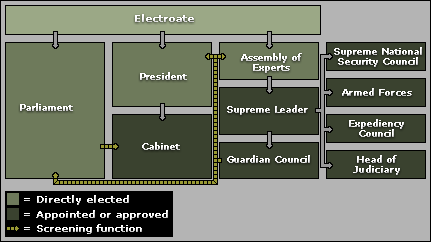
Iran is one of the most misunderstood places in the world for most Westerners. Beyond the obvious misconceptions about language, culture and ethnicity, there is also a mistaken desire to frame their entire existence within a Western paradigm. As many have pointed out, this is a problem (I would suggest reading Michael Axworthy on this). One of the significant ways in which Westerners fail to understand Iran, and in particular the Islamic Republic, is the governmental structure. The United States has a fairly simple system that many are familiar with. It has clearly delineated Executive, Legislative and Judicial branches, where each one of these three acts in a way to compliment and also to prevent the others from becoming too powerful. Iran as well has these three branches but they function in a very different way. 


Available at: http://www.iranchamber.com/government/articles/images/power_chart.gif

As the preceding chart from IranChamber.com shows, Iran's government is a convoluted and contradictory organizational mess. Not only is it the only state in the world where the head of government (President Rouhani in this case) does not control the armed forces (this includes the IRGC which is loyal to the revolution, and effectively the Supreme Leader), but also the Judicial is subject to the whims of the indirectly 'elected' Supreme Leader. The fact that certain 'elected' bodies (the President for example) have to be 'approved' by unelected groups, certainly doesn't help make the system any more straight-forward to outsiders.

While the former president Mahmoud Ahmadi-Nezhad was in power, many on the right in Israel and America would take his words (whether they were translated well or not) at face-value. They made a sport of raving about how this fanatical and powerful leader was a menace to the world and that he must be stopped etc. Those who spoke to me during this time are probably familiar with the way in which I was sharply dismissive of this idea. President Rouhani does not have the same legal authority as the Supreme Leader, or as much as fear-mongers incorrectly claimed Ahmadi-Nezhad had. However, dismissing him as powerless is just as foolish. It remains to be seen if genuine negotiations can happen on his watch. 

Given the amount of possible disinformation and denials coming from the Iranian side, it is unclear if the hardline backbone of the Iranian government will support any sort of concession on their part. They have created a culture of resistance against the West and its allies (against the Americans, the Iraqis, the Israelis, the Shah and leftist movements such as the Communists and the MEK), and while still on this track, it may be increasingly difficult for them to disengage themselves. This same singularity of thought is also true of the conservative American Congress, and much of the Israeli political establishment. The nervous one-track hive-mind is certainly not helped by it's inability to understand the Iranian government's decision making process and power structure. Speculation can, on occasion, be beneficial, but uneducated speculation based upon a simplified understanding of a very complicated Iranian governmental apparatus helps no one. 

Saturday, September 14, 2013

Mossadeq and the US: an Introduction


The following is the introduction to a paper I wrote on Prime Minister Mohammad Mossadeq and his relations with the US Administrations of Truman and Eisenhower:

The overthrow of the Iranian Prime Minister Mohammad Mossadeq in August 1953 has long been a sore point for Iranians; the inspiration for many conspiracy theories and the source of much ill will directed towards the US government by the average Iranian citizen.[i] The extensive writings on this subject are predictably voluminous. While the perpetrators of the coup included foreign and domestic agents, as well as Iranians from all parts of the political spectrum, the Americans, particularly the CIA, are often singled out as the primary antagonists.
            The reasons for this are many, but important amongst them are the claims made by Kermit Roosevelt Jr. in his book, Countercoup: The Struggle for the Control of Iran. Roosevelt writes about his own role as a CIA agent in fomenting the civil unrest and pressuring the Shah into issuing Firmans removing Mossadeq.[ii] CIA documents corroborate some of his claims, while others contradict them.
            The British, in fact, had a significant role in the coup, but because diplomatic relations between the United Kingdom and Iran were severed prior to the coup, the British Embassy had been closed, and therefore the British had less of a direct role in the actual execution of the events of 16 and 19 August, 1953.[iii] The British foreign intelligence service, the MI6, which had been based out of the embassy, was restricted by the degradation in relations, but still managed to assist the CIA and the locals who acted to overthrow the Iranian government.[iv]
            Reinforcing the beliefs of American involvement were statements by Secretary of State Madeline Albright apologizing for the United States' "significant role" in the 1953 coup[v], and President Barack Obama with a similar apology in 2009.[vi] Despite the claims of responsibility by a variety of different groups, and innumerable theories on the events of August 19th, 1953, what actually happened remains difficult to determine.
            What makes this question all the more interesting is that the United States initially had been very supportive of Prime Minister Mossadeq, but then in 1953 made an attempt to overthrow Mossadeq. What caused this change?
            During and immediately following the Second World War, the foreign policy of the United States underwent significant changes. Up to this time, the state's foreign policy had been primarily isolationist with a few exceptions (Cuba, Philippines etc.), but with the perceived threat of rampant communism, the focus expanded and the state became more predisposed to intervene globally. This change in priorities coincided with a greater demand for natural resources (in particular petroleum) following World War II. In December 1943 a memo from the Petroleum Division stated that the US preferred “Middle Eastern oil to be developed to the maximum” while American and Caribbean oil was conserved because it would be easier to defend in war.[vii]
            Iran became a natural focal point for the building tensions to manifest themselves as it has one of the largest reserves of both natural gas as well as petroleum.[viii] Adding to this, there were tens of thousands of American troops occupying the country to ensure delivery of supplies to the Soviet Union.[ix] Even before the discovery of oil, Iran has long been important geopolitically to Western powers, with innumerable examples from history dating back to pre-Roman times.
            Perhaps the best pre-modern depiction of how the West saw this part of the world is British political geographer Halford Mackinder's 'Heartland Theory'.[x] The 'Heartland Theory' claims that a state that wishes to dominate the world must physically control the Central Asian Plateau, the Caucasus and what is today Russia.[xi] Iran is a part of this central "pivot area" which Mackinder's theory is concerned with. With the Russian Empire and then the USSR controlling the majority of the "Heartland", fears that Iran, one of the few places of the "Heartland" not under Russian/Soviet control, could fall, led to a British interest in maintaining a footprint in the region. The Great Game between Russia and Britain, where they competed over Central Asia and Iran, is an example of the struggles between global powers over this part of the world and provides the background for American political sentiments towards Iran. Though Mackinder was an academic, during the Bolshevik Revolution in Russia he was appointed "British High Commissioner in Southern Russia".[xii] Even if his theory was not wholeheartedly embraced by the British government, his presence in this part of the world as a representative of the British implies that Mackinder held some measure of influence in the British government. While Mackinder's theory was not published until 1904, the British had long seen this part of the world as essential to their geopolitical aspirations.
            The election of Republican Dwight Eisenhower as the President of the United States in 1952 changed American policy towards Iran. Eisenhower's beliefs were more in line with the British who (whether they believed it themselves or not), argued vociferously that the threat of communism was increasingly dangerous in Iran.[xiii] Initially Eisenhower's administration attempted to keep Mossadeq in power as they believed that the alternatives to him would lead to Soviet control of Iran and subsequently the rest of the Middle East. As late as March 1953, Eisenhower is on record stating that he wished for Mohammad Mossadeq to continue be the Prime Minister of Iran for he was seen as a moderating voice between the right-wing military, royalist and religious parties, and the left-wing Communist Tudeh party.
            It was the beginning of the Cold War, and the Republican President Eisenhower was fearful of the possibility that the Communists might take over the Middle East. Mossadeq was not necessarily friendly towards the Tudeh Party, but he also did not suppress them as forcefully as the Americans would have preferred. He even allowed front organizations and publishing houses of political opponents to operate.[xiv] In the dichotic view of the Western powers, the lack of a consistent, strict crackdown on Communist sympathizers by Mossadeq's government was seen as evidence of an anti-Western bias.
            The CIA’s internal history written in 1998, claims that “Even the most bitter anti-Mossadeq partisans did not claim the Iranian Prime Minister was a Communist or sympathizer”.[xv] The evidence suggests that this however, is not the case. A French newspaper said the following about Mossadeq: “The opposition called him an Anglophile, The Russians entitled him the servant of American imperialism. The British labeled him a Communist”.[xvi] Mossadeq, (apparently in a bid to gain Western sympathies) overemphasized the power of the Tudeh to the West.[xvii] Despite the fact that the Tudeh (Communist) party of Iran was officially outlawed, many in the American government and some in the CIA were fearful that Prime Minister Mossadeq was sympathetic towards communism. Mossadeq’s attempt to play the sides against each other by the concept of “negative equilibrium” evidently backfired, as the Americans then saw him as weak and replaceable, rather than weak, but still worthy of support.
            The United States was stuck in a position where they had already committed resources to the Iranian government (before and during Mossadeq's tenure), and wished to resolve the oil dispute as soon as possible to reduce tensions in the unstable Middle East. At the same time the risks of harming American business interests and potentially also long-term geopolitical interests were ever-present in the minds of the Eisenhower Administration.
            The Truman administration had spent millions of dollars trying to support the Iranian economy through loans and grants.[xviii] This was intended to keep the Iranian government as stable as possible and prevent a Communist takeover. There were also American officials who were sympathetic to Iran's Mossadeq-inspired drive for oil nationalization which complicated the US-Iran relationship even further.[xix] Other Americans were worried for the potential of nationalization happening in American areas of influence and oil production such as Saudi Arabia.[xx] That the oil agreement with Saudi Arabia had recently been renegotiated to a still profitable 50/50 split may have alleviated some of these fears. However, the Anglo Iranian Oil Company’s (AIOC) 'concessionary' deal with Iran was far more exploitative (to the benefit of the British) than the Saudi Aramco agreement and the Iranians were well-aware of this fact.[xxi]
            Mossadeq, in his idealism, believed that the United States with its principles of democracy and justice, was likely to side with him in his struggles against the British. Iran and the US had been enjoying closer relations at the expense of Britain and the Soviet Union during and after the Second World War, which reinforced Mossadeq’s beliefs.[xxii] He evidently did not anticipate that political expediencies and historical alliances would play such strong roles in the American decision making process. The good relations which Mossadeq had with several key American officials and negotiators, likely have convinced him that the rest of the government was also sympathetic to his situation. As time passed and an agreement was not reached, Mossadeq's relations with the Americans soured. One reason for this was apparently the perceived mutability of Mossadeq in his oil negotiations. The United States while relatively neutral in the process, wanted the matter settled, as the dispute was a destabilizing factor in an unstable, potentially volatile, geopolitically important region.
            Mossadeq was named Time Magazine's Man of the Year for 1951 for his work in nationalizing Iran's oil and other achievements.[xxiii] Despite this honor, the description of his physical and personal characteristics was overwhelmingly negative and used marginally racist words.[xxiv] These sentiments can be described as representative of American public perception, and if not, that fact that these words came from a leading national magazine publication, understandably had a significant influence on people. The New York Times often described Mossadeq as a ‘dictator’, although the paper never bestowed this disparaging title upon the Shah who ruled for 25 years after Mossadeq fell from power.[xxv] Iran was not a wealthy country, and was seen as backwards by many in the West. Disparaging or patronizing attitudes from the West towards the developing countries and their people was commonplace and impacted interactions between the states and individuals, certainly including those between Mossadeq and the West.


[i] In the executive system of the time Iran, Prime Minister was elected by the Parliament (Majles). Mossadeq was voted in by a 79-12 margin. See Foran, John. "Democratization, Separatism, Nationalization, Coup." Fragile Resistance: Social Transformation in Iran from 1500 to the Revolution., 1993. 285.
[ii] Bayandor claims that the removal process is technically legal, but because of the duress it was an illegal act. Bayandor, Darioush. Iran and the CIA: The Fall of Mosaddeq Revisited. 2010..
[iii] Keddie, Nikki R., Yann Richard, and Nikki R. Keddie. Modern Iran: Roots and Results of Revolution., 2003. 129
[iv] Katouzian, Homa. "Democratization, Separatism, Nationalization, Coup." Musaddiq's Memoirs. By Mohammad Mosaddeq. Trans. Homa Katouzian. London: 1988. 55
[v] Albright, M. (2000, March 17). American-Iranian Relations. Remarks before the American-Iranian Council, Washington, D.C.
[vi] "Obama Admits US Involvement in 1953 Iran Coup." AFP. Google, 04 June 2009. Web. 10 Mar. 2013.
[vii] 1 December 1943, folder: ‘Petroleum Reserves Corporation Activities. 7/3/43-1/1/44’ box 1, Records of the Petroleum Division, RG 59 via Anderson, Irvine H. "The American Oil Industry and the Fifty-Fifty Agreement of 1950." Musaddiq, Iranian Nationalism, and Oil. By James A. Bill and William Roger Louis. 1988. 151
[viii] It was known that Iran possessed vast reserves of oil-based fuels, and the discovery and understanding of how much Iran has is not a recent development.
[ix] Foran 271
[x] O'Hara, Sarah, and Michael Heffernan. "From Geo-Strategy to Geo-Economics: The ‘Heartland’ and British Imperialism Before and After MacKinder." (2006): 54
[xi] O’Hara and Heffernan 67
[xii] O’Hara and Heffernan 66
[xiii] Ansari, Ali M. Modern Iran since 1921: The Pahlavis and after. 2003. 121; Azimi, Fakhreddin. Iran: The Crisis of Democracy. 1989. 295; Ferrier, Ronald W. "The Anglo-Iranian Oil Dispute." Musaddiq, Iranian Nationalism, and Oil. By James A. Bill and William Roger Louis. 1988. 186; Louis, Wm. Roger. "Musaddiq and the Dilemmas of British Imperialism." Musaddiq, Iranian Nationalism, and Oil. By James A. Bill and William Roger Louis. 1988. 242
[xiv] Foran 290; Cottam, Richard W. Nationalism in Iran. 1964. 215
[xv] Koch, Scott A., "Zendebad, Shah!": The Central Intelligence Agency and the Fall of Iranian Prime Minister Mohammed Mossadeq, August 1953," Top Secret Draft History, History Staff, Central Intelligence Agency, June 1998., 79
[xvi] Bill, James A. Musaddiq, Iranian Nationalism, and Oil. By James A. Bill and William Roger Louis. 1988. 265
[xvii] Bill 277
[xviii] Truman’s Point Four program was intended to help develop Iran, and was responsible for investing tens of millions of US dollars in Iran.
[xix] In particular George McGhee, and Dr. Henry F. Grady, US Ambassador to Iran from 1950-1951
[xx] Bill 273; Siavoshi, Sussan. "The Oil Nationalization Movement, 1949-1953." A Century of Revolution: Social Movements in Iran. By John Foran. 1994. 128
[xxi] Bill 273
[xxii] Foran 271
[xxiii] "Man of the Year: Challenge of the East." Time 7 Jan. 1952: n. pag. Time Magazine. Web.
[xxiv] Bill 265; "Man of the Year: Challenge of the East." Time 7 Jan. 1952: n. pag. Time Magazine. Web.
[xxv] Bill 265

Sunday, September 8, 2013

9 Questions the Media should be asking Iran about Syria

Iran's former FM Salehi (Also current Defense Minister Dehqan, and current FM Zarif) recently claimed that Iran notified the United States 9 months ago (via Switzerland which handles American interests relating to Iran) that chemical weapons had arrived in Syria. Iran has been sensitive towards chemical warfare because of the usage of chemical weapons during the Iran-Iraq War. News media have latched onto this claim, and criticized the United States for not responding, yet these same reporters have not raised critical questions about Mr. Salehi's claims.

1) What types of chemical weapons were they? Sarin? VX? Exactly what weapons were allegedly smuggled into Syria?

2) Which countries have or possess the capability to produce these weapons? If they are only available in certain locations, then it would almost certainly have come from one of these locations. 

3) Where did these weapons come from? The route to Syria is important for understanding who would have shipped the weapons there. If a certain route is commonly used by a certain group, then there is a good chance that there will be some connections.

4) Do 1) and 3) match up? If the weapons came from somewhere which does not possess the capabilities to produce them, there clearly is a problem with the accuracy of this information.

5) How long can the weapon last in storage (both properly stored and improperly). Iraq whose chemical weapons stockpile has not been secured throughout has sarin but according to this CIA document, the weapons have shelf-life problems and had degraded quickly

6) Is it possible for this weapon to be properly stored in Syria by rebels? Are there any special procedures that must be taken to assure that the chemical agents do not degrade?

7) Which groups received this weapon as it arrived into Syria? Are these groups capable of staging a large-scale attack over a several kilometer sized area?

8) Who are these groups aligned with? Are the others they work with more capable of making an attack of the scale of Ghouta?

9) Where are these groups located? Where do they operate from? Syria is insecure in many areas and certain factions have control of different areas. If the exact location of this smuggling is identified, then those responsible may be identified. If these groups are incapable of operating in Damascus, (due to lack of reliable transit and chemical weapons handling or whatever other reason), then the Ghouta attack almost certainly was NOT perpetrated by these groups.


Until Iran answers these questions, I believe there is no reason to question the American/English/French/German intelligence claims that Assad was almost certainly the one responsible for the Ghouta attack. It is possible that these chemical weapons allegedly brought into Syria were used at another location, but the length of time since this alleged incident and the timing of the revelation of this information is highly suspicious. It is clear that Iran is attempting to imply that the Ghouta Massacre was perpetrated by these smuggled weapons. Iran has made a serious accusation, but has provided so little evidence so that I find myself doubting their claims. 

Sunday, September 1, 2013

Why Obama was Right to Delay Action on Syria


After President Obama spoke today in the Rose Garden announcing that his decision to take the matter of a possible Syrian intervention to the US Congress the reactions I saw on the television and on Twitter were mostly negative. The President has been criticized heavily on his foreign policy in recent years, especially on matters pertaining to the Middle East, and for many, this was further proof of his lack of leadership, and even worse, lack of a spine. Many military types rightly pointed out that by threatening force, and continually delaying, Assad and his military are able to prepare for the possible strikes. This is true, but the military aspect is only a part of the political decision-making process.

I have long been in favor of an active role in intervening in Syria. I believe that a head of state that willingly kills civilians and insurgents indiscriminately on a large scale for a continuing period of time, without any real attempts to verbally engage and resolve differences, must be punished and in extreme cases, removed from power. 'President' Assad, certainly is an extreme case. 

President Obama's decision to 'telegraph' his war plans, before suspending them seem strange at first, but looking deeper, I think that this is a very good political move. The Obama administration has been heavily criticized for many civil rights issues ranging from drone warfare and detention of non-combatant prisoners to privacy violations by way of the NSA. One of the arguments against Obama is that there is not enough transparency (therefore people do not have enough say in, and understanding of what the government does). The release of a declassified intelligence report on what the United States Intelligence Community believes happened on August 21, 2013 in East Ghouta is a step towards addressing the unhappiness of the American people in this regard. 

Obama's decision to task Congress is advantageous for the administration for many ways. Congress has been an obstinate thorn in Obama's side for the last 5 years, attempting to undercut and undermine his every move (or lack thereof). Even though Congress's approval rating is the lowest it has been in years, they are still elected representatives of the American people and in theory, a more 'democratic' apparatus than an executive decision by one man. By passing the responsibility on to Congress, Obama is able to deflect the attention from himself. The way in which both he and Secretary of State Kerry have reiterated the allegations against Assad's usage of chemical weapons makes it clear that they both believe that military action must be taken. In many cases this should be a slam dunk, an easy decision to make. However, with the difficulties and financial expenses of interventions in Iraq, Afghanistan and Libya still on the mind of the American voter and taxpayer, public support for an intervention in Syria is very lower. Before the Ghouta Massacre, support from Americans was as low as 9%

Despite the very low support in the earlier poll, a new poll has shown a sharp increase; 42% support 'military action against the Syrian government in response to the use of chemical weapons' (50% opposed and 8% were undecided). When the military action is 'limited to air strikes using cruise missiles launched from U.S. navy ships that were meant to destroy military units and infrastructure that have been used to carry out chemical attacks' a plurality of 50% supported this action (44% oppose and 6% were undecided). Nearly 60% of respondents indicated that they believe use of chemical weapons is a 'red line' which requires a 'significant U.S. response, including the possibility of military action'. A similar number believed that the most important objective of military action in Syria would be to stop the use of chemical weapons. What is most surprising about this poll is that a full 79% thought that President Obama should be required to receive approval from Congress before taking military action in Syria. 

The poll numbers show a clear increase in support for military action against Syria, but it is not a majority, and given Obama's other domestic troubles and the looming debt crisis, it makes a lot of sense to listen to the will of the people. This way, if Congress again proves to be unwilling be more than sticks in the mud, Obama can say that he tried to listen to the American people. If Obama does take military action after Congress says no (which he said he believes he legally can do), then Obama shows his spine and his willingness to make a tough choice. If Congress says yes, then Obama is able to say that he was right in wishing to intervene militarily, and also that he was willing to listen to Congress and act in a bipartisan manner for the good of the country. 

Support for strikes against Syria are not popular in several key allied countries around the world. The UK's House of Commons voted against authorizing military force, and Germany, Canada and Poland stated that they would not participate in aggressive action against Assad's regime. The United States has unilaterally used military force to the discontent of many around the world. The rush to war in Iraq 2003 is a prime example of where the intelligence was wrong and going around the United Nations did not help the United States' standing abroad. By delaying until more intelligence is gathered, and more debate is held, this administration hedges its own bet on the non-confirmation of Assad's culpability in the chemical attack. If further evidence is produced which exonerates or convicts Assad, then this stall for time will look to have been a wise decision. 

Assad has now been able to disperse and prepare his troops for a looming strike which is not good if the intention is solely to damage his military. However, this is a slightly unrealistic point of view as the goal of an intervention is (or at least should be) not to destroy the army of Assad and create even further instability, but to punish the use of chemical weapons. No matter when the US strikes (if it chooses to do so), the military power of Assad's forces are weaker by order of magnitudes in comparison to the US. We have to be honest in accepting the fact that we are not out there to destroy Assad's army, and forcibly taking his chemical weapons would require troops to physically secure sites. This is an unrealistic goal. What is more feasible is heavily damaging Assad's air force, air defense, and if possible, chemical weapons delivery systems. This leaves him vulnerable to further air strikes (by the West or Israel) and avoids committing the US and its allies to a lasting presence.

So it is my belief that Obama has made the correct choice in this situation. I would love it if the United States and its allies were able to destroy all of Assad's forces and his properties but this is an unreasonable expectation. A series of strikes, especially on airfields, would damage the Assad regime's ability to conduct war and show the world that using chemical weapons is unacceptable. This decision must not be rushed towards, and Obama's delay allows time to think, among other things.