Earlier this week the US government publicly went after the IRGC. President Trump's Nowruz statement on Monday was mainly about the evils of the IRGC rather than the holiday itself. On Friday Deputy AG Rod Rosenstein announced indictments for a number of Iranians with the IRGC for hacking.
A third incident, the naming of John Bolton as the new national security adviser to President Trump can also be seen as an anti-IRGC move, given Bolton's belligerence towards the regime and his affinity for the Marxist cult the MeK.
Whether this is coincidental or not is hard to discern, given the chaotic and disjointed nature of the administration and so it is the hacking announcement that interests me most.
A few years back I'd noticed a series of pro-Iranian bots tweeting about the Iranian Supreme Leader Ayatollah Khamenei's "Letter to the Youth in Europe and North America". I wrote about this in detail noting how the bots and message evolved. It was not particularly sophisticated, did not gain much traction, but polluted trending and other hashtags on various social media. Another followup campaign titled "Powerful_Iran" was covered by the BBC.
The hacks and bots seem connected, and are clearly linked to the regime in some manner, but the details are unclear. The distinction between the more skilled hackers and the Twitter bots makes me curious about the Iranian cyber programs, how they are set up, who runs them, and if there are multiple organizations or factions running them. I would be surprised if the recently indicted hackers are directly responsible for the older bot networks, but I'd also not rule it out.
Showing posts with label MeK. Show all posts
Showing posts with label MeK. Show all posts
Saturday, March 24, 2018

Tuesday, February 24, 2015
More Iranian Nuclear Sites?
The MeK announced today that they have more evidence of Iranian nuclear intransigence. According to news reports, a site in northeastern suburban Tehran houses a secret underground facility where uranium enrichment has occurred for nearly a decade.
The MeK press release is available on DropBox, and details their history in revealing information about Iran's nuclear facilities. Strangely enough, in this history they neglect to include another 'revelation' made a mere 16 months ago. At this time it was claimed that an underground facility around 70 km northeast of Tehran under a mountain near the town of Damavand housed more illegal Iranian nuclear activities, though the details were unclear.
I noted a few problems with the claims, notably the notorious unreliability of the MeK, as well as the very suspicious timing. Less than a month prior, the most left-leaning candidate, Hassan Rouhani, was elected president of Iran in a shockingly uncompetitive landslide. This 'revelation' was no doubt intended to ruin any possible good will or potential rapprochement between Iran and the West.
Today as well, the timing is suspicious. Rumblings from both Iranian and international press seem to indicate an optimism that a nuclear deal is imminent. The MeK is trying to remain relevant, while also scuttle any possibility for a nuclear deal while alleging that Iran's actions are so terrible that a nuclear deal would be a terrible thing for the West. They have been right in the past, but this is not always the case, and the example of July 2013 shows, they are not reliable.
UPDATE:
I should have trusted my gut and checked the image used for the safe door. Others have noted that it is in fact copied from the website an Iranian company that sells safes. The MeK's website put forward a bizarrely fitting rambling refutation which makes them look like liars, and incompetent ones at that.
While the color appears slightly different in the background it is clear that the image is the exact same as the one on the company sales website. The major difference is that there are horizontal white lines across.
Here is a comparison of the images

It is clear that the coloration and saturation are nearly identical. The image used is clearly the same.
The MeK claim that this image is taken from one of their sources, yet they have no explanation for why the EXACT same photo, with the same detailed bricks, and spots are used. For this to have happened naturally the picture would have to have been taken from the exact same spot and the camera would have had to have been held at the exact same height.
The complexities of creating this exact same situation make the MeK claims laughable. Furthermore, the image posted on the Iranian companies site is dated to February 12 of this year so it would have to be a hell of a coincidence for them to have posted photo that is now suddenly relevant.
As I'd mentioned before the MeK is of questionable reliability and this merely serves to reinforce my previous statements.
Tuesday, October 1, 2013
What to Expect from Netanyahu's UNGA Speech
What to expect from Netanyahu's speech tomorrow:
More of the same. His political situation at home is not very good, his diverse ruling coalition is fragmented on serious issues such as the economy, the ultra-orthodox, and everything involving Palestinians. As long as Iran is on everyone's mind, the real existential issues for Israel will not be debated, and he will continue with the status quo (which while not optimal for anyone, includes him as the Prime Minister's home).
Repeated references to Iran's naughty behavior. This will likely focus on terrorism (IRGC and Hezbollah) and Syria, with a special emphasis on Burgas, and the attempted attacks in Thailand, India, Georgia and Cyprus. He is also likely to bring up Iran's non-compliance with the IAEA in providing full access to Parchin (where some, including the IAEA, believe some nuclear weaponization testing has occurred), and its 'deception' (the legality of Iran's actions is disputed by the various parties) in not disclosing the existence of Natanz and Arak until the MeK revealed it in 2003. Lastly he will mention the attempts to infiltrate and target the country through Ali Mansouri. The timing of the release of this information by the Israeli press was certainly not coincidental (corroborated by an unnamed Israeli police official). Israel's press is subject to strict censorship laws on national security issues (on other topics it is quite open) and revealing this episode just after the United States and Iran seem on the edge of a diplomatic 'breakthrough' (quotations because at this point even agreeing to talk is 'progress') and just before his own speech is likely intended to sour the goodwill.
Fiery rhetoric. I am probably not the only one who looks forward to Netanyahu's speeches. He is eloquent, and comes up with very interesting phrases. While I usually disagree with him, I very much enjoy his clever turns of phrase such as the 'insatiable crocodile of militant Islam' from the 2011 UNGA speech.
No matter what Mr. Netanyahu ends up saying, it is certain to be a major news item because of the importance of Israel and Iran to the American news media. There seems to be some flexibility from Israel on Iran's nuclear program, but I am hesitant to state unequivocally that Netanyahu's speech will contain the same malleability. Netanyahu's Israel has long been the 'bad cop' in the relationship with the US/EU against Iran and I do not think that this is likely to change too much in the near future.
No matter what Mr. Netanyahu ends up saying, it is certain to be a major news item because of the importance of Israel and Iran to the American news media. There seems to be some flexibility from Israel on Iran's nuclear program, but I am hesitant to state unequivocally that Netanyahu's speech will contain the same malleability. Netanyahu's Israel has long been the 'bad cop' in the relationship with the US/EU against Iran and I do not think that this is likely to change too much in the near future.
Saturday, September 21, 2013
The Complexities of the Iranian Government and Nuclear Negotiations
With the impending annual UN General Assembly slated for this coming week, and the anticipation of important political developments, a common story in the news is the potentiality of a diplomatic breakthrough regarding Iran's nuclear program. Much has been made of Iran's new President Hassan Rouhani's increasingly friendly tone towards America and the West and his stated desire for dialogue. From what many have written, it seems an almost foregone conclusion that for the first time in what seems like an eternity, the heads of government for the United States and Iran may meet face to face. For now, this is nothing but blind speculation; no matter how friendly the words of both sides are, no real 'progress' has been made as of yet.
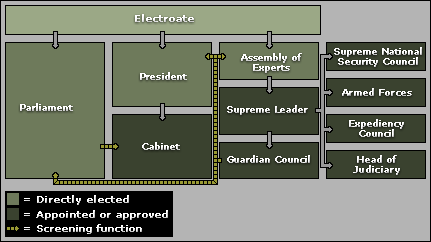
Iran is one of the most misunderstood places in the world for most Westerners. Beyond the obvious misconceptions about language, culture and ethnicity, there is also a mistaken desire to frame their entire existence within a Western paradigm. As many have pointed out, this is a problem (I would suggest reading Michael Axworthy on this). One of the significant ways in which Westerners fail to understand Iran, and in particular the Islamic Republic, is the governmental structure. The United States has a fairly simple system that many are familiar with. It has clearly delineated Executive, Legislative and Judicial branches, where each one of these three acts in a way to compliment and also to prevent the others from becoming too powerful. Iran as well has these three branches but they function in a very different way.
 |
| Available at: http://www.iranchamber.com/government/articles/images/power_chart.gif |
As the preceding chart from IranChamber.com shows, Iran's government is a convoluted and contradictory organizational mess. Not only is it the only state in the world where the head of government (President Rouhani in this case) does not control the armed forces (this includes the IRGC which is loyal to the revolution, and effectively the Supreme Leader), but also the Judicial is subject to the whims of the indirectly 'elected' Supreme Leader. The fact that certain 'elected' bodies (the President for example) have to be 'approved' by unelected groups, certainly doesn't help make the system any more straight-forward to outsiders.
While the former president Mahmoud Ahmadi-Nezhad was in power, many on the right in Israel and America would take his words (whether they were translated well or not) at face-value. They made a sport of raving about how this fanatical and powerful leader was a menace to the world and that he must be stopped etc. Those who spoke to me during this time are probably familiar with the way in which I was sharply dismissive of this idea. President Rouhani does not have the same legal authority as the Supreme Leader, or as much as fear-mongers incorrectly claimed Ahmadi-Nezhad had. However, dismissing him as powerless is just as foolish. It remains to be seen if genuine negotiations can happen on his watch.
Given the amount of possible disinformation and denials coming from the Iranian side, it is unclear if the hardline backbone of the Iranian government will support any sort of concession on their part. They have created a culture of resistance against the West and its allies (against the Americans, the Iraqis, the Israelis, the Shah and leftist movements such as the Communists and the MEK), and while still on this track, it may be increasingly difficult for them to disengage themselves. This same singularity of thought is also true of the conservative American Congress, and much of the Israeli political establishment. The nervous one-track hive-mind is certainly not helped by it's inability to understand the Iranian government's decision making process and power structure. Speculation can, on occasion, be beneficial, but uneducated speculation based upon a simplified understanding of a very complicated Iranian governmental apparatus helps no one.
Thursday, July 11, 2013
New Iranian Nuclear Sites?
The National Council of Resistance of Iran (political branch of the People's Mujahedin Of Iran/Mujahedin-E Khalq) has "revealed" another "new" Iranian nuclear site. Surprisingly, this article does quite a good job of addressing the potential flaws of these allegations. While this group (NCRI) has correctly identified several sites in the past, they have also been wrong about sites as well.
The NCRI clearly has an agenda, and the timing (right after the election of the 'moderate' cleric Hassan Rouhani to the Iranian presidency) makes me curious why this was released now. Many hawks have been frustrated by the election of a less controversial, antagonistic figure than Mahmoud Ahmadi Nezhad, the last president of Iran who was best known for his incendiary remarks and Holocaust denial.
If Iran were to once again to be in non-compliance with the NPT (requires proper notification to the IAEA if any new nuclear facilities are built etc.) as they admitted in 2003, it would certainly reduce the prospects for negotiations on Iran's nuclear program. Even though Binyamin Netanyahu has finally admitted that Supreme Leader Khamenei is in fact in control of the Iranian nuclear program (not Ahmadi Nezhad as Netanyahu incessantly and vociferously claimed for years), and Mr. Rouhani has not even been sworn in yet, this revelation, if true, would mitigate the positive feelings created by Rouhani's election and his attempts to repair relations with countries.
Sources close to #Rouhani say he is planning to send special envoys to some countries to repair broken ties & start new chapter with #TehranWhile I am skeptical of anything from the NCRI for the obvious reasons, I am also highly suspicious of Iran considering its track record of non-compliance. Things have appeared to have calmed down a bit regarding the Iran-Israel/US conflict and a new problem such as a hidden nuclear site would quickly ramp up tensions once again.
— Negar Mortazavi (@negarmortazavi) July 10, 2013
Saturday, April 27, 2013
The Enemy of my Enemy
Is the enemy of my enemy my friend? Innumerable examples of this from Osama bin Laden to Soviet Russia in World War 2, indicate otherwise. In the volatile Middle East in particular, shifting alliances cause problems for everyone but the most able political manipulators.
In 20th century Iran there is a prevalent theme of doomed alliances. In the oil-nationalization dispute with Britain, Prime Minister Mohammad Mossadeq's National Front was made up of several nationalist political parties. Due to several factors including external meddling (Soviet, British and American), gaps soon appeared between the parties. Some of these parties ended up working in conjunction with the British and Americans to overthrow Mossadeq in 1953. This same theme of broken coalitions was perhaps most important in the 1979 Iranian Revolution. Nearly every part of Iranian society was upset with the Shah's increasingly despotic rule and all worked together to ensure his fall. There were Islamists, Marxists, Communists, Socialists, Intellectuals and others, all working together because they shared a common enemy. In the end, one group won at the expense of all of the others. While the most significant gaps at the time were between the religious, the seculars and the Marxists/Communists, even amongst the religious groups which supported Ayatollah Khomeini there were huge ideological gaps.
The dismissal of Ayatollah Hossein Ali Montazeri as the successor to Ayatollah Khomeini several months before Khomeini's death is an important example of the ideological gaps between the religious factions. There are several reasons why Montazeri was dismissed from his position. First he was not a very astute politician, but probably more importantly, Hashemi Rafsanjani (chairman of the Majles at the time, and President shortly thereafter) and the current Supreme Leader Ali Khamenei (President at the time) worked together to undermine the authority of Montazeri so they each would have a chance to gain more power. While Rafsanjani and Khamenei were once allied in their opposition to Montazeri, their own personal and political differences have since then made them fierce rivals, if not outright enemies. After the disputed 2009 Iranian Presidential Election Rafsanjani expressed marginal support for the reformists and has since criticized the Islamic Republic many times. Since then, several of his children have been jailed, assaulted, and forced to resign from their jobs. Rafsanjani himself was removed as the chairman of the Assembly of Experts, the group responsible for electing, supervising and theoretically removing the Supreme Leader. There can only be one winner, and for now, Rafsanjani is not it. This may change a bit in the Iranian Presidential election this June, but given the fractious state of Iranian politics, this is difficult to predict.
Moderates, seculars and former regime insiders are not the only ones who have been betrayed by their former allies. The United States has also been burned by former partners so many times in the Middle East it is puzzling why the government seems unable to learn from their mistakes. Today support from Congress for the Islamo-Marxist terrorist cult MeK (Mujahedin-e Khalq) is just as troubling. This support is based purely on parallel mutual enmities between the US and Iran and the MeK and Iran. While trumpeted as a "democratic" alternative to the IRI, opinion polls show support amongst Iranian-Americans for the MeK under 1%. I would hope that Washington has learned from the lessons of Iraq and Ahmed Chalabi. The lack of action in Syria by the Obama Administration is a cause for both concern (innocents are being slaughtered), but it is also somewhat encouraging as there is not a rush to give armed support to groups that have the potential to harm us in the future. Perhaps the lessons of Osama bin Laden and Afghanistan circa 1979 may have taught us something after all?
As cartoonist Howard Taylor wisely pointed out: "The Enemy of my Enemy is my Enemy's Enemy, no more, no less." Hopefully this is taken to heart by policy makers in the future as they are not the ones who suffer from their mistakes, we all are.
UPDATE 1: I am embarrassed to admit that I misread the poll on Iranian-Americans and the 5% (that support the MeK) I initially quoted was actually 5% OF THE 15% who openly state that they DO support an opposition group. So the poll responses indicate that 6 people out of the 800 who participated in the survey stated that they support the MeK, resulting in a total of .75%.
UPDATE 1: I am embarrassed to admit that I misread the poll on Iranian-Americans and the 5% (that support the MeK) I initially quoted was actually 5% OF THE 15% who openly state that they DO support an opposition group. So the poll responses indicate that 6 people out of the 800 who participated in the survey stated that they support the MeK, resulting in a total of .75%.
Subscribe to:
Posts (Atom)