Monday, June 19, 2017

New CIA/State Department Docs on the 1953 Iran Coup (Part 4)

This is part 4 of my series on the new CIA and State Department docs on the 1953 Iran Coup. 

One of the most curious and difficult aspects of the Iran coup of 1953 is determining which parties were involved in the overthrow of Prime Minister Mossadeq, and to what extent they bear responsibility. The roles of the United States and Britain are undeniable, yet there are still inconsistencies and unknowns; primarily what happened between the first and second coup attempts, and when exactly they decided to try a coup. The following documents shed some light, but still many questions remain.

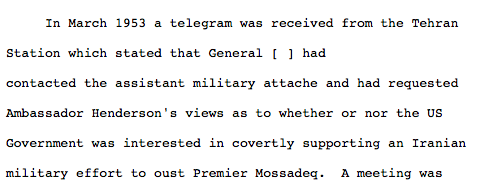
As I have previously noted (Myth 6), there were multiple contacts by IRANIANS in the months before the coup, trying to gauge the American interest in a coup. We know of at least two contacts made during March 1953, and perhaps as many as four. One referenced by Donald Wilber in his "Wilber Report" notes a General (name redacted), had contacted the "assistant military attache" and "requested Ambassador Henderson's views as to whether or nor the US government was interested in covertly supporting an Iranian military effort to oust Premier Mossadeq".
This is quite significant, as it establishes a precedent of Iranians approaching the United States to ask about a coup BEFORE the United States had decided to overthrow Mossadeq.

A previously released document (cable 3853 from Amb Henderson to Dulles dated March 31 and referring to a conversation from March 30th) has a record of former prime minister Hossein Ala' inquiring about the possibility of an American coup. Ala' was never a general so it is not possible that this request is from the same person. Henderson makes it quite clear to Ala' that the United States will not take a regime change policy, and will accept as head of the government whomever has the firman (edict) from the Shah establishing the individual as prime minister. 

A new CIA document dated March 31 indicates that Majles Deputy Haerizadeh, General Batmangelitch, and retired Generals Garzan, Bahadori, and Zahedi were planning a coup to take place within a few weeks. It also says that they claim that the US embassy approves (the footnote indicates that this appears to be "wishful thinking"). 

There may be overlap here, but it is quite clear that there were at least 3 instances in March 1953 of Iranians contacting United States officials about a coup. 

One of the next new documents is dated April 4th, and references an April 2nd conversation between Roosevelt and Dulles about initial plans to start TPAJAX (the code name of the coup attempt). It is unclear if these multiple attempts by Iranians to get the Americans on board for a coup had an effect, but given the proximity it seems as though there must be a connection of some sort. Also of note is the fact that TP AJAX was hand-written, as if it was either forgotten, or this is when they decided to name it. 

These documents are significant in establishing an Iranian interest in a coup before the United States had seriously considered regime change, and perhaps helps understand how the various American figures came to decide that a coup was worth exploring. Unfortunately there is not record of the April 2nd conversation, which would be much more useful in determining what motivated the change in policy. Kermit Roosevelt's "memoir" Countercoup—which is just as helpful as it is harmful—makes no note of this conversation, yet he mentions an additional meeting with an Iranian general who also wished to collaborate with the Americans on a coup. Again, because the name is redacted and other information is missing, we cannot be sure who exactly this was and if it was another Iranian who wished to overthrow Mossadeq, or the same one asking two different Americans the same thing.

Sunday, June 18, 2017

New CIA/State Department Docs on the 1953 Iran Coup (Part 3)

This is part 3 of my series on the new CIA and State Department docs on the 1953 Iran Coup. 

One of the most interesting and substantial documents newly released is an analysis of the nature of a potential Ayatollah Kashani run Iranian government by the Office of Intelligence and Research.

Kashani had been an ally of Mossadeq, before breaking with him and his National Front in early 1953. Kashani's role in Mossadeq's ouster has been downplayed in the traditional narrative of the events (which places most of the blame on the Americans), yet revisionists have noticed the extent of Kashani's influence, and how important he was in fomenting unrest against Mossadeq in the months leading up to the coup.

What is most striking about the document is how Kashani is described. If you took out his name, and other identifying information one might think that the authors are describing Ayatollah Khomeini or Khamenei. Kashani's sees "contemporary problems from a narrowly Moslem outlook, severely warped by many years of bitter conflict with British authority".

Mossadeq at the time had significant support and the authors deemed it unlikely that he would be replaced by Kashani, but they also note Kashani's influence, as the second largest bloc in the Majles (Iranian parliament). 
The authors point to a handful of negative characteristics of Kashani, ranging from conceit and ambition, to unscrupulousness and support of bigoted practices, and a lack of business and executive experience. 

Kashani was vehemently anti-British based upon his past experiences, he had experienced foreign meddling. This he shared with Mossadeq, though their motivations and approaches to addressing foreign interference was very different. 

The authors blame Kashani (like Mossadeq) for taking credit of others work to forward his own ambitions. He is likened to a "ward boss" and "gangster". His supporters are considered to be from a similar social class as Mossadeq (most appropriately described as middle-class), though with a distinct religious inclination.

Kashani, had disagreements with the Shah, the army, and starting in early 1953 Mossadeq as well. Shia clergy in Iran had historically been quietist, subservient to the monarchy. Kashani was outspoken, a break from tradition. He disapproved of the late Shah's work to sideline the clergy, and to uphold the mantle of Shiism, when the Shah wasn't even a theologian. This is virtually identical to Khomeini's approach years later. 

The authors noted that Kashani's relatively lower popularity and all of the enemies he had limited the prospects for a theocratic state. That they were considering it as a possibility is still quite telling.


Again the parallels to Khomeini, and even Khamenei here are striking. They believe that the West is engaging in plots to control weaker nations. He also is credited with having a disparaging attitude towards oil, and wanted to diversify the economy to create self-sufficiency and limit dependence.

The last section is also eerily reminiscent of Khomeini. It is acknowledged that Kashani wouldn't want to accept foreign funds because it would undermine him. The authors note that this makes cooperation with Kashani difficult, but they didn't rule it out. The last paragraph is also interesting as it directly points to a policy of neutrality from the Iranian government. The Dulles brothers in particular speak repetitively about the dangers of communism taking over, yet this memo, just months ahead of the coup explicitly notes neutrality as the Iranian government policy.

This analysis of Kashani is fascinating and apt and as I mentioned throughout, the similarities to Khomeini are significant.


Saturday, June 17, 2017

New CIA/State Department Docs on the 1953 Iran Coup (Part 2)


This is part 2 of my series on the new CIA and State Department docs on the 1953 Iran Coup. 

The third section of the new documents "Planning and Implementation of Operation TPAJAX, March–August 1953 (Documents 169-308)" and starts with a doozy; a CIA memo for the president dated March 1, 1953. While it is in fact an old document that was included in the 1989 original Iran FRUS, there are some additional sentences and clauses that are included as demonstrated in this screenshot of the two side by side.

Again as I've indicated in the past, the role of Ayatollah Kashani is dismissed by apologists and clerics alike. These documents make it quite clear that he had an immensely important role in the build up to the coup. 

The next document is also new to the FRUS collection and concerns the "Capabilities of the CIA Clandestine Services in Iran"
This is another very important document. It indicates that the propaganda outlets the CIA controlled were NOT capable of spreading anti-Mossadeq propaganda a mere five months before the coup.

Later parts of the memo include this damning passage: the CIA didn't have the capability of creating riots against Mossadeq.
Again there are still redactions in the new documents, a very frustrating reality for historians trying to better understand the events of and leading up to the coup.

Interestingly enough the Top Secret cable (2266, March 2, 1953) from John Foster Dulles to the Iran embassy is not included in the new FRUS, despite its undeniable relevance and importance. Perhaps they are only including ones with changes?

The next document is from the famous NSC 135. One can see the ellipses on the left document indicating a redaction, and the new version which has additional information. 

There is an editorial note following NSC 135 which discusses Foreign Minister Eden's trip to the United States from March 4-7, 1953. As I've previously noted, the CIA's chronology in Zendebad Shah! made a mistake in characterizing the nature of Eden's discussions, implying that negotiations broke down before the trip, when in fact they were, at the time, ongoing and were not dissolved until after Eden returned to the UK.

Three documents later, my work is confirmed. On March 10th, A memo from Byroade to JF Dulles references the potential breakdown of oil negotiations, and a recommendation (from Henderson) to not buy Iranian oil, to not encourage or discourage American firms from engaging in business, and to withhold some financial assistance from Iran. 

A March 11th CIA memo is helpful in outlining the situation as it was. It covers the various opposition groups, starting with Kashani. 


Even after big demonstrations in February and unrest, despite instability with the oil negotiations, the CIA thought Mossadeq had a lot going for him.


The analysis of what Mossadeq's choices were is very good and did a good job predicting what Mossadeq would do.

Friday, June 16, 2017

New CIA/State Department Docs on the 1953 Iran Coup (Part 1)

This is Part 1. In Part 2 I will discuss a few of the more interesting documents

Finally, after years of delays, the State Department released an update to the 1951-1954 Iran FRUS (Foreign Relations of the United States). The purpose of the series is to provide a better record of diplomatic events in the past. The previous edition, released in 1989, was widely criticized for failing to note the depth of US involvement in the 1953 Iran coup, and for leaving many documents classified despite the decades that had past since this time.

Generally FRUS does not contain everything, and there are many documents, some historically pertinent, that are stored at the National Archives in Maryland. I have annotated a few from this time: Part 1 Part 2. I have noted in the past how the record is incomplete; in some instances there are hundreds of cables in a row that are not in FRUS, and in many places there are missing documents. They could be completely mundane (as so many are), or they could be very revealing.

The release was also interesting because of how hard President Obama and Secretary of State John Kerry had worked to keep them from being released. It was reported that up to the last hours of Obama's presidency they were trying to keep them secret.
“As it expressed in last year’s annual report, the HAC was repeatedly frustrated–and disappointed–by Secretary Kerry’s refusal to allow the volume’s publication,” Prof. Immerman said yesterday. “In this regard the change in State’s perspective from the Obama to Trump administration is dramatic.”
This bothered State Department officials as noted here:
https://history.state.gov/about/hac/june-2016

I have speculated about the motivations for the two not wanting the documents to become public: http://persophilia.blogspot.com/2016/06/why-is-state-delaying-release-of.htmlhttp://persophilia.blogspot.com/2016/10/no-frus-doesnt-have-all-answers.html.

Obama and Kerry were worried about the reaction of the Iranians to the releases. I postulated that this would be due to revealing the nature of the participation of clerical elements. It is clear to the world that the United States and the UK tried to overthrow Mossadeq on the 16th of August 1953; no one denies this. What happened next, between then and the successful August 19th coup, and who was involved in addition to the United States is what could potentially be so inflammatory. Ayatollah Kashani, an inspiration for Ayatollah Khomeini and many other important clerics to come later, was a key player.

The release yesterday was particularly important because it also contains CIA documents. It was claimed that these documents were lost, yet they have reproduced some of them. There are also copies of old documents that have been public for over 25 years. They are mostly quite important, but their exact purpose in this collection is unclear. At the same time, many CIA documents are NOT included. The best example is here:

Sequentially there is document TEHE 737.1 and the next document is TEHE 742.1. Both have the same date, yet are clearly from different points in the day. In the first (737), there is almost a despair about the failure of the coup, and further efforts to commence damage control. In the second (742), there is a brief message of success. Did nothing happen in between these two moments? How did they go from potentially cancelling military aid, to a successful coup and an urgent need for 5 million dollars?! What do the four documents between 737 and 742 say?

While I have yet to read through the entire set of documents (there are over 500, and over 900 pages), I read the whole section on the coup (section 3, 272 pages), and the events leading up to the coup. My theories are almost uniformly supported, though there are still holes in the documentation.

  1.  CIA documentation is still contradictory (I've noted problems in the narrative and chronology http://nationalinterest.org/feature/six-myths-about-the-coup-against-irans-mossadegh-11173http://persophilia.blogspot.com/2013/11/relations-between-mossadeq-and-united.html)
  2. Roosevelt is unreliable (A lot of what he's said reads as though he is covering for his mistakes)
  3. Religious elements were KEY to the coup (They make this quite clear throughout)
  4. The "spontaneity" of the events of August 19 is emphasized throughout

While none of this exonerates the United States and the UK of course, the documents make quite clear that domestic actors must accept a not insignificant share of the blame.

I have noted multiple Iranian officials approached the United States asking about a coup in the months prior (last paragraph in myth #6). It was evident that while Mossadeq was undoubtedly a noble, well-intentioned individual, he was not capable of bringing Iran out of the crisis alone, and he made too many enemies, both foreign and domestic.

Part 2 will have more on specific documents

Sunday, May 21, 2017

Iranian Military Spending

The relationship between Saudi Arabia's and Iran's military spending is interesting, often cited, yet almost always misrepresented. Lobbyists and pundits like to point to this as an indicator of foreign policy and aggression, but the reality is that it is far more complex.

Saudi Arabia spends a significant amount money on conventional arms; President Trump during his trip to the kingdom sealed a massive $110 billion dollar arms deal. Iran on the other hand, spends much less. This is taken by many to indicate that Saudi Arabia is the aggressor, while Iran is defensive or even docile in nature. This does not take into account strategies or the structure of the defense apparatuses or funding of terror groups, which both do, despite very different military spending numbers.

Saudi Arabia has emphasized conventional weapons and arms deals, buying the latest gadgets from the US. Iran, on the other hand, focuses on its missile program, and other asymmetrical aspects. It bombastically threatens to create a blue-water navy, but this is empty talk. Iran is restricted by geography, a smaller economy, and sanctions. Iran also has the experience of the Iran-Iraq War to draw upon; a bloody war where hundreds of thousands died.

After the revolution, Iran intended to exert influence by "exporting" their revolution. Given Iran's weakness relative to the rest of the region—they are incapable of using force to conquer Iraq to Morocco and everywhere in between— they realized they needed to project soft power, and when using violence, to use it asymmetrically. Hezbollah, Amal, and various Palestinian groups benefited from this.

The most significant beneficiary of this approach is the Iranian Revolutionary Guards Corp (IRGC). In 2016-17 only 5.3 MILLION was allocated to "refurbishing the fleet" of the regular Iranian Air Force. They operate what is essentially a parallel military (with some overlap) to the regulars (Artesh). This moves them into a grey area, with a completely different command structure (while still ultimately answering to the Supreme Leader).

Asymmetric warfare is by its very nature less cost-intensive. It isn't about overpowering the enemy, but about exploiting the stronger enemy's weak points and utilizing this to the advantage of the conventionally weaker party. Comparing the simple raw military spending numbers of Saudi Arabia and Iran does not fully capture the intricacies and nuances of strategically dissimilar entities.

Wednesday, February 8, 2017

Iran and Trump

Iran is one of the most interesting geopolitical threats facing President Trump. The new president has expressed strong distaste for Iran, mostly relating to the nuclear deal reached between the P5+1 and Iran during President Obama’s term. At the same time, Trump has expressed a strong preference for Russia and its president, Vladimir Putin. Russia and Iran have complementary interests in the Middle East, especially regarding Syria, while Russia has habitually nominally supported Iran in an effort to undermine the United States’ hegemony. 

Trump appears to believe that a better deal can be reached with Iran, one abrogating the previous one. For this to be possible, the United States would need to reach a superior bargaining position. Whether the current position is weak or strong, at least one party (Iran) does not wish to give up more. Therefore they would need to be convinced that they are worse off than they believe, or to change the situation to the advantage of the United States. 

Iran, as always, has its own domestic concerns, mostly relating to keeping the population docile, and solidifying regime control over the economy and political system. At the same time, they are active in Syria, Yemen, and the Gulf. Their goal is to establish regional clout, and like Russia, to undermine the United States.

Iran has been making deals with European, and Asian countries since the nuclear accord was finalized. Countries like Greece and Italy, who already have massive financial troubles, benefit from Iranian crude. China always demands more, and other major purchasers like South Korea and India are also interested. 

Trump is faced with a situation where everyone except the United States (and Israel) is happy with the deal, or doesn’t care enough to make a fuss. The United States has virtually no leverage. The only path forward would be to enact coercive measures, forcibly preventing other countries from doing business with Iran. It would the United States versus the world. 

Iran knows this, and they have made a point of pushing in various ways. They ramped up their antagonist actions, especially in the Gulf after the nuclear deal was signed, and continue to act out. General Michael Flynn (Ret.), put Iran “on notice” recently after they test fired a ballistic missile. While not technically a violation of UNSC Resolution 2231 (the text is very poorly worded and unspecific), this test certainly “violated the spirit” of the nuclear agreement and the resolution. 

Today Iran fired another (short range air-defense missile) from the same location. This clearly is not a violation, as it is not ballistic, but it is provocative. While this is much less antagonizing than the previous launch, it is still a clear message to the Trump administration. Iran knows that the United States does not have the same global coalition Obama managed to wrangle, and they are betting that Trump, despite his erratic behavior, won’t be able to do anything to substantive. 

I expect limited provocations to continue, namely in the Gulf as I mentioned a week ago (https://twitter.com/MorganCarlston/status/827160413414506496), but is possible they try to find another dual-citizen hostage, or harass US navy vessels or commercial shipping. They realize how bad Trump looks globally with his inability to control his emotions, and how hypocritical some of his policies are. They are betting that he will be hamstrung by his inability to create a coalition, and to conduct effective diplomacy, while bogged down with domestic concerns.

Monday, October 17, 2016

No, FRUS doesn't have all the answers

A recent article in Politico on the 1953 Iran Coup, while well intentioned, is unfortunately fundamentally flawed. Malcolm Byrne, who collaborated with Mark Gasiorowski to provide one of the most important academic books on the coup, writes in support of releasing the updated FRUS (Foreign Relations of the US). I too have argued for the same thing, but our reasons are very different.

Mr. Byrne makes a variety of mistakes in his assessment of the situation, ones that someone with his experience with archival documents, and with this episode in history should not make.

First he neglects to mention that the first coup attempt failed miserably, leading to the arrest of dozens of high-ranking officers and conspirators. There was no backup plan. Mr. Byrne does not state how one man, with zero knowledge of Persian managed to create a 2nd coup a mere three days later after his entire plan collapsed.

He also fails to account for competing interests, including Iranians who despised the Iranian Prime Minister, who wished to remove Mr. Mossadeq from power. He ends his introductory paragraph blaming the coup for feelings of anti-Americanism that endure to this day, ignoring once again, that clerics, including the direct spiritual predecessor of Ayatollah Khomeini (Ayatollah Kashani), was key in the attempts to remove Mossadeq from power.

His argument is based upon the core principle that the US, and the US alone (well including the UK), is guilty of overthrowing Mossadeq, rejecting the possibility of domestic (or other foreign) collaboration.

Mr. Byrne goes on to claim that the American public does not have full-access to the full historical record. This is partially true, as the CIA "lost" all of its files from the time in a suspicious fire, and some of the documents from the State Department remain classified. At the same time, the vast majority of these documents ARE available at the National Archives in Maryland.

Mr. Byrne also seems to not understand the point of the FRUS system. These are not complete records containing every single cable to and from an embassy or consulate. There are a small fraction that are included in FRUS collections. They are selected to be pertinent, not a complete data dump. There are many more documents from and to Tehran and other places that are in the National Archives, I have seen them myself. Most of them are mundane, but some are quite interesting. It would be nice to include these in a massive digital archive including every single document, but this is not how the FRUS system is set up.

Mr. Byrne claims that the US and UK role in the coup is covered up, and the documents the State Department refuses to release will prove the two parties guilty. In the Archives, the additional documents I have read myself, indicate otherwise as I have demonstrated here and here.

Mr. Byrne believes that US and UK guilt over the coup is the major reason to not release the documents, but his analysis falls far short. He does not account for the local efforts to remove the Shah, and their ties to the current regime. He additionally fails to mention the saga (covered by David Ignatius of the Washington Post), where BP (formerly AIOC) forced Kermit Roosevelt and his publishing company to pull the entire run, though he has written about it in the past.

What would be more infuriating for the regime, to show that the US was involved (which is what they are already furious about), or that major regime figures, or their direct influences played a role in fomenting the coup?

Given the sensitivity of the Iran nuclear talks which have been ongoing, this delay makes sense in that they do not want to upset the Iranians so that they completely withdraw, and years of diplomatic efforts are lost.

While I agree with Mr. Byrne that the updated FRUS should be released, I strongly disagree with his analysis and I am very disappointed with his failure to mention the most likely scenario: that documents will show involvement from the Iranian clergy.

There are classified documents out there, documents which have not undergone their 50 year declassification review. Why hasn't Mr. Byrne filed MDRs (Mandatory Declassification Review) for these documents? He spends his time working on archives, yet in his article he ignores this potentiality.

His argument does not stand up. It does not make any sense for him to claim that the documents are not available when they mostly are. For the few that are classified, he simply has to go to the Archives and find the sheet that says how there is a classified document missing and then file an MDR. Yet he refuses to mention this aspect in his article, instead making it about some conspiracy to hide the truth from the American people.

It is also quite disheartening that he is convinced that there are going to be documents giving us a definitive answer as to what happened, and who the guilty parties are. I have demonstrated how even the CIA's latest (known) internal history has at least one glaring mistake (see #5). If the CIA doesn't have the story straight, how would the State Department?

There may be documents proving Mr. Byrne right, yet his shoddy work, and misleading, baseless claims do not help shed a light on a complicated historical event.

In conclusion, this quote from Donald Wilber, the author of the CIA's first internal history of the coup sums up the entire situation: "The early accounts of various participants differed widely enough to make it impossible to follow the slender thread of truth through the dark night"