Showing posts with label UN. Show all posts

Wednesday, July 8, 2015

Will the Iranian Arms Embargo Remain?

For me, one of the most interesting aspects of the Iranian nuclear negotiations is the sanctions, their meanings and classifications, and the circumstances under which they may be removed. For months, or perhaps even years, Iranian officials have unanimously and unequivocally stated that 'all' sanctions must be removed, and removed immediately. The P5+1, especially the Americans have stated that nuclear sanctions are a part of the negotiations, while 'non-nuclear' sanctions are not. Recently, Iranian rhetoric softened slightly when Ayatollah Khamenei stated that there will be a time-table for the removal of sanctions rather than immediate and complete reversal. The latest statement from the Iranian negotiating team in Vienna however, insists on removing an arms embargo placed on Iran.

They are, as far as I can tell, referring to the UN Security Council Resolution 1747, unanimously supported in 2007, punishing Iran for proliferation concerns and not fully complying with the IAEA. The sanctions clearly have a nuclear connection, but at the same time, explicitly mention ballistic missiles. The factsheet released by the White House in April in the JCPOA (Joint Comprehensive Plan of Action) emphatically states that while nuclear sanctions will be removed, "U.S. sanctions on Iran for terrorism, human rights abuses, and ballistic missiles will remain in place under the deal." The following excerpt from the JCPOA indicates that there is a plan to create a new resolution reaffirming the embargo on "conventional arms and ballistic missiles".


Given the inconsistencies here, there are a few important questions to be asked: 

  1. Will the arms embargo remain or be renewed in some way?
  2. Is Iran reneging on previously agreed terms?
  3. Did the White House put this in the JCPOA while it was still up for negotiation?
  4. Is this appeasement of hardline constituencies? Is one side trying to take advantage of the other? Does Iran not want a nuclear deal after all?
These questions are incredibly important, not only for understanding the contributions made by the different sides, but also because there are legitimate concerns over weaponry going to and coming from Iran. Hezbollah and other terror groups are armed by Iran, and easing restrictions on the Iran's armaments is bound to create further instability. Israel has not been afraid to bomb Syria, Lebanon and Sudan when they feel threatened by a possible arms transfer, usually of more advanced weaponry. The likelihood of this happening again would be much higher with this arms embargo removed. Iran may change its behavior towards its terror clients in the long-term, but a radical reduction in the scope and frequency of its covert actions is unlikely in the short term.

Friday, May 23, 2014

Wikileaks and Afghanistan

Earlier this week internationally recognized news organizations suffered heavy criticism from the anti-secrecy organization Wikileaks for redacting the name of a nation surveilled by the NSA. Even Glenn Greenwald voiced his support for redacting the country’s name for fears “that doing so could lead to increased violence.” Following this, the Wikileaks Twitter account (widely assumed to be run by Julian Assange directly), engaged Mr. Greenwald with vitriolic language and slurs, culminating in the account claiming that it would release the name of the target nation in 72 hours

72 hours passed, and Wikileaks did not released the name. 3 hours after the deadline the account posted the following tweet:
Bizarrely enough a mere hour and a half later, the handle did in fact publish the name which turned out to be Afghanistan.


While it is unclear if this in fact is true, it is certain that this action appears to be a desperate attempt at gaining attention. Anyone who has followed the news and has a memory beyond the last minute is probably more than aware of the strife in Afghanistan, and the widely varied sources of violence. It was only a few months ago when the Taliban, one of the most significant insurgent groups in the country attacked the United States Consulate in Herat, killing 3. Months before this, the Taliban set off a car bomb, murdering a US diplomat and four other Americans

The Taliban are not the only group which has attacked American and International interests in Afghanistan:

In September 2012 there were widespread riots over the film “Innocence of Muslims”, even though many of the rioters had not in fact seen the film clip. 

In February 2012 there were riots for a week over American troops dumping Korans in a garbage dump and burning them (the ones responsible were disciplined by the US Army). 

On April 1, 2011 the United Nations compound in Mazar-e Sharif, was stormed and as many as ten foreigners were murdered (some may have been decapitated) in response to the burning of a Koran a week and a half earlier by an American pastor. The riots continued throughout the country for a week following the attack on the compound. 

Earlier in 2011 thousands demonstrated in Qalat after young Afghan children alleged that foreigners had ‘disrespected the Koran’. 


What is clear from this brief catalogue of recent events is that Afghanistan remains a very tense place with unrest possible at any moment and for any reason. Something like what Wikileaks has alleged can prove to be deadly, even for innocents or civilians whose presence in the country is entirely innocent and well-intentioned. 

I do not know if Afghanistan is the country redacted by Glenn Greenwald, but if it is, the callousness of Julian Assange is horrifying. It would truly demonstrate how egomaniacal Julian Assange is and how little he values a human life that is not his own. 


Thursday, September 26, 2013

Iran and Nuclear Safety (or lack thereof)

Belarus, Cuba, India, Israel, Libya, Pakistan, Sudan, Syria. Most would think that being on this list is a bad thing, however, in this particular instance, it is not. These countries have all signed (and most have also acceded to or ratified) the Convention on Nuclear Safety. Notably missing, Iran and North Korea. While I've written on why Iran and North Korea should not be compared, in this one case I feel as though showing that both of these countries are absent from a certain international treaty is important.

The Convention on Nuclear Safety was adopted in 1994 after several years of work. 'Its aim is to legally commit participating States operating land-based nuclear power plants to maintain a high level of safety by setting international benchmarks to which States would subscribe.' As this clearly describes, the treaty is intended to ensure that nuclear power plants are kept at a reasonable safety level. Nuclear accidents can affect many (see Chernobyl and Fukushima, not to mention 3 Mile Island), and regulating and ensuring the safety of these facilities is in the interests of all. 

Of all the states with nuclear power plants, Iran is the ONLY one that has not signed the CNS (they have also not signed other important nuclear treaties including 'the Convention on the Physical Protection of Nuclear Material (CPPNM), the Convention for the Suppression of Acts of Nuclear Terrorism, and the Joint Convention on the Safety of Spent Fuel Management and on the Safety of Radioactive Waste Management.'). Why is it that a country whose expressed reason for developing nuclear technologies is only power and medical uses, has refused to sign this incentive-based treaty, which ONLY concerns safety and the protection of civilians? 

Iran keeps yammering on and on about how Israel has not signed the NPT (and yes they are right in this case). However after President Rouhani's speech criticizing the double standards of the West in being anti-terrorism yet conducting drone strikes which have killed innocents, doesn't this affair itself also demonstrate an incredibly disheartening example of double standards? 

Iran may claim that the West is imposing an agenda upon them, and that they are trying to force Iran to bend to the will of the West, but this argument is a problematic one. If Iran is so worried about the will of the West, why bother with the UN, or why be a member of any international treaty at all? Even more troubling is the fact that the CNS is purely incentive-based; it applies to safety at nuclear power plants so that nuclear accidents are less likely to occur. It has nothing to do with stopping or limiting enrichment (one of Iran's primary concerns and arguments with both the IAEA and the P5+1), or preventing countries from operating nuclear facilities.

This section of the preamble of the CNS provides important context: 
'…this Convention entails a commitment to the application of fundamental safety principles for nuclear installations rather than of detailed safety standards and that there are internationally formulated safety guidelines which are updated from time to time and so can provide guidance on contemporary means of achieving a high level of safety;'

If I had the ear of Iran (or any environmentalist groups anywhere) I would strongly urge them to commit the government of Iran to this important legislation. It could be an important confidence boosting step for both the P5+1 and Iran. The P5+1 would be encouraged by the fact that Iran is agreeing to an important civilian safety regulation, while Iran would be protecting its own citizens and scientists, and also those of the states near to earthquake-prone Bushehr, the site of Iran's nuclear power station. 


NOTE: I've written about this in the past as well. The blog can be accessed here: http://persophilia.blogspot.com/2013/04/earthquake-danger-at-bushehr.html 

Ali Vaez has written about Iran and nuclear safety, this publication with Charles Ferguson I find particularly compelling.

Mark Fitzpatrick, the director of the IISS's Non-Proliferation and Disarmament Programme also has an important paper on non-proliferation and nuclear safety which mentions Iran and the CNS. Access here:  http://www.nonproliferation.eu/documents/backgroundpapers/fitzpatrick2.pdf

Saturday, September 21, 2013

The Complexities of the Iranian Government and Nuclear Negotiations

With the impending annual UN General Assembly slated for this coming week, and the anticipation of important political developments, a common story in the news is the potentiality of a diplomatic breakthrough regarding Iran's nuclear program. Much has been made of Iran's new President Hassan Rouhani's increasingly friendly tone towards America and the West and his stated desire for dialogue. From what many have written, it seems an almost foregone conclusion that for the first time in what seems like an eternity, the heads of government for the United States and Iran may meet face to face. For now, this is nothing but blind speculation; no matter how friendly the words of both sides are, no real 'progress' has been made as of yet. 

Iran is one of the most misunderstood places in the world for most Westerners. Beyond the obvious misconceptions about language, culture and ethnicity, there is also a mistaken desire to frame their entire existence within a Western paradigm. As many have pointed out, this is a problem (I would suggest reading Michael Axworthy on this). One of the significant ways in which Westerners fail to understand Iran, and in particular the Islamic Republic, is the governmental structure. The United States has a fairly simple system that many are familiar with. It has clearly delineated Executive, Legislative and Judicial branches, where each one of these three acts in a way to compliment and also to prevent the others from becoming too powerful. Iran as well has these three branches but they function in a very different way. 


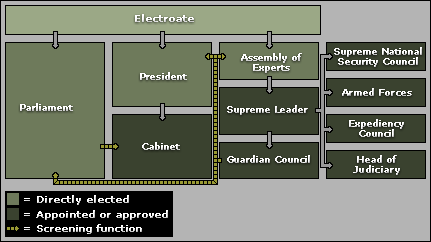
Available at: http://www.iranchamber.com/government/articles/images/power_chart.gif

As the preceding chart from IranChamber.com shows, Iran's government is a convoluted and contradictory organizational mess. Not only is it the only state in the world where the head of government (President Rouhani in this case) does not control the armed forces (this includes the IRGC which is loyal to the revolution, and effectively the Supreme Leader), but also the Judicial is subject to the whims of the indirectly 'elected' Supreme Leader. The fact that certain 'elected' bodies (the President for example) have to be 'approved' by unelected groups, certainly doesn't help make the system any more straight-forward to outsiders.

While the former president Mahmoud Ahmadi-Nezhad was in power, many on the right in Israel and America would take his words (whether they were translated well or not) at face-value. They made a sport of raving about how this fanatical and powerful leader was a menace to the world and that he must be stopped etc. Those who spoke to me during this time are probably familiar with the way in which I was sharply dismissive of this idea. President Rouhani does not have the same legal authority as the Supreme Leader, or as much as fear-mongers incorrectly claimed Ahmadi-Nezhad had. However, dismissing him as powerless is just as foolish. It remains to be seen if genuine negotiations can happen on his watch. 

Given the amount of possible disinformation and denials coming from the Iranian side, it is unclear if the hardline backbone of the Iranian government will support any sort of concession on their part. They have created a culture of resistance against the West and its allies (against the Americans, the Iraqis, the Israelis, the Shah and leftist movements such as the Communists and the MEK), and while still on this track, it may be increasingly difficult for them to disengage themselves. This same singularity of thought is also true of the conservative American Congress, and much of the Israeli political establishment. The nervous one-track hive-mind is certainly not helped by it's inability to understand the Iranian government's decision making process and power structure. Speculation can, on occasion, be beneficial, but uneducated speculation based upon a simplified understanding of a very complicated Iranian governmental apparatus helps no one.