Showing posts with label Government. Show all posts

Wednesday, June 4, 2014

Head of Assembly of Experts Mahdavi-Kani in coma

With the Ayatollah Mahdavi-Kani reportedly in a coma following a heart attack, a new head of the Assembly of Experts will likely have to be selected at some point in the near future. 

The Assembly of Experts is a body of Mujtahids that are responsible for electing and removing the Supreme Leader. As I have written before, Iran’s governmental structure is complicated at best, and while in theory this group has these powers, there is virtually no chance of them removing the Supreme Leader at any point (and even if they wanted to, the Supreme Leader has other powers, including complete control of the judiciary and armed forces, which would make this near impossible). That being said, they do have the authority to select the next Supreme Leader when the time comes. 

The chairmanship of this group is of particular importance. Ayatollah Akbar Hashemi Rafsanjani had been the chairman prior to his decision to express some support for the Green Movement of 2009, but was forced out and replaced by Ayatollah Mahdavi-Kani. Mahdavi-Kani is less hardline than some of the alternatives so this was actually seen as a minor victory for Rafsanjani who stood to lose a lot more. 


Rafsanjani’s family has been heavily persecuted by the state as well as his domestic rivals which I have also written about in the past, and I would be very surprised if Rafsanjani was reinstated. And even though the Supreme Leader recently delegated additional constitutional powers to the body which Rafsanjani is still the chair of (the Expediency Council), it seems unlikely that there would be another significant move to benefit Rafsanjani. Khamenei and Rafsanjani are still rivals and the Supreme Leader does not want to empower him.

UPDATE 1: A list of folks who have reportedly visited the Ayatollah include the Supreme Leader, the President, the head of the Basij, Khomeini's grandson and others.

UPDATE 2: Ahmed Khatami, the hardline cleric evidently cancelled the upcoming elections to replace Ayatollah Mahdavi-Kani. Ayatollah Rafsanjani was a (the?) favorite to replace the comatose Mahdavi-Kani, despite habitual and continuing persecution against Rafsanjani and his family from regime insiders.

UPDATE 3: Ayatollah Mahdavi-Kani has died according to multiple sources (PressTVFars etc). It is unclear what steps will be taken to replace him, if the acting chairman (Shahroudi) will be promoted, or if there will be elections. 

Tuesday, October 8, 2013

Who's afraid of the NSA? The Roles of Government and the Corporation

Throughout the series of NSA surveillance scandals, what has surprised me the most is the public's response. While out and about I have heard people talking politics, something that has rarely happened to me in America. Everyone cares, and everyone has an opinion. While overhearing these shockingly loud (perhaps Americanesque is the best term for this phenomenon) conversations, I have also noticed something which troubles me. People are angry with 'the government' for this perceived slight, yet at the same time are ok with voluntarily giving the exact same personal information to big corporations (Facebook, Google, Apple, etc). Why would people be afraid of the government and not of the corporation, when they are doing very similar, if not the exact same things? Who is accountable to whom?

The role of government in its citizens' lives is relatively straightforward. It exists to protect its citizens, and to provide services. Its legitimacy may be derived in a variety of ways, which is dependent on the form of the government. In America, our representative constitutional republic holds elections where we either directly or indirectly select decision makers for ourselves. The government is not out there to 'get us', it has no reason to individually seek out and destroy certain parts of our society unprovoked. All the government asks is that we participate in the democratic process, fund it by paying our taxes, and do not try to overthrow it or create civil disorder. Government's role in its citizen's lives can be quite different than this, especially when it is not a democratic institution and it does not derive its authority from a popular mandate. It is also common for government officials and legislative bodies to work to maintain or augment their power, primarily in the form of being re-elected, but occasionally by other means. However, even with this potential case of abuse of power, the persecution or repression of individuals is not a guarantee.

Contrast this with the relationship between citizens and corporations. A corporation's sole purpose is to make money for its shareholders and owners. It does usually provide some sort of service to its customers (whether this service is essential, useful or even beneficial is another matter), but its motivating factor is profits. The customer has something which the corporation wants (money), and is ACTIVELY trying to get. This is not the symbiotic (and often mutually beneficial) relationship between a government and its people. 

So why be afraid of one's government? Sure there are many examples of dictatorial regimes around the world suppressing even the most basic voting rights of its population, but this is a far cry from the domestic situation in the United States. The United States of America was not created to oppress people, or to exploit them, but to free them from the colonialism of the British. The true problem is when corporations impose their interests on elected officials or other governing bodies. By exerting their influence (whether this is through political contributions or PR campaigns), they can corrupt the role of government as steward of the people. This does NOT make a government inherently evil or malevolent, but is more than anything a reminder of the motivation of for-profit companies and the potential for abuse, especially if they work to affect political change. Before blaming 'the government', consider the other potential perpetrators who have more to gain and more reasons for acting against your interests.

Saturday, September 21, 2013

The Complexities of the Iranian Government and Nuclear Negotiations

With the impending annual UN General Assembly slated for this coming week, and the anticipation of important political developments, a common story in the news is the potentiality of a diplomatic breakthrough regarding Iran's nuclear program. Much has been made of Iran's new President Hassan Rouhani's increasingly friendly tone towards America and the West and his stated desire for dialogue. From what many have written, it seems an almost foregone conclusion that for the first time in what seems like an eternity, the heads of government for the United States and Iran may meet face to face. For now, this is nothing but blind speculation; no matter how friendly the words of both sides are, no real 'progress' has been made as of yet. 

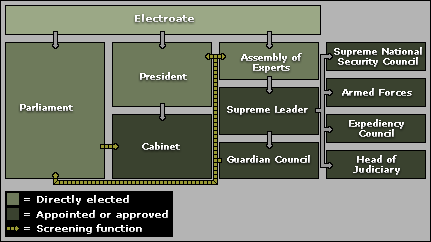
Iran is one of the most misunderstood places in the world for most Westerners. Beyond the obvious misconceptions about language, culture and ethnicity, there is also a mistaken desire to frame their entire existence within a Western paradigm. As many have pointed out, this is a problem (I would suggest reading Michael Axworthy on this). One of the significant ways in which Westerners fail to understand Iran, and in particular the Islamic Republic, is the governmental structure. The United States has a fairly simple system that many are familiar with. It has clearly delineated Executive, Legislative and Judicial branches, where each one of these three acts in a way to compliment and also to prevent the others from becoming too powerful. Iran as well has these three branches but they function in a very different way. 


Available at: http://www.iranchamber.com/government/articles/images/power_chart.gif

As the preceding chart from IranChamber.com shows, Iran's government is a convoluted and contradictory organizational mess. Not only is it the only state in the world where the head of government (President Rouhani in this case) does not control the armed forces (this includes the IRGC which is loyal to the revolution, and effectively the Supreme Leader), but also the Judicial is subject to the whims of the indirectly 'elected' Supreme Leader. The fact that certain 'elected' bodies (the President for example) have to be 'approved' by unelected groups, certainly doesn't help make the system any more straight-forward to outsiders.

While the former president Mahmoud Ahmadi-Nezhad was in power, many on the right in Israel and America would take his words (whether they were translated well or not) at face-value. They made a sport of raving about how this fanatical and powerful leader was a menace to the world and that he must be stopped etc. Those who spoke to me during this time are probably familiar with the way in which I was sharply dismissive of this idea. President Rouhani does not have the same legal authority as the Supreme Leader, or as much as fear-mongers incorrectly claimed Ahmadi-Nezhad had. However, dismissing him as powerless is just as foolish. It remains to be seen if genuine negotiations can happen on his watch. 

Given the amount of possible disinformation and denials coming from the Iranian side, it is unclear if the hardline backbone of the Iranian government will support any sort of concession on their part. They have created a culture of resistance against the West and its allies (against the Americans, the Iraqis, the Israelis, the Shah and leftist movements such as the Communists and the MEK), and while still on this track, it may be increasingly difficult for them to disengage themselves. This same singularity of thought is also true of the conservative American Congress, and much of the Israeli political establishment. The nervous one-track hive-mind is certainly not helped by it's inability to understand the Iranian government's decision making process and power structure. Speculation can, on occasion, be beneficial, but uneducated speculation based upon a simplified understanding of a very complicated Iranian governmental apparatus helps no one.