Earlier this week the US government publicly went after the IRGC. President Trump's Nowruz statement on Monday was mainly about the evils of the IRGC rather than the holiday itself. On Friday Deputy AG Rod Rosenstein announced indictments for a number of Iranians with the IRGC for hacking.
A third incident, the naming of John Bolton as the new national security adviser to President Trump can also be seen as an anti-IRGC move, given Bolton's belligerence towards the regime and his affinity for the Marxist cult the MeK.
Whether this is coincidental or not is hard to discern, given the chaotic and disjointed nature of the administration and so it is the hacking announcement that interests me most.
A few years back I'd noticed a series of pro-Iranian bots tweeting about the Iranian Supreme Leader Ayatollah Khamenei's "Letter to the Youth in Europe and North America". I wrote about this in detail noting how the bots and message evolved. It was not particularly sophisticated, did not gain much traction, but polluted trending and other hashtags on various social media. Another followup campaign titled "Powerful_Iran" was covered by the BBC.
The hacks and bots seem connected, and are clearly linked to the regime in some manner, but the details are unclear. The distinction between the more skilled hackers and the Twitter bots makes me curious about the Iranian cyber programs, how they are set up, who runs them, and if there are multiple organizations or factions running them. I would be surprised if the recently indicted hackers are directly responsible for the older bot networks, but I'd also not rule it out.
Showing posts with label Revolutionary Guards. Show all posts
Showing posts with label Revolutionary Guards. Show all posts
Saturday, March 24, 2018

Sunday, January 25, 2015
Spinning the Syria Strike
This week the Israeli military allegedly struck a convoy in Southern Syria, killing Jihad Mughniyeh, the son of the infamous Imad Mughnieyh, as well as an Iranian IRGC general, several other Hezbollah fighters, and several other Iranian soldiers. This event has been a hot topic in the press, though the information released by the Israelis and the Hezbollah/Syria/Iran/Lebanon axis has proven contradictory, incoherent and nonsensical.
Initial reports indicated that helicopters had carried out the attack, and this claim has been repeated by all sides; Lebanese, Israeli and even Iranian. It would be strange for the Israelis to risk helicopters and the pilots/gunners/whoever else when they possess a large number of drones, not to mention their advanced fighter jets, and artillery capabilities. A drone strike makes a lot more sense, especially when the target was a group of individuals and it appears as though there were no Israelis on the ground inside Syria (the other possible reason why helicopters could have been used).
The Syrian media claimed that the strike was located within the Quneitra Governorate. This area is mostly located inside the Israeli-controlled Golan Heights and bordered by the Rif Dimashq Governorate (Damascus countryside) on the other side, so the remaining areas where the strike could have occurred are extremely limited. Additionally, a portion of the governorate controlled by Syria is the UNDOF DMZ.
The UNDOF stated that they had observed Israeli drones flying over their base at position 30 (Jabata al Khashab) which is slightly north of the mostly abandoned town of Quneitra, and is located closer to the Mount Hermon mountain range.
The UNDOF also claimed to observe smoke rising slightly after the drones flew past. Given the location of this observation post and the terrain in the area, this once again limits the possiblities. Footage from al-Manar, while inconclusive, seems to hint that the strike happened very close to the Hermon mountain range.
As of yet, the precise location of the strike has yet to be determined, but it appears as though the strike would have occurred on the Syrian side of the DMZ, leaving a tiny sliver of terrain where the strike would have had to happened if it truly was inside Quneitra Governorate.
This leads to the next question, which is why the Israelis chose to attack this particular convoy. Initially it was claimed that the reason for the strike was that the targeted individuals had been planning an attack on Northern Israel. Later however, an Israeli official leaked that they did not intend to kill the Iranian general, and that 'it believed it was attacking only low-level guerillas'. So why would they attack this particular group, and why would they bother with 'low-level guerillas'? An article in the Jerusalem Post stated that this attack was intended to 'thwart an attack on Israel', but this seems disingenuous.
Israel has struck Syria several times over the last few years, most times it was thought that the strikes were intended to prevent Hezbollah and/or Syria from crossing a 'red-line' (usually transferring advanced weapons to the terror group). There have been a few instances where the IDF has returned fire after facing fire from the Syrian side, but this is not something that happens every time munitions land in Israel. Dozens, if not hundreds of mortars have landed beyond the DMZ, inside the Israeli-controlled Golan, without an Israeli armed response. Mortars are of limited range, and to miss a target by miles is hardly 'accidental'. There have also been instances of "stray" gunfire hitting IDF troops, as well as purposeful attacks.
What made this convoy such an important target to attack? Recent Israeli actions in Syria have been limited and selective, despite the ongoing hostilities in and around Quneitra. Would they risk an attack on a convoy without knowing who was in it? I would imagine that they must have had some ideas who was there, and they'd determined that the targets were high-value. Otherwise, why would they attack a small convoy? Was the strike a response to the bombastic speech from Hassan Nasrallah three days prior?
A few weeks ago Hezbollah admitted that the head of their Unit 910 (tasked with 'external operations') was in fact an Israeli asset. He and his accomplices had given information to Israel on a variety of subjects, most notably, the identities of the Burgas Bombing suspects. Given the timing of this, I wonder if the Israelis felt pressure to act on whatever remaining intel they had from the burned asset. The actions by the Israelis seem rash, was there a limited amount of time to act on the information? Why else would they risk aggravating the Iranians and Hezbollah so soon after the last summer's war in Gaza?
Yesterday a Lebanese paper claimed that according to Hezbollah, the strike took place because the Iranian general had not turned off his cell phone, which allowed the Israelis to locate him. Does this statement mean anything or is Hezbollah trying to distract from a massive intelligence and logistical failure? Hezbollah implied that the normal procedure is for cell phones to be turned off, and because the phone was on, the Israelis were able to realize who it was.
Why is a cell phone able to identify the place as a target or was it this particular cell phone which was incriminating? Did the Iranian general have a standard mobile phone with an Iranian SIM card inside? How else could this information be of any use to Israeli intelligence? Do Syrians (military, civilians or rebels) normally travel with their cell phones turned off in this part of the country? If it was the actual phone, would this indicate that the Israelis have managed to infiltrate either the Syrian or Iranian or Lebanese mobile networks and identified the phones used by military officials?
This entire affair is chock full of misinformation, illogical claims and subterfuge. Other analysts like Yossi Melman and Dan Raviv have similarly questioned the Israeli claims. There are so many problems with the narrative from both sides, and the actions and reactions of the parties involved seem atypical. I expect a further set of leaks in the near future.
Initial reports indicated that helicopters had carried out the attack, and this claim has been repeated by all sides; Lebanese, Israeli and even Iranian. It would be strange for the Israelis to risk helicopters and the pilots/gunners/whoever else when they possess a large number of drones, not to mention their advanced fighter jets, and artillery capabilities. A drone strike makes a lot more sense, especially when the target was a group of individuals and it appears as though there were no Israelis on the ground inside Syria (the other possible reason why helicopters could have been used).
The Syrian media claimed that the strike was located within the Quneitra Governorate. This area is mostly located inside the Israeli-controlled Golan Heights and bordered by the Rif Dimashq Governorate (Damascus countryside) on the other side, so the remaining areas where the strike could have occurred are extremely limited. Additionally, a portion of the governorate controlled by Syria is the UNDOF DMZ.
 |
| Quneitra Governorate (Wikipedia) |
The UNDOF stated that they had observed Israeli drones flying over their base at position 30 (Jabata al Khashab) which is slightly north of the mostly abandoned town of Quneitra, and is located closer to the Mount Hermon mountain range.
 |
| UNDOF Deployment (Wikipedia) |
 |
| Jabata al Khashab is the town just to the left (West) of the quarries. Hermon is in the background |
As of yet, the precise location of the strike has yet to be determined, but it appears as though the strike would have occurred on the Syrian side of the DMZ, leaving a tiny sliver of terrain where the strike would have had to happened if it truly was inside Quneitra Governorate.
This leads to the next question, which is why the Israelis chose to attack this particular convoy. Initially it was claimed that the reason for the strike was that the targeted individuals had been planning an attack on Northern Israel. Later however, an Israeli official leaked that they did not intend to kill the Iranian general, and that 'it believed it was attacking only low-level guerillas'. So why would they attack this particular group, and why would they bother with 'low-level guerillas'? An article in the Jerusalem Post stated that this attack was intended to 'thwart an attack on Israel', but this seems disingenuous.
Israel has struck Syria several times over the last few years, most times it was thought that the strikes were intended to prevent Hezbollah and/or Syria from crossing a 'red-line' (usually transferring advanced weapons to the terror group). There have been a few instances where the IDF has returned fire after facing fire from the Syrian side, but this is not something that happens every time munitions land in Israel. Dozens, if not hundreds of mortars have landed beyond the DMZ, inside the Israeli-controlled Golan, without an Israeli armed response. Mortars are of limited range, and to miss a target by miles is hardly 'accidental'. There have also been instances of "stray" gunfire hitting IDF troops, as well as purposeful attacks.
What made this convoy such an important target to attack? Recent Israeli actions in Syria have been limited and selective, despite the ongoing hostilities in and around Quneitra. Would they risk an attack on a convoy without knowing who was in it? I would imagine that they must have had some ideas who was there, and they'd determined that the targets were high-value. Otherwise, why would they attack a small convoy? Was the strike a response to the bombastic speech from Hassan Nasrallah three days prior?
A few weeks ago Hezbollah admitted that the head of their Unit 910 (tasked with 'external operations') was in fact an Israeli asset. He and his accomplices had given information to Israel on a variety of subjects, most notably, the identities of the Burgas Bombing suspects. Given the timing of this, I wonder if the Israelis felt pressure to act on whatever remaining intel they had from the burned asset. The actions by the Israelis seem rash, was there a limited amount of time to act on the information? Why else would they risk aggravating the Iranians and Hezbollah so soon after the last summer's war in Gaza?
Yesterday a Lebanese paper claimed that according to Hezbollah, the strike took place because the Iranian general had not turned off his cell phone, which allowed the Israelis to locate him. Does this statement mean anything or is Hezbollah trying to distract from a massive intelligence and logistical failure? Hezbollah implied that the normal procedure is for cell phones to be turned off, and because the phone was on, the Israelis were able to realize who it was.
Why is a cell phone able to identify the place as a target or was it this particular cell phone which was incriminating? Did the Iranian general have a standard mobile phone with an Iranian SIM card inside? How else could this information be of any use to Israeli intelligence? Do Syrians (military, civilians or rebels) normally travel with their cell phones turned off in this part of the country? If it was the actual phone, would this indicate that the Israelis have managed to infiltrate either the Syrian or Iranian or Lebanese mobile networks and identified the phones used by military officials?
This entire affair is chock full of misinformation, illogical claims and subterfuge. Other analysts like Yossi Melman and Dan Raviv have similarly questioned the Israeli claims. There are so many problems with the narrative from both sides, and the actions and reactions of the parties involved seem atypical. I expect a further set of leaks in the near future.
Saturday, September 21, 2013
The Complexities of the Iranian Government and Nuclear Negotiations
With the impending annual UN General Assembly slated for this coming week, and the anticipation of important political developments, a common story in the news is the potentiality of a diplomatic breakthrough regarding Iran's nuclear program. Much has been made of Iran's new President Hassan Rouhani's increasingly friendly tone towards America and the West and his stated desire for dialogue. From what many have written, it seems an almost foregone conclusion that for the first time in what seems like an eternity, the heads of government for the United States and Iran may meet face to face. For now, this is nothing but blind speculation; no matter how friendly the words of both sides are, no real 'progress' has been made as of yet.
Iran is one of the most misunderstood places in the world for most Westerners. Beyond the obvious misconceptions about language, culture and ethnicity, there is also a mistaken desire to frame their entire existence within a Western paradigm. As many have pointed out, this is a problem (I would suggest reading Michael Axworthy on this). One of the significant ways in which Westerners fail to understand Iran, and in particular the Islamic Republic, is the governmental structure. The United States has a fairly simple system that many are familiar with. It has clearly delineated Executive, Legislative and Judicial branches, where each one of these three acts in a way to compliment and also to prevent the others from becoming too powerful. Iran as well has these three branches but they function in a very different way.
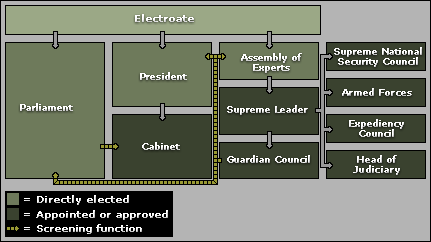 |
| Available at: http://www.iranchamber.com/government/articles/images/power_chart.gif |
As the preceding chart from IranChamber.com shows, Iran's government is a convoluted and contradictory organizational mess. Not only is it the only state in the world where the head of government (President Rouhani in this case) does not control the armed forces (this includes the IRGC which is loyal to the revolution, and effectively the Supreme Leader), but also the Judicial is subject to the whims of the indirectly 'elected' Supreme Leader. The fact that certain 'elected' bodies (the President for example) have to be 'approved' by unelected groups, certainly doesn't help make the system any more straight-forward to outsiders.
While the former president Mahmoud Ahmadi-Nezhad was in power, many on the right in Israel and America would take his words (whether they were translated well or not) at face-value. They made a sport of raving about how this fanatical and powerful leader was a menace to the world and that he must be stopped etc. Those who spoke to me during this time are probably familiar with the way in which I was sharply dismissive of this idea. President Rouhani does not have the same legal authority as the Supreme Leader, or as much as fear-mongers incorrectly claimed Ahmadi-Nezhad had. However, dismissing him as powerless is just as foolish. It remains to be seen if genuine negotiations can happen on his watch.
Given the amount of possible disinformation and denials coming from the Iranian side, it is unclear if the hardline backbone of the Iranian government will support any sort of concession on their part. They have created a culture of resistance against the West and its allies (against the Americans, the Iraqis, the Israelis, the Shah and leftist movements such as the Communists and the MEK), and while still on this track, it may be increasingly difficult for them to disengage themselves. This same singularity of thought is also true of the conservative American Congress, and much of the Israeli political establishment. The nervous one-track hive-mind is certainly not helped by it's inability to understand the Iranian government's decision making process and power structure. Speculation can, on occasion, be beneficial, but uneducated speculation based upon a simplified understanding of a very complicated Iranian governmental apparatus helps no one.
Tuesday, June 4, 2013
Why sanction the Iranian Auto Industry?
Today the United States announced a few more sanctions on Iran intended to "further tighten U.S. sanctions on Iran and isolate the Iranian government for its continued failure to meet its international obligations."
The targets of the sanctions include the Iranian Rial, the automotive sector, and any "material support to the government of Iran".
At first I thought it strange that the auto industry would be targeted, but then I remembered an article published by Forbes from last month about how there should be sanctions imposed upon Iran's auto manufacturing industry.
The author's main argument for sanctions is that Iranian owned car companies enable access to 'dual-use technology for Iran's nuclear designs'. The evidence that he uses for this is that there are gas cylinders produced for hybrid cars by an Iranian owned factory in Germany. These "…included carbon fiber and hardened steel – key components of Iran’s second generation nuclear enrichment centrifuges. It also had sophisticated machinery in its inventory, which can be used both to make cylinders and manufacture centrifuges."
The problem here is that MCS, the operator of the factory, is not an Iranian car company (though as the Iranians have clearly demonstrated, their clever usage of shell corporations make determining the true owner of any company quite difficult) although the author claims that auto companies are the shadow owners of MCS. The original Washington Post article (referenced in the Forbes piece) does not describe the factory as one which creates auto-parts, but rather "high-pressure gas tanks". In fact, the word "auto" or any of its derivatives is found only once in the article where it states: "One of the dual-use materials at MCS was carbon fiber, which is often used in the aerospace and automotive fields".
So why does the author insist on sanctioning the automobile industry? The Washington Post article states that Iran has been "scouring the world for carbon fiber". High quality carbon fiber is evidently a key part of advanced stage centrifuges and so, there apparently are already sanctions on Iranian purchases of high quality carbon fiber. According to ISIS (Institute for Science and International Security), as a result of this, Iran has begun to produce its own carbon fiber (albeit of low quality).
I may be wrong, but from what I understand of the evidence, the target of the sanctions is not the actual industry itself, but those who run it (IRGC), who are also known to have attempted to proliferate materials important for nuclear activities. Therefore the argument should not be that the industry, the cars or the materials themselves that are a problem, but rather that those who lead the industry are the problem and the reason for such sanctions.
While I think that the argument on Forbes is problematic, it may not even be connected to the new Obama sanctions. The sanctions were created by executive order rather than by Congress, so instead of having to try to force an increasingly pig-headed and obstinate House of Representatives to agree with him if he wants to remove the sanctions in the future, Obama may have created a situation where he himself is able to remove them as a bargaining chip with the Iranians.
So why does the author insist on sanctioning the automobile industry? The Washington Post article states that Iran has been "scouring the world for carbon fiber". High quality carbon fiber is evidently a key part of advanced stage centrifuges and so, there apparently are already sanctions on Iranian purchases of high quality carbon fiber. According to ISIS (Institute for Science and International Security), as a result of this, Iran has begun to produce its own carbon fiber (albeit of low quality).
I may be wrong, but from what I understand of the evidence, the target of the sanctions is not the actual industry itself, but those who run it (IRGC), who are also known to have attempted to proliferate materials important for nuclear activities. Therefore the argument should not be that the industry, the cars or the materials themselves that are a problem, but rather that those who lead the industry are the problem and the reason for such sanctions.
While I think that the argument on Forbes is problematic, it may not even be connected to the new Obama sanctions. The sanctions were created by executive order rather than by Congress, so instead of having to try to force an increasingly pig-headed and obstinate House of Representatives to agree with him if he wants to remove the sanctions in the future, Obama may have created a situation where he himself is able to remove them as a bargaining chip with the Iranians.
Subscribe to:
Posts (Atom)