As expected, a hardliner and a conservative were selected to head both Iranian governmental bodies "elected" a few months back.
The leading vote getters in both elections ended up not being selected to head either the Assembly of Experts (Rafsanjani) or the Majles (Aref). The individual who was selected to lead the Assembly of Experts for the next 2 years (of the 8 year term) was in fact the last place finisher in Tehran.
The "loss" by the "moderates" in both of these decisions was not surprising for a many reasons. The elections were rigged from the beginning, with thousands of candidates disqualified, in particular those with views less in line with the regime. Additionally, as I and others have noted, the "moderate" list was in fact not as moderate as the pro-Iran lobby, and portions of the left in the United States trying to sell the Iran Deal have claimed.
With significant overlap between the "Principalists" and this "moderate" "List of Hope", it was only natural for the more hardline members of the "moderate" list to vote for the hardliners.
This complexity has gone way over many pundits heads here in the West. As the usual suspects point to the hardline victory as proof that there are no moderates (and of course no liberals) in Iran, the reality remains more complex. Again, they miss the greater point, that the elections had to be fixed to undermine genuine attempts from the population to move towards the West and the rest of the international community. The scale of this ideological schism may not be large, and many of the people pushing for change may approve of Iran's unending support for terror groups throughout the region, but the attempts to move away from the anti-Western ideologues must not be ignored.
Each time there is a political event where the hardliners do not win outright, the system, the regime, the deep state is put under pressure. This pressure forces a decision out of the regime; to allow an opening, or to crack down, and repress the population. Either way resources are expended, and the system becomes more unstable. However limited it may be, this instability at home undermines Iran's ability to conduct operations abroad; more attention must be given to preventing civil unrest.
Iran has a choice: to fully embrace autocracy like China, or to reform. They had previously mentioned attempts to create a "halal" internet, so that only sites that were deemed appropriate would be available in Iran. This failed. The real question is how far apart the Iranian public and the regime will drift, and how, when and if this will happen.
It is very difficult to measure the ideological bent of the population. The previous election for the Majles (2012) was boycott by the Reformist bloc so they only received a few seats. The election prior (2008) the "Reformists" had under 20% of the vote. Principalists have controlled the Majles since the 2004 election when they forced the heavily disqualified Reformist majority to the sidelines.
That there are so many members who are not Principalists is encouraging, but doesn't mean too much in the grand scheme of things. The greater system of control by the regime and deep state remains intact, and the Majles will continue to be more or less powerless as it has been for decades. The wins by hardline candidates are important in showing that anti-Westernism is still a fundamental value of the state, but the turnout for those with a different point of view should be encouraging to the West. The situation continues to be multi-faceted and fluid.
Showing posts with label Rouhani. Show all posts
Showing posts with label Rouhani. Show all posts
Sunday, May 29, 2016

Thursday, February 4, 2016
Leading up to the Iranian Elections
Iranian domestic affairs are notoriously difficult to predict. This is especially true at such an important moment in the Islamic Republic when the stakes are as high as they have ever been. Rumors, unreliable polling and opaqueness in the approval and electoral process have made this election (like most previous ones), very interesting.
I have a few expectations and predictions to share, based upon what has happened so far. Here is how I have come to these conclusions:
As I have made quite clear, I supported the Iran nuclear negotiations/JPOA/JCPOA because of the potential to influence this coming set of elections, as well as the Iranian youth in general. Empowered reformists and pragmatists/moderates, leads to more pressure for Iran domestically. This (at least temporarily) reduces its ability to be disruptive regionally and internationally (especially in Syria and the Gulf). This election is vital for hardliners as they are on the defensive from the implications of a negotiated settlement with the West. Any sort of agreement with the West goes against their core ideology, and the violation of nearly all of Khamenei's 'red lines' is indisputable.
Western hardliners have argued that the backlash against moderates and reformists by Khamenei and Iranian hardliners is from a position of strength, but this couldn't be further from the truth. This election is a chance for hardliners to take back the momentum, and the actions of the Guardian Council in rejecting various candidates, the refusal of Khamenei to overrule them, and the assorted hostile acts by the IRGC-Navy in the Gulf are all part of a larger strategy to distance Iran from the West.
I was surprised by the numbers of reformists excluded from elections. I knew there would be a massive number of rejections, but I did not anticipate that the number would be so high. This more than anything shows the insecurity of the establishment. Rejections of moderates in addition to the previously mentioned reformists reinforces this.
The exclusion of Hassan Khomeini, a cleric and grandson of the Islamic Republic's first Supreme Leader, is particularly troubling for democracy and reform in Iran, but I would not count him, or the reform movement out yet.
One reason for these massive disqualifications (which is coupled with an unprecedented number of applications for these electoral races) is the complexity of rigging municipal elections on a nation-wide scale. The 2009 stolen election was much easier to manipulate because it was an election for only one position with only 2 serious candidates (4 total). The Majles has nearly 300 seats and the Assembly of Experts has 88. Because so many candidates were excluded, some of these seats have no competition (for example the provinces of Ardabil, Azerbaijan West, Bushehr, Hormuzgan, Khorasan North and Semnan), and hardliners will automatically win the seat(s) in these locations.
While hardliners have the natural advantage as they control the bodies concerned with oversight, I would not count out the Iranian people. I expect large numbers to turn out and vote, especially for reformists and moderates. Sanctions have just been removed, and there is optimism. The challenge here is that Rouhani's efforts to repair the extensive damage of the past administration have not been entirely successful, and Iran is still struggling with inflation and budgetary issues.
The actions from the Iranian government before the elections are important. Will they cave and allow more reformists and moderates to run? There were rumors of this happening, but as of yet, it has not been confirmed. The more pragmatists are allowed to run, the further the election can swing in their favor.
Rouhani seems to have aspirations to be the next Supreme Leader, and he knows that he will never gain this position if the hardliners handily win this election.
If there are additional plans to fix the elections I would suspect the Assembly of Experts to be around 75-80% hardliners, perhaps even more, and at least 60% of the Parliament (Majles) to be this way. I think the establishment is aware that if they go much higher, there are serious risks for another mass protest like 2009.
The unknown for me is how badly the election has to be stolen for the Iranian public to protest en masse.
As long as the reformist/moderate/pragmatist groups vote and expect the result to reflect their voting preferences, I would be cautiously optimistic for either a result or resulting protests. In either case, the current attitude of the Iranian state is unsustainable, and unacceptable and I see this election as key for moving towards making necessary changes.
UPDATE #1 (02/05/16): It appears as though an undetermined number of Majles candidates will now be allowed to run as the Guardian Council has reversed their decision in approximately 20-25% of cases:
I have a few expectations and predictions to share, based upon what has happened so far. Here is how I have come to these conclusions:
As I have made quite clear, I supported the Iran nuclear negotiations/JPOA/JCPOA because of the potential to influence this coming set of elections, as well as the Iranian youth in general. Empowered reformists and pragmatists/moderates, leads to more pressure for Iran domestically. This (at least temporarily) reduces its ability to be disruptive regionally and internationally (especially in Syria and the Gulf). This election is vital for hardliners as they are on the defensive from the implications of a negotiated settlement with the West. Any sort of agreement with the West goes against their core ideology, and the violation of nearly all of Khamenei's 'red lines' is indisputable.
Western hardliners have argued that the backlash against moderates and reformists by Khamenei and Iranian hardliners is from a position of strength, but this couldn't be further from the truth. This election is a chance for hardliners to take back the momentum, and the actions of the Guardian Council in rejecting various candidates, the refusal of Khamenei to overrule them, and the assorted hostile acts by the IRGC-Navy in the Gulf are all part of a larger strategy to distance Iran from the West.
I was surprised by the numbers of reformists excluded from elections. I knew there would be a massive number of rejections, but I did not anticipate that the number would be so high. This more than anything shows the insecurity of the establishment. Rejections of moderates in addition to the previously mentioned reformists reinforces this.
The exclusion of Hassan Khomeini, a cleric and grandson of the Islamic Republic's first Supreme Leader, is particularly troubling for democracy and reform in Iran, but I would not count him, or the reform movement out yet.
One reason for these massive disqualifications (which is coupled with an unprecedented number of applications for these electoral races) is the complexity of rigging municipal elections on a nation-wide scale. The 2009 stolen election was much easier to manipulate because it was an election for only one position with only 2 serious candidates (4 total). The Majles has nearly 300 seats and the Assembly of Experts has 88. Because so many candidates were excluded, some of these seats have no competition (for example the provinces of Ardabil, Azerbaijan West, Bushehr, Hormuzgan, Khorasan North and Semnan), and hardliners will automatically win the seat(s) in these locations.
While hardliners have the natural advantage as they control the bodies concerned with oversight, I would not count out the Iranian people. I expect large numbers to turn out and vote, especially for reformists and moderates. Sanctions have just been removed, and there is optimism. The challenge here is that Rouhani's efforts to repair the extensive damage of the past administration have not been entirely successful, and Iran is still struggling with inflation and budgetary issues.
The actions from the Iranian government before the elections are important. Will they cave and allow more reformists and moderates to run? There were rumors of this happening, but as of yet, it has not been confirmed. The more pragmatists are allowed to run, the further the election can swing in their favor.
Rouhani seems to have aspirations to be the next Supreme Leader, and he knows that he will never gain this position if the hardliners handily win this election.
If there are additional plans to fix the elections I would suspect the Assembly of Experts to be around 75-80% hardliners, perhaps even more, and at least 60% of the Parliament (Majles) to be this way. I think the establishment is aware that if they go much higher, there are serious risks for another mass protest like 2009.
The unknown for me is how badly the election has to be stolen for the Iranian public to protest en masse.
As long as the reformist/moderate/pragmatist groups vote and expect the result to reflect their voting preferences, I would be cautiously optimistic for either a result or resulting protests. In either case, the current attitude of the Iranian state is unsustainable, and unacceptable and I see this election as key for moving towards making necessary changes.
UPDATE #1 (02/05/16): It appears as though an undetermined number of Majles candidates will now be allowed to run as the Guardian Council has reversed their decision in approximately 20-25% of cases:
Again because of the absurd opaqueness of the system it is unclear where this decision was made and why it was made. It is believed that various high-level figures were upset with the decision to bar so many candidates. At this time however, the identities and political affiliations of the candidates are unknown, so it is just as likely that hardliners, or even moderates were approved ahead of reformists.Iran Guardian Council Spox Nejatollah Ebrahimian: 20-25% of previously disqualified parliamentary election candidates now qualified to run.— Hanif Zarrabi-K. (@hanifzk) February 5, 2016
Saturday, July 18, 2015
Khamenei's Eid al Fitr Speech
Ayatollah Khamenei's Eid al Fitr speech has received quite a bit of attention in the international press (here, here and here) because it is the first time Khamenei has spoken directly about the recent nuclear deal between the P5+1 and Iran. The speech was nothing out of the ordinary, as Khamenei repeated the same tropes he has repeated for decades. This was immediately jumped upon as proof that Iran, and Khamenei in particular, negotiated in bad faith, that Iran will never change et cetera et cetera. It is much more complicated than this.
Once again, the people saying this do little more than display their intense narcissism and lack of political acumen. These speeches are nearly always about domestic issues more than international ones (even when talking about international affairs), and at the same time they must be taken in context. Khamenei is a reactionary, a pragmatic one at that, but his political bent remains one way and will remain this way. This doesn't mean that Iran isn't going to change; Khamenei himself is threatened by this change and must act to mitigate this. The Eid al Fitr speech is a way for him to do this.
Rouhani, like Khatami a decade ago and Montazeri 30 years ago, is a challenge to the Ayatollah's politics. This coming year is a most important one, as the Majles and the Assembly of Experts both are slated to hold one of the most significant elections in the history of the Islamic Republic. Khamenei wishes to ensure his legacy continues once he dies, which means stifling domestic dissent, especially reformists, and electing a conservative AoE, so that if Khamenei were to die during this 8 year term, an 'acceptable' principalist candidate (or candidates) are selected to succeed him.
Iran needed the sanctions relief, and this gives room to Rouhani and his administration to improve the economy (one of the few important things the Iranian president has some degree of control over), but at the same time Khamenei wants to makes sure that the hardliners are not sidelined. I expect crackdowns, especially in the media (probably a closure or a lawsuit directed at reformist newspapers or journalists), as Khamenei tries to give a boost to the Islamic right.
Once again, the people saying this do little more than display their intense narcissism and lack of political acumen. These speeches are nearly always about domestic issues more than international ones (even when talking about international affairs), and at the same time they must be taken in context. Khamenei is a reactionary, a pragmatic one at that, but his political bent remains one way and will remain this way. This doesn't mean that Iran isn't going to change; Khamenei himself is threatened by this change and must act to mitigate this. The Eid al Fitr speech is a way for him to do this.
Rouhani, like Khatami a decade ago and Montazeri 30 years ago, is a challenge to the Ayatollah's politics. This coming year is a most important one, as the Majles and the Assembly of Experts both are slated to hold one of the most significant elections in the history of the Islamic Republic. Khamenei wishes to ensure his legacy continues once he dies, which means stifling domestic dissent, especially reformists, and electing a conservative AoE, so that if Khamenei were to die during this 8 year term, an 'acceptable' principalist candidate (or candidates) are selected to succeed him.
Iran needed the sanctions relief, and this gives room to Rouhani and his administration to improve the economy (one of the few important things the Iranian president has some degree of control over), but at the same time Khamenei wants to makes sure that the hardliners are not sidelined. I expect crackdowns, especially in the media (probably a closure or a lawsuit directed at reformist newspapers or journalists), as Khamenei tries to give a boost to the Islamic right.
Tuesday, February 24, 2015
More Iranian Nuclear Sites?
The MeK announced today that they have more evidence of Iranian nuclear intransigence. According to news reports, a site in northeastern suburban Tehran houses a secret underground facility where uranium enrichment has occurred for nearly a decade.
The MeK press release is available on DropBox, and details their history in revealing information about Iran's nuclear facilities. Strangely enough, in this history they neglect to include another 'revelation' made a mere 16 months ago. At this time it was claimed that an underground facility around 70 km northeast of Tehran under a mountain near the town of Damavand housed more illegal Iranian nuclear activities, though the details were unclear.
I noted a few problems with the claims, notably the notorious unreliability of the MeK, as well as the very suspicious timing. Less than a month prior, the most left-leaning candidate, Hassan Rouhani, was elected president of Iran in a shockingly uncompetitive landslide. This 'revelation' was no doubt intended to ruin any possible good will or potential rapprochement between Iran and the West.
Today as well, the timing is suspicious. Rumblings from both Iranian and international press seem to indicate an optimism that a nuclear deal is imminent. The MeK is trying to remain relevant, while also scuttle any possibility for a nuclear deal while alleging that Iran's actions are so terrible that a nuclear deal would be a terrible thing for the West. They have been right in the past, but this is not always the case, and the example of July 2013 shows, they are not reliable.
UPDATE:
I should have trusted my gut and checked the image used for the safe door. Others have noted that it is in fact copied from the website an Iranian company that sells safes. The MeK's website put forward a bizarrely fitting rambling refutation which makes them look like liars, and incompetent ones at that.
While the color appears slightly different in the background it is clear that the image is the exact same as the one on the company sales website. The major difference is that there are horizontal white lines across.
Here is a comparison of the images


The MeK press release is available on DropBox, and details their history in revealing information about Iran's nuclear facilities. Strangely enough, in this history they neglect to include another 'revelation' made a mere 16 months ago. At this time it was claimed that an underground facility around 70 km northeast of Tehran under a mountain near the town of Damavand housed more illegal Iranian nuclear activities, though the details were unclear.
I noted a few problems with the claims, notably the notorious unreliability of the MeK, as well as the very suspicious timing. Less than a month prior, the most left-leaning candidate, Hassan Rouhani, was elected president of Iran in a shockingly uncompetitive landslide. This 'revelation' was no doubt intended to ruin any possible good will or potential rapprochement between Iran and the West.
Today as well, the timing is suspicious. Rumblings from both Iranian and international press seem to indicate an optimism that a nuclear deal is imminent. The MeK is trying to remain relevant, while also scuttle any possibility for a nuclear deal while alleging that Iran's actions are so terrible that a nuclear deal would be a terrible thing for the West. They have been right in the past, but this is not always the case, and the example of July 2013 shows, they are not reliable.
UPDATE:
I should have trusted my gut and checked the image used for the safe door. Others have noted that it is in fact copied from the website an Iranian company that sells safes. The MeK's website put forward a bizarrely fitting rambling refutation which makes them look like liars, and incompetent ones at that.
While the color appears slightly different in the background it is clear that the image is the exact same as the one on the company sales website. The major difference is that there are horizontal white lines across.
Here is a comparison of the images
It is clear that the coloration and saturation are nearly identical. The image used is clearly the same.
The MeK claim that this image is taken from one of their sources, yet they have no explanation for why the EXACT same photo, with the same detailed bricks, and spots are used. For this to have happened naturally the picture would have to have been taken from the exact same spot and the camera would have had to have been held at the exact same height.
The complexities of creating this exact same situation make the MeK claims laughable. Furthermore, the image posted on the Iranian companies site is dated to February 12 of this year so it would have to be a hell of a coincidence for them to have posted photo that is now suddenly relevant.
As I'd mentioned before the MeK is of questionable reliability and this merely serves to reinforce my previous statements.
Monday, July 21, 2014
The Iranian government doesn't care about Syrians
Earlier today the President of Iran, Hassan Rouhani tweeted the following:
While what is happening in Gaza and Israel today is clearly a tragedy, it is far from one of the 'biggest tragedies of our time'. For example: MILLIONS in Syria are now displaced, and hundreds of thousands are dead, and at the same time Iranian support for Assad and Hezbollah continues unabated. The hypocrisy is self-evident so it is not worth writing much about. I hope that Iranians realize what their government is doing in Syria and are just as upset about that, as they may be with the situation in Gaza.
For an excellent review of Iranian-Syrian relations I recommend this IranPrimer article: Iran and Syria
(This is no way is meant to excuse misdeeds or hypocrisies of other governments. I spend most of my time focusing on Iran rather than other places)
What's happening in Gaza is one of the biggest tragedies of our time! Stop the aggression and stop the killing! #GazaUnderAttack
— Hassan Rouhani (@HassanRouhani) July 21, 2014
While what is happening in Gaza and Israel today is clearly a tragedy, it is far from one of the 'biggest tragedies of our time'. For example: MILLIONS in Syria are now displaced, and hundreds of thousands are dead, and at the same time Iranian support for Assad and Hezbollah continues unabated. The hypocrisy is self-evident so it is not worth writing much about. I hope that Iranians realize what their government is doing in Syria and are just as upset about that, as they may be with the situation in Gaza.
For an excellent review of Iranian-Syrian relations I recommend this IranPrimer article: Iran and Syria
(This is no way is meant to excuse misdeeds or hypocrisies of other governments. I spend most of my time focusing on Iran rather than other places)
Wednesday, January 1, 2014
Is Corruption in Iran finally being addressed?
The arrest of Babak Zanjani is a significant event in Iran. Corruption in Iran is understood to be rampant; figures as significant as former Presidents Ahmadi Nezhad and Hashemi Rafsanjani have been accused of abusing their authority for financial and/or nepotistic reasons. In-fighting and factionalization in Iran is also a problem, with the various groups at odds with each other. If someone like Zanjani who allegedly has been instrumental in helping the Islamic Republic avoid US/EU sanctions has now fallen out of favor, one must wonder why this would happen now before the nuclear agreement between the P5+1 and Iran has not yet been applied?
The sanctions relief scheduled to implemented under the new nuclear agreement has not started yet. One would think that someone who has supposedly been so important to the Islamic Republic's efforts in limiting the bite of international sanctions would not be thrown in jail, especially not at this stage. Was the alleged corruption so significant that Iran's government and economy would be better off without such an important businessman? Is this a sign that there will be efforts aimed at reducing corruption in Iran, or is this a personal vendetta or domestic political squabbling? President Rouhani is close to former President Hashemi Rafsanjani, who also has been accused of corruption amongst other criminal acts. Will Rafsanjani also be investigated for corruption or will his ties to the President exempt him?
Babak Zanjani's arrest is interesting and it remains to be seen if this is the first step towards a genuine attempt to eliminate corruption or if this is just political witch hunt like what happened to Russian oil tycoon Mikhail Khodorkovsky. I hope that this will be a step towards stopping corruption, and that Setad, the case exposed by Reuters, as well as any other abusers of the system will also be subject to investigation.
Friday, December 20, 2013
Article for Enduring America
I wrote an article on the parallels of the 1950s Iranian Oil Crisis and the current Iranian nuclear negotiations. It can be accessed here:
http://eaworldview.com/2013/12/op-ed-can-us-iran-2013-overcome-legacy-us-iran-1953/
http://eaworldview.com/2013/12/op-ed-can-us-iran-2013-overcome-legacy-us-iran-1953/
Tuesday, November 5, 2013
One of the worst articles on Iran ever.
I often disagree with some aspect of the articles I read about Iran. Usually it is something minor, and occasionally it is an entire argument that I disagree with. These arguments are opinion based, and use facts to back up their opinions, so while my disagreement is there, it is often a matter of opinion. So when I today encountered a truly remarkably terrible article I felt compelled to comment on and refute it in its entirety.
Micah Halpern's HuffPo piece, 'Where is the Ayatollah' is one of those terrible articles clearly written by an amateur with little understanding of the past or present. Thankfully it was a short article so my face was not permanently contorted into a horrible grimace by the experience.
I will now take Halpern's claims and destroy them:
1) 'Rafsanjani is believed to be a reformer and as such, he could really create change'
No. Rafsanjani is not, was not, and will not be a reformer. He has long been what we call a 'pragmatist', someone who works within the system to create solutions that are not necessarily based on an ideology. Reformists connect him to the horrific crimes of his office (while president and in previous roles as well) towards the more liberal parts of the Iranian population. In the run up to the recent presidential elections where the most moderate candidate remaining at the end won (Rouhani), there was some doubt that the wave of reformist and moderate voices would embrace Rouhani because of his close ties to Rafsanjani.
Conclusion: Implying that Rafsanjani is a reformer is stupid, and speculating based on a miserably failed understanding of reality is even stupider. -2 points for Mr Halpern.
2) 'He is extremely well qualified to be the Supreme Leader, even more qualified than Khamenei in terms of his level of learning and academic standing'
The favored replacement for Ayatollah Khomeini in the 80s was a man named Hussein-Ali Montazeri. He was the highest ranking Shi'a mujtahid to support Khomeini's idea of Velayat-e Faqih (others who would have outranked him—albeit not by a lot—such as Morteza Mottahari, were assassinated during the revolutionary period). Montazeri became more liberal during the Iran-Iraq war, especially in regards to the civil rights violations he saw being perpetrated by the regime and publicly stated his opposition. Montazeri was a principled man but had very little political acumen. Montazeri was also responsible for 'exporting the revolution', a similar role to what the Qods Force plays today, although less militant by nature. The brother of Montazeri son-in-law, Mehdi Hashemi was in charge of this office and was executed for revealing RAFSANJANI's role in Iran-Contra (hint: it was major). Montazeri took this, amongst other actions against him very personally. Long story short, Montazeri was removed from his position as deputy Supreme Leader, leaving Khomeini's ideology in trouble. It previously had been stated that the Faqih must be the most educated (see Khomeini's Islamic Government for more on this), but because the 2nd most educated (not counting other Shi'a clerics in other countries which were and continue to be nearly universally opposed to the idea), the replacement, was in opposition to the regime, they had to make changes. Khomeini eventually changed the constitution so that the Faqih no longer needed to be the most educated, highest-ranking mujtahid which allowed Khamenei, who was a relatively low ranking Hojjat-o-Eslam prior to this, to take over. At the time there was speculation in the West that because there was not a viable replacement, that Iran may decide to have a council of Supreme Leaders (I read this article in a 25 year old magazine during my MA but I cannot find it online anywhere). Khamenei was the President of Iran at the time, but he was by no means the most senior cleric. There was also a Prime Minister at this point, a position with more power than the Presidency, which had been occupied by more moderate and liberal people such as Mehdi Bazargan (since exiled) and Mir-Hossein Mousavi (who has been under house arrest for years following his Green Movement protests), but this position was removed in a joint effort of Khamenei and Rafsanjani. The two of them then swapped when Rafsanjani pushed Khamenei as the candidate for Supreme Leader, and Rafsanjani took the presidency.
Conclusion: While religious qualifications have some connection to the office of the Supreme Leader, implying this is the sole criteria is foolish and uninformed. Halpern also does not mention the fact that Rafsanjani was removed from his position as the chairman of the Assembly of Experts in 2011, the legislative body tasked with overseeing the Supreme Leader. -2 points for Mr. Halpern.
3) 'The friendship never suffered over the fact that they have starkly contrasting visions of the way Islam should play out in the Islamic Republic.'
Probably not the case. I am unfamiliar with the details of the personal relationship between the two figures, as are most Westerners, but it is safe to say that today they are not the most friendly. The Rafsanjani family has been heavily persecuted since 2009 and Rafsanjani's decision to lend some support to the Green Movement (which has since increased). Rafsanjani's children have been arrested, beaten, jailed etc. as I wrote here on my blog . The idea that they would remain friends despite the state-sponsored abuse of the family is beyond ridiculous. Also see my conclusion for #2, where Rafsanjani was removed from his chairmanship. If this is not evidence of a break in friendship I do not know what is...Max Fisher wrote a blog on the 'tumultuous' relationship of the two.
Conclusion: They do have 'starkly contrasting visions of the way Islam should play out in the Islamic Republic', but saying the friendship never suffered is a bit of a leap. .5 points for Mr Halpern for almost not being wrong
4) 'After the reports of Syria gassing its own citizens Rafsanjani made the following statement: "A government that uses chemical bombs against it people, will face hard consequences, just like Saddam, who earned eternal shame in the bombing of Halabja and suffered such a horrible fate."'
Not only is this completely unrelated to the surrounding paragraphs, it is completely irrelevant. Iranians are rightfully very sensitive to the use of chemical weapons because of the extensive use by Iraq on Iranian soldiers and civilians during the Iran-Iraq War. At the time of this quote from Rafsanjani the prevailing claim among non-Western powers was that Syrian rebels had used the chemical weapons so this made complete sense.
Conclusion: Terrible organization and taking something out of context. -1 points for Mr. Halpern for not doing his homework.
5) When he announced that he was running for president in the 2013 election, a position he was elected to twice already, he was disqualified for two reasons. He was over the maximum age and he had supported protestors on the street during the Green Revolution.
There is no maximum age for the office of president. Read the constitution, it clearly says nothing about this. The GIVEN reason by the Guardian Council for excluding him was his age, despite the fact that many members of the Guardian Council is significantly older than Mr. Rafsanjani and the Guardian Council's term is 6 years which is longer than the 4 year term of the presidency. Lastly, Rafsanjani's support of the Green Revolution was also not as clearcut as Mr. Halpern stated.
Conclusion: Being almost right on Rafsanjani and the Green Movement (calling it the Green Revolution is another negative for Mr. Halpern) results in -.5 points for Mr Halpern
6) 'In a fascinating move, Khomeini's daughter sent a letter to the Grand Ayatollah Khamenei and then even published it in May 2013 asking the Supreme Leader to overrule the committee and let Rafsanjani run.'
Some of Khomeini's children and grandchildren are relatively liberal, and while this is true, it is again taken out of context by Mr. Halpern
Conclusion: A half truth reduced by context. A generous .5 points for Mr. Halpern
7) 'Why has the Supreme Leader, the Grand Ayatollah Khamenei not been seen in public of late, I am not about to speculate.'
The entirety of Mr. Halpern's article is full of untruths and things taken out of context, it would be just as useful for him to speculate as it is for him to put pen to page (or finger to keyboard)
Conclusion: Do I need a reason? -1 points for Mr. Halpern
FINAL CONCLUSION: Do not read this article. It is terrible and the author should be ashamed. HuffPo should be ashamed for publishing it, as should its entire staff for being associated with this. I am sure that there is something else I missed in the article that is terrible, but frankly it is not worth my time to identify and critique it.
P.S. Another bit which Mr. Halpern did not mention at all: Khamenei's arm has been paralyzed since a failed assassination attempt in 1981, his health has also been in question several times as the CableGate affair demonstrated. It 'fits' into the context of the article, why was this ignored? -1 points for Mr. Halpern
Running total: 1) -2, 2) -4, 3) -3.5, 4) -4.5, 5), -5, 6) -4.5, 7) -5.5 and a bonus -1 reaching a total of -6.5. Truly an embarrassing work.
Friday, October 18, 2013
Reasons for Optimism? Iran and the Media
With all the babble in the media over the P5+1 talks with Iran in Geneva, Switzerland, one very important event slipped through the cracks of most major papers. BBC Persian's Bahman Kalbasi noted that non-state-sponsored Iranian news organization's reporters had accompanied Foreign Minister Javad Zarif to the talks.
For the 1st time in 8 yrs Iran's delegation allowed none State Broadcasting reporters to travel. Both w/ reformist papers. 1/2Suppression of free speech has been a cornerstone of the Ayatollah's domestic 'population management' program, and any loosening of this, is potentially a drastic shift.
— Bahman Kalbasi (@BahmanKalbasi) October 14, 2013
Recently Iran has been in the process of developing and implementing a 'Halal' intranet which would be a completely isolated internal network. Understandably, this plan has been heavily criticized by free speech and human rights activists. Major social media sites such as Twitter and Facebook are blocked (even though major regime figures maintain a social media presence on these same sites), and access to this as well as other services such as those of Google, is often only available with VPN or other filter-breaking techniques.
Iran has also maintained a tight grip over the print media, forcing liberal papers to close, and removing editors that allowed 'too much' to be printed. The forced closure of popular papers such as Zanan, the feminist women's production in 2008 is a prime example of this.
During the campaign for President and immediately following his victory, Hassan Rouhani indicated that he wished to loosen these restrictions, in particular access to social media, and also releasing prisoners. With a few exceptions (perhaps accidental), this has not exactly been the case. Some political prisoners and activists languishing in Evin prison have been released, but others such as opposition figureheads Mir-Hossein Mousavi and Mehdi Karroubi have remained under house arrest for over 2 a half years despite health problems (reportedly conditions of their house arrest are 'improving', but I find this laughable, they are still under house arrest).
While only a small step, the inclusion of reformist reporters on the Geneva trip looks to be an encouraging sign. It remains to be seen if this continues, or if this is merely a means of appeasing a restive domestic population, and international human rights activist groups.
UPDATES 1 and 4: Neshat, a reformist paper banned in 1999 has evidently been allowed to publish once again. (This may have been cancelled).
UPDATE 2: Bahar (Spring), another reformist paper has been banned again.
UPDATE 3: Another reformist paper, Hammihan, has been banned according to the Iranian paper, Shargh.
UPDATES 1 and 4: Neshat, a reformist paper banned in 1999 has evidently been allowed to publish once again. (This may have been cancelled).
UPDATE 2: Bahar (Spring), another reformist paper has been banned again.
UPDATE 3: Another reformist paper, Hammihan, has been banned according to the Iranian paper, Shargh.
Thursday, September 26, 2013
Iran and Nuclear Safety (or lack thereof)
Belarus, Cuba, India, Israel, Libya, Pakistan, Sudan, Syria. Most would think that being on this list is a bad thing, however, in this particular instance, it is not. These countries have all signed (and most have also acceded to or ratified) the Convention on Nuclear Safety. Notably missing, Iran and North Korea. While I've written on why Iran and North Korea should not be compared, in this one case I feel as though showing that both of these countries are absent from a certain international treaty is important.
The Convention on Nuclear Safety was adopted in 1994 after several years of work. 'Its aim is to legally commit participating States operating land-based nuclear power plants to maintain a high level of safety by setting international benchmarks to which States would subscribe.' As this clearly describes, the treaty is intended to ensure that nuclear power plants are kept at a reasonable safety level. Nuclear accidents can affect many (see Chernobyl and Fukushima, not to mention 3 Mile Island), and regulating and ensuring the safety of these facilities is in the interests of all.
Of all the states with nuclear power plants, Iran is the ONLY one that has not signed the CNS (they have also not signed other important nuclear treaties including 'the Convention on the Physical Protection of Nuclear Material (CPPNM), the Convention for the Suppression of Acts of Nuclear Terrorism, and the Joint Convention on the Safety of Spent Fuel Management and on the Safety of Radioactive Waste Management.'). Why is it that a country whose expressed reason for developing nuclear technologies is only power and medical uses, has refused to sign this incentive-based treaty, which ONLY concerns safety and the protection of civilians?
Iran keeps yammering on and on about how Israel has not signed the NPT (and yes they are right in this case). However after President Rouhani's speech criticizing the double standards of the West in being anti-terrorism yet conducting drone strikes which have killed innocents, doesn't this affair itself also demonstrate an incredibly disheartening example of double standards?
Iran may claim that the West is imposing an agenda upon them, and that they are trying to force Iran to bend to the will of the West, but this argument is a problematic one. If Iran is so worried about the will of the West, why bother with the UN, or why be a member of any international treaty at all? Even more troubling is the fact that the CNS is purely incentive-based; it applies to safety at nuclear power plants so that nuclear accidents are less likely to occur. It has nothing to do with stopping or limiting enrichment (one of Iran's primary concerns and arguments with both the IAEA and the P5+1), or preventing countries from operating nuclear facilities.
This section of the preamble of the CNS provides important context:
'…this Convention entails a commitment to the application of fundamental safety principles for nuclear installations rather than of detailed safety standards and that there are internationally formulated safety guidelines which are updated from time to time and so can provide guidance on contemporary means of achieving a high level of safety;'
If I had the ear of Iran (or any environmentalist groups anywhere) I would strongly urge them to commit the government of Iran to this important legislation. It could be an important confidence boosting step for both the P5+1 and Iran. The P5+1 would be encouraged by the fact that Iran is agreeing to an important civilian safety regulation, while Iran would be protecting its own citizens and scientists, and also those of the states near to earthquake-prone Bushehr, the site of Iran's nuclear power station.
NOTE: I've written about this in the past as well. The blog can be accessed here: http://persophilia.blogspot.com/2013/04/earthquake-danger-at-bushehr.html
Ali Vaez has written about Iran and nuclear safety, this publication with Charles Ferguson I find particularly compelling.
Mark Fitzpatrick, the director of the IISS's Non-Proliferation and Disarmament Programme also has an important paper on non-proliferation and nuclear safety which mentions Iran and the CNS. Access here: http://www.nonproliferation.eu/documents/backgroundpapers/fitzpatrick2.pdf
Mark Fitzpatrick, the director of the IISS's Non-Proliferation and Disarmament Programme also has an important paper on non-proliferation and nuclear safety which mentions Iran and the CNS. Access here: http://www.nonproliferation.eu/documents/backgroundpapers/fitzpatrick2.pdf
Saturday, September 21, 2013
The Complexities of the Iranian Government and Nuclear Negotiations
With the impending annual UN General Assembly slated for this coming week, and the anticipation of important political developments, a common story in the news is the potentiality of a diplomatic breakthrough regarding Iran's nuclear program. Much has been made of Iran's new President Hassan Rouhani's increasingly friendly tone towards America and the West and his stated desire for dialogue. From what many have written, it seems an almost foregone conclusion that for the first time in what seems like an eternity, the heads of government for the United States and Iran may meet face to face. For now, this is nothing but blind speculation; no matter how friendly the words of both sides are, no real 'progress' has been made as of yet.
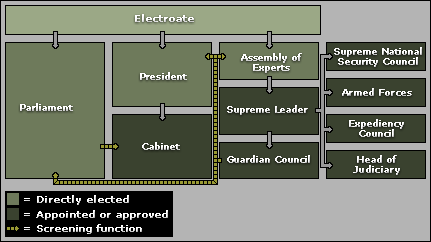
Iran is one of the most misunderstood places in the world for most Westerners. Beyond the obvious misconceptions about language, culture and ethnicity, there is also a mistaken desire to frame their entire existence within a Western paradigm. As many have pointed out, this is a problem (I would suggest reading Michael Axworthy on this). One of the significant ways in which Westerners fail to understand Iran, and in particular the Islamic Republic, is the governmental structure. The United States has a fairly simple system that many are familiar with. It has clearly delineated Executive, Legislative and Judicial branches, where each one of these three acts in a way to compliment and also to prevent the others from becoming too powerful. Iran as well has these three branches but they function in a very different way.
 |
| Available at: http://www.iranchamber.com/government/articles/images/power_chart.gif |
As the preceding chart from IranChamber.com shows, Iran's government is a convoluted and contradictory organizational mess. Not only is it the only state in the world where the head of government (President Rouhani in this case) does not control the armed forces (this includes the IRGC which is loyal to the revolution, and effectively the Supreme Leader), but also the Judicial is subject to the whims of the indirectly 'elected' Supreme Leader. The fact that certain 'elected' bodies (the President for example) have to be 'approved' by unelected groups, certainly doesn't help make the system any more straight-forward to outsiders.
While the former president Mahmoud Ahmadi-Nezhad was in power, many on the right in Israel and America would take his words (whether they were translated well or not) at face-value. They made a sport of raving about how this fanatical and powerful leader was a menace to the world and that he must be stopped etc. Those who spoke to me during this time are probably familiar with the way in which I was sharply dismissive of this idea. President Rouhani does not have the same legal authority as the Supreme Leader, or as much as fear-mongers incorrectly claimed Ahmadi-Nezhad had. However, dismissing him as powerless is just as foolish. It remains to be seen if genuine negotiations can happen on his watch.
Given the amount of possible disinformation and denials coming from the Iranian side, it is unclear if the hardline backbone of the Iranian government will support any sort of concession on their part. They have created a culture of resistance against the West and its allies (against the Americans, the Iraqis, the Israelis, the Shah and leftist movements such as the Communists and the MEK), and while still on this track, it may be increasingly difficult for them to disengage themselves. This same singularity of thought is also true of the conservative American Congress, and much of the Israeli political establishment. The nervous one-track hive-mind is certainly not helped by it's inability to understand the Iranian government's decision making process and power structure. Speculation can, on occasion, be beneficial, but uneducated speculation based upon a simplified understanding of a very complicated Iranian governmental apparatus helps no one.
Sunday, August 4, 2013
Partial List of Rouhani's Cabinet Nominations
Finally the list has been released!
http://en.irna.ir/News.aspx?Nid=80762362
Bijan Namdar Zanganeh for oil ministry (same as Sharq and Tasnim)
Abdolreza Rahmani-Fazli for interior ministry
Ali Tayyeb-Nia for ministry of economy and finance
Mahmoud Alavi for intelligence ministry (many expected Ali Younesi to this position)
Hamid Chitchiyan for energy ministry
Hossein Dehqan for defense ministry (Tasnim picked this)
Mohammad Reza Nematzadeh for industry, mine and commerce ministry
Mahmoud Hojjati for agriculture Jehad ministry
Ali Rabiei for ministry of labor, cooperative and social welfare
Abbas Akhoundi for ministry of roads, housing and urban development
Mohammad Ali Najafi for education ministry
Hassan Qazizadeh-Hashemi for ministry of health, treatment and medical education
Masoud Soltanifar for sports and youth ministry
Mohammad Javad Zarif for foreign ministry
Mostafa Pour-Mohammadi for justice ministry
Ali Jannati for ministry of culture and Islamic guidance
Mahmoud Vaezi for ministry of communications and information technology
Jafar Mili-Monfared for ministry of sciences, research and technology
Comparing this to the list of rumored cabinet members which I compiled from a variety of sources, the end result is is very different. Pretty much the only pick which most got right is Bijan Namdar Zanganeh as Oil Minister.
Zanganeh was a member of Khatami and Rafsanjani's cabinets.
Nematzadeh was a member of Rafsanjani's cabinet.
Najafi was a member of Khatami and Rafsanjani's cabinets.
Comparing this list to the leaked/rumored lists, Ali Younesi was an early front-runner for Intel who was not selected, and Mahmoud Vaezi was a near universal pick for Foreign Ministry who was also not picked. Al-Monitor's Ali Hashem was incorrect in every pick he made, although this list from IRNA is incomplete and there are a few positions which may end up being filled by those that Mr. Hashem claimed would do so. The Iranian newspaper Bahar had a few selections correct such as Mr. Zarif to the Foreign Ministry.
As a reminder, this list is incomplete, and these are only nominations, but this is very very different from what both conservatives and reformist Iranian sources estimated in June.
http://en.irna.ir/News.aspx?Nid=80762362
Bijan Namdar Zanganeh for oil ministry (same as Sharq and Tasnim)
Abdolreza Rahmani-Fazli for interior ministry
Ali Tayyeb-Nia for ministry of economy and finance
Mahmoud Alavi for intelligence ministry (many expected Ali Younesi to this position)
Hamid Chitchiyan for energy ministry
Hossein Dehqan for defense ministry (Tasnim picked this)
Mohammad Reza Nematzadeh for industry, mine and commerce ministry
Mahmoud Hojjati for agriculture Jehad ministry
Ali Rabiei for ministry of labor, cooperative and social welfare
Abbas Akhoundi for ministry of roads, housing and urban development
Mohammad Ali Najafi for education ministry
Hassan Qazizadeh-Hashemi for ministry of health, treatment and medical education
Masoud Soltanifar for sports and youth ministry
Mohammad Javad Zarif for foreign ministry
Mostafa Pour-Mohammadi for justice ministry
Ali Jannati for ministry of culture and Islamic guidance
Mahmoud Vaezi for ministry of communications and information technology
Jafar Mili-Monfared for ministry of sciences, research and technology
Comparing this to the list of rumored cabinet members which I compiled from a variety of sources, the end result is is very different. Pretty much the only pick which most got right is Bijan Namdar Zanganeh as Oil Minister.
Zanganeh was a member of Khatami and Rafsanjani's cabinets.
Nematzadeh was a member of Rafsanjani's cabinet.
Najafi was a member of Khatami and Rafsanjani's cabinets.
Comparing this list to the leaked/rumored lists, Ali Younesi was an early front-runner for Intel who was not selected, and Mahmoud Vaezi was a near universal pick for Foreign Ministry who was also not picked. Al-Monitor's Ali Hashem was incorrect in every pick he made, although this list from IRNA is incomplete and there are a few positions which may end up being filled by those that Mr. Hashem claimed would do so. The Iranian newspaper Bahar had a few selections correct such as Mr. Zarif to the Foreign Ministry.
As a reminder, this list is incomplete, and these are only nominations, but this is very very different from what both conservatives and reformist Iranian sources estimated in June.
Thursday, July 11, 2013
New Iranian Nuclear Sites?
The National Council of Resistance of Iran (political branch of the People's Mujahedin Of Iran/Mujahedin-E Khalq) has "revealed" another "new" Iranian nuclear site. Surprisingly, this article does quite a good job of addressing the potential flaws of these allegations. While this group (NCRI) has correctly identified several sites in the past, they have also been wrong about sites as well.
The NCRI clearly has an agenda, and the timing (right after the election of the 'moderate' cleric Hassan Rouhani to the Iranian presidency) makes me curious why this was released now. Many hawks have been frustrated by the election of a less controversial, antagonistic figure than Mahmoud Ahmadi Nezhad, the last president of Iran who was best known for his incendiary remarks and Holocaust denial.
If Iran were to once again to be in non-compliance with the NPT (requires proper notification to the IAEA if any new nuclear facilities are built etc.) as they admitted in 2003, it would certainly reduce the prospects for negotiations on Iran's nuclear program. Even though Binyamin Netanyahu has finally admitted that Supreme Leader Khamenei is in fact in control of the Iranian nuclear program (not Ahmadi Nezhad as Netanyahu incessantly and vociferously claimed for years), and Mr. Rouhani has not even been sworn in yet, this revelation, if true, would mitigate the positive feelings created by Rouhani's election and his attempts to repair relations with countries.
The NCRI clearly has an agenda, and the timing (right after the election of the 'moderate' cleric Hassan Rouhani to the Iranian presidency) makes me curious why this was released now. Many hawks have been frustrated by the election of a less controversial, antagonistic figure than Mahmoud Ahmadi Nezhad, the last president of Iran who was best known for his incendiary remarks and Holocaust denial.
If Iran were to once again to be in non-compliance with the NPT (requires proper notification to the IAEA if any new nuclear facilities are built etc.) as they admitted in 2003, it would certainly reduce the prospects for negotiations on Iran's nuclear program. Even though Binyamin Netanyahu has finally admitted that Supreme Leader Khamenei is in fact in control of the Iranian nuclear program (not Ahmadi Nezhad as Netanyahu incessantly and vociferously claimed for years), and Mr. Rouhani has not even been sworn in yet, this revelation, if true, would mitigate the positive feelings created by Rouhani's election and his attempts to repair relations with countries.
Sources close to #Rouhani say he is planning to send special envoys to some countries to repair broken ties & start new chapter with #TehranWhile I am skeptical of anything from the NCRI for the obvious reasons, I am also highly suspicious of Iran considering its track record of non-compliance. Things have appeared to have calmed down a bit regarding the Iran-Israel/US conflict and a new problem such as a hidden nuclear site would quickly ramp up tensions once again.
— Negar Mortazavi (@negarmortazavi) July 10, 2013
Wednesday, June 26, 2013
Rumored Members of Rouhani's new Cabinet
This list is taken from a BBC World Monitoring translation of Sharq, an Iranian Reformist Newspaper. This appeared in the 22 June, 2013 publication of Sharq, and was translated by the BBC World Monitoring service on 24 June, 2013.
What is striking about this list is the number of reformists and members with connections to Rafsanjani. (There may be more connections that I am unaware of, but most of these people are unknown outside Iran so it is hard to know for certain).
Former members of Khatami's government are highlighted in red, former members of Rafsanjani's government are highlighted in blue, former members of both are purple, former members of Mousavi's are green
First vice-president: Mohammad Reza Aref—Reformist presidential candidate from the 1392/2013 election, and former First vice-president under Khatami
Secretary of Supreme National Security Council: Ali Akbar Velayati—Presidential candidate from 1392/2013
Ministry of Education and Training: Ali Motahhari— Son of assassinated protegé of Ayatollah Khomeini, Morteza Motahhari
Ministry of Economic and Financial Affairs: Mohammad Baqer Nobakht
Foreign Ministry: Mahmoud Va'ezi
Ministry of Health Care and Medical Education: Mas'ud Pezeshkian—Held same position under Khatami
Ministry of Agricultural Jihad: Esa Kalantari—Same position under Rafsanjani
Ministry of Justice: Hojjat ol-Eslam Shushtari— Same position under Rafsanjani and Khatami
Ministry of Defense and Armed Forces Logistics: Akbar Torkan— Same position under Rafsanjani (Minister of Roads in Rafsanjani's 2nd term)
Ministry of Roads and Urban Development: Ali Abdol'alizadeh
Ministry of Industries, Mines and Commerce: Mohammad Reza Nehavandian
Ministry of Science, Research and Technology: Ja'far Tawfiqi—Same position under Khatami
Ministry of Culture and Islamic Guidance: Mohammad Ali Zam
Ministry of Labor and Cooperatives: Morteza Bank—Deputy Foreign Minister under Khatami
Ministry of the Interior: Hojjat ol-Eslam Ali Akbar Nateq-Nuri—Same position under Mousavi
Ministry of Oil: Bizhan Namdar Zanganeh— Minister of Jihad?? under Rafsanjani and Khatami
Ministry of Energy: Habibollah Bitaraf— Same position under Khatami
Ministry of Sports and Youth Affairs: Mohammad Fard
Plan and Budget Organization: Mohammad Ali Najafi—Same position under Khatami (Minister of education under Rafsanjani)
Atomic Energy Organization: Gholamreza Aqazadeh
Ministry of Communications and Information Technology: Ahmad Mo'tamedi
Vice-president for Majles affairs: Qodratollah Alikhani
Environmental Protection Organization: Ma'sumeh Ebtekar—Same position under Khatami (first female leader in this role)
Central Bank: Majid Qasemi
Vice-president of the republic and chief of the Martyr Foundation: Hoseyn Dehqan
Vice-president of the republic for clerical affairs: Hojjat ol-Eslam Shahidi
Vice-president for technology: Alireza Olfat—Member of Khatami's govt
Government Secretary and Spokesman: Alireza Nateqi—Chairman of Rouhani's Campaign Committee
Ministry of Information: Ali Younesi—Same position under Khatami
Chief of the President of the Republic's Center for Women's Participation and Family Affairs: Zahra Pishgahifard—Female
Ministry of Intelligence: Ali Younesi—Same position under Khatami (unsure if same as Information Ministry)
Chief of Cultural Heritage and Handicraft Industries Organization: Hoseyn Mar'ashi
Consultant to the president of the republic and supervisor of the Presidency Institute: Mohammad Reza Ne'matzadeh—Minister of Labor under Rafsanjani
Consultants to the president of the republic: Dr. Mohammad Reza Sadeq, Ali Asgari, Hoseyn Faridun (Rouhani's brother)
Special inspector for the president of the republic: Hoseyn Faridun (Rouhani's brother)
UPDATE 1: American Enterprise Institute published a list on 19 June based on a report from Tasnim (a principlist paper). There are some differences and some similarities, but the list is far less complete and only has a few names. E'tedad (A reformist paper) on 20 June published an analysis with similar names. Because of the consensus between several papers with different political leanings, I feel as though its safe to say that Ali Younesi and Mouhammad Reza Ne'matzadeh are both expected to play important roles in Rouhani's government. There are some significant differences between the E'tedad and Sharq lists, though they have virtually all of the same names.
UPDATE 2: Al-Monitor has weighed in with some similar opinions although the man they believe will be the next Defense Minister (Shamakhani) is someone not mentioned by E'tedad or Sharq (AEI concurs with Al-Monitor on this selection).
UPDATE 3: Another translated text via BBC Monitoring with more of the same names, although this one also includes the figures appointed to the committee selecting/advising selection of the cabinet. These include: Yunesi, Torkan, Ne'matzadeh, Hoseyn Rouhani (Faridun), Vaezi, Najafi, Jahangiri, Sadegh, Ashena.
UPDATE 4: CSM picked up a Reuters story quoting Rouhani on his cabinet. Rouhani stated that the cabinet will be inclusive and moderate. This is encouraging to conservatives who may have felt as though they would be excluded, and goes along with the information from UPDATE 3 which states that the reformists wish to keep some of their representatives in the Majles rather than promote them to the cabinet to insure that their seats will remain in the hands of reformists.
UPDATE 2: Al-Monitor has weighed in with some similar opinions although the man they believe will be the next Defense Minister (Shamakhani) is someone not mentioned by E'tedad or Sharq (AEI concurs with Al-Monitor on this selection).
UPDATE 3: Another translated text via BBC Monitoring with more of the same names, although this one also includes the figures appointed to the committee selecting/advising selection of the cabinet. These include: Yunesi, Torkan, Ne'matzadeh, Hoseyn Rouhani (Faridun), Vaezi, Najafi, Jahangiri, Sadegh, Ashena.
UPDATE 4: CSM picked up a Reuters story quoting Rouhani on his cabinet. Rouhani stated that the cabinet will be inclusive and moderate. This is encouraging to conservatives who may have felt as though they would be excluded, and goes along with the information from UPDATE 3 which states that the reformists wish to keep some of their representatives in the Majles rather than promote them to the cabinet to insure that their seats will remain in the hands of reformists.
Saturday, June 15, 2013
Reactions to Rouhani's Big Victory
Here are my initial reactions and questions following the somewhat surprising result of the Iranian Presidential Election
UPDATE 1: mentioned Twitter posts by Khamenei on voter turnout.
1) There should be no doubts that the 2009 election was fraudulent.
Many believe that the 2009 election where reformists Mir-Hossein Mousavi and Mehdi Karroubi were slighted, was fixed in favor of the Supreme Leaders' favored candidate, Mahmoud Ahmadi-Nezhad (also known as Ahmadinejad). There were a number of inconsistencies including Mousavi being defeated in a landslide in his home province and that the election results were announced after only a few hours. This time there was clearly some sort of effort to count the ballots as the 40+ million cast took over 12 hours to count.
2) Reformists and Moderates are still relevant in Iran
Another expectation about this election was that it would be either boycotted or have a low turnout. A mere 8 candidates were allowed to run (out of hundreds that registered and were not approved) and only 2 of these were not conservatives. Without many choices, why would anyone want to vote, especially if their vote would not be counted like in 2009?
3) The Supreme Leader Khamenei is threatened
Hassan Rouhani has close ties to the ruling establishment (just like the other approved presidential candidates did), but he is closer to former president and pistachio magnate Hashemi Rafsanjani. As I have written multiple times, the Supreme Leader owes his current position (along with many other things) to Hashemi. Hashemi's family has been persecuted since raising questions about the integrity of the 2009 elections. This includes the assault and arrest of his daughter, and the arrest of his son. Another son was sacked as the head of the Tehran Metro. These were seen as efforts (endorsed by the Supreme Leader) to curtail Hashemi's influence. Another and probably more important step taken against Hashemi was his removal from the chairmanship of the Assembly of Experts in 2011. These all led to a situation where Khamenei is likely to be unhappy with the result and the potential power struggle with Hashemi, the only one with equal political history, influence, and revolutionary credentials.
In April Khamenei stated that any vote in the election is a vote for the Islamic Republic. He attempted to show that a high turn out validates the legitimacy of the electoral process and the Islamic Republic of Iran. However, two days before the election he changed course stating that everyone should vote even if they disagreed with the Islamic Republic. Khamenei then reversed course again saying that the original statement he made is valid. Khamenei's attempt to exploit Iranian nationalism and increase voter turnout shows that he may actually care about public opinion. The number of moderate votes will not be welcomed by Khamenei.
In April Khamenei stated that any vote in the election is a vote for the Islamic Republic. He attempted to show that a high turn out validates the legitimacy of the electoral process and the Islamic Republic of Iran. However, two days before the election he changed course stating that everyone should vote even if they disagreed with the Islamic Republic. Khamenei then reversed course again saying that the original statement he made is valid. Khamenei's attempt to exploit Iranian nationalism and increase voter turnout shows that he may actually care about public opinion. The number of moderate votes will not be welcomed by Khamenei.
4) The Supreme Leader is not THAT threatened
Despite this not being the "ideal" result for Khamenei, he also may not be so upset about it. Rouhani is a cleric who currently enjoys good relations with most parties in Iran. He did not receive as significant a mandate as former President Khatami, but due to his ties and his clerical background there is a good chance that he will be less radical than Khatami (I realize Khatami is not a liberal but this is a relative comparison). Rouhani does not have the religious stature to challenge Khamenei on clerical matters, and this will always be on Rouhani's mind. When Khamenei's handpicked candidate from the 2009 election Ahmadi Nezhad started acting in a manner which Khamenei did not appreciate. This included firing members of his cabinet who Khamenei then forced him to reinstate. Because of Rouhani's connections to the clergy, a problem like this does not seem to be likely.
5) Will the foreign policy change?
The Supreme Leader is in charge of all major foreign policy decisions and the country's armed forces, but the actions and words of the president can also have a big impact. Under Ahmadi-Nezhad, Iran's foreign policy took on an increasingly combative tone. While they had sponsored terrorism and continued to do so (see 1994 AMIA bombing purportedly green lit by President Rafsanjani, not to mention their ties to Hezbollah), Ahmadi-Nezhad's hostility towards Israel and holocaust denial was incredibly damaging to Iran's reputation. How much will Rouhani tone this down and try to bring about more diplomacy with the West? He is considered to be a pragmatist along with his close mentor Hashemi (who even at one point indicated that he was ok with US intervention in Bosnia if it was done correctly) so it would seem likely that there will be some foreign policy change.
6) Can Reform happen in Iran?
While reformist former president Khatami is still wildly popular in Iran, he is considered by academics to have been an ineffective and weak leader during his two terms (he won both elections in an overwhelming landslide). An example about which I've written before before, was how his attempt to raise the age of marriage from 9 to 13 years. Because of opposition in the majles, this 'change' is a non-compulsory law and does not have to be enforced. Will reformists feel empowered by Rouhani's victory and make an effort to campaign for changes? Will they try to run in the next elections rather than boycotting like the last one?
7) Which way will Rouhani turn?
Will Rouhani pull a Khamenei and betray/abandon those who helped him gain power or will he respect his campaign promises and free political activists, journalists and Mousavi and Karroubi (who are still under house arrest after more than 2 years). Will he attempt to create changes in the economic system (one of the presidents key tasks)? Will he allow the press to become more free? If he does wish to and attempts to make any changes, will the Supreme Leader and the still conservative Majles allow him to, or will he be another Khatami?
UPDATE 1: mentioned Twitter posts by Khamenei on voter turnout.
Subscribe to:
Posts (Atom)