Two significant events occurred this past week concerning Iranian domestic politics.
1) Mehdi Hashemi, the son of Akbar Hashemi Rafsanjani (former president and former head of the Assembly of Experts, and current head of the Expediency Council), was sentenced to 10 years in prison for his role in corruption and other associated crimes
2) Mahmoud Ahmadi-Nezhad (another former president) attempted to create a new political party for his followers (YEKTA) which evidently has been banned the day after formation.
Both of these events show attempts to reinforce the status quo among the Iranian governing elite. Hashemi's family has suffered intense persecution since the 2009 election when the former president gave nominal support to the Green Movement. He has since lost his position as head of the Assembly of Experts (and failed in his 2015 re-election bid), though his protégé Hassan Rouhani's surprising election to the Iranian presidency in 2013 shows that he and his ideology has at least some public support.
Ahmadi-Nezhad's comeback has been quiet, though his position in the Expediency Council (a body appointed by the Supreme Leader) shows that he is not necessarily out of the picture indefinitely.
These events show the power and conservatism of the Iranian political system and how difficult 'change' can be. The upcoming legislative elections are sure to be very interesting as reformists will feel empowered by the relatively moderate Rouhani election, and conservatives will be desperate to stamp out this reemerging threat.
Despite this, a person like Ahmadi-Nezhad could turn the situation on its head if he manages to gain enough momentum to pose a threat to the established conservative factions. Iranian domestic politics are so multi-faceted any power shifts can lead to unprecedented and indeterminate changes.
Showing posts with label Ahmadi Nezhad. Show all posts
Showing posts with label Ahmadi Nezhad. Show all posts
Tuesday, June 16, 2015

Wednesday, June 4, 2014
Head of Assembly of Experts Mahdavi-Kani in coma
With the Ayatollah Mahdavi-Kani reportedly in a coma following a heart attack, a new head of the Assembly of Experts will likely have to be selected at some point in the near future.
The Assembly of Experts is a body of Mujtahids that are responsible for electing and removing the Supreme Leader. As I have written before, Iran’s governmental structure is complicated at best, and while in theory this group has these powers, there is virtually no chance of them removing the Supreme Leader at any point (and even if they wanted to, the Supreme Leader has other powers, including complete control of the judiciary and armed forces, which would make this near impossible). That being said, they do have the authority to select the next Supreme Leader when the time comes.
The chairmanship of this group is of particular importance. Ayatollah Akbar Hashemi Rafsanjani had been the chairman prior to his decision to express some support for the Green Movement of 2009, but was forced out and replaced by Ayatollah Mahdavi-Kani. Mahdavi-Kani is less hardline than some of the alternatives so this was actually seen as a minor victory for Rafsanjani who stood to lose a lot more.
Rafsanjani’s family has been heavily persecuted by the state as well as his domestic rivals which I have also written about in the past, and I would be very surprised if Rafsanjani was reinstated. And even though the Supreme Leader recently delegated additional constitutional powers to the body which Rafsanjani is still the chair of (the Expediency Council), it seems unlikely that there would be another significant move to benefit Rafsanjani. Khamenei and Rafsanjani are still rivals and the Supreme Leader does not want to empower him.
UPDATE 1: A list of folks who have reportedly visited the Ayatollah include the Supreme Leader, the President, the head of the Basij, Khomeini's grandson and others.
UPDATE 2: Ahmed Khatami, the hardline cleric evidently cancelled the upcoming elections to replace Ayatollah Mahdavi-Kani. Ayatollah Rafsanjani was a (the?) favorite to replace the comatose Mahdavi-Kani, despite habitual and continuing persecution against Rafsanjani and his family from regime insiders.
UPDATE 3: Ayatollah Mahdavi-Kani has died according to multiple sources (PressTV, Fars etc). It is unclear what steps will be taken to replace him, if the acting chairman (Shahroudi) will be promoted, or if there will be elections.
UPDATE 1: A list of folks who have reportedly visited the Ayatollah include the Supreme Leader, the President, the head of the Basij, Khomeini's grandson and others.
UPDATE 2: Ahmed Khatami, the hardline cleric evidently cancelled the upcoming elections to replace Ayatollah Mahdavi-Kani. Ayatollah Rafsanjani was a (the?) favorite to replace the comatose Mahdavi-Kani, despite habitual and continuing persecution against Rafsanjani and his family from regime insiders.
UPDATE 3: Ayatollah Mahdavi-Kani has died according to multiple sources (PressTV, Fars etc). It is unclear what steps will be taken to replace him, if the acting chairman (Shahroudi) will be promoted, or if there will be elections.
Wednesday, January 1, 2014
Is Corruption in Iran finally being addressed?
The arrest of Babak Zanjani is a significant event in Iran. Corruption in Iran is understood to be rampant; figures as significant as former Presidents Ahmadi Nezhad and Hashemi Rafsanjani have been accused of abusing their authority for financial and/or nepotistic reasons. In-fighting and factionalization in Iran is also a problem, with the various groups at odds with each other. If someone like Zanjani who allegedly has been instrumental in helping the Islamic Republic avoid US/EU sanctions has now fallen out of favor, one must wonder why this would happen now before the nuclear agreement between the P5+1 and Iran has not yet been applied?
The sanctions relief scheduled to implemented under the new nuclear agreement has not started yet. One would think that someone who has supposedly been so important to the Islamic Republic's efforts in limiting the bite of international sanctions would not be thrown in jail, especially not at this stage. Was the alleged corruption so significant that Iran's government and economy would be better off without such an important businessman? Is this a sign that there will be efforts aimed at reducing corruption in Iran, or is this a personal vendetta or domestic political squabbling? President Rouhani is close to former President Hashemi Rafsanjani, who also has been accused of corruption amongst other criminal acts. Will Rafsanjani also be investigated for corruption or will his ties to the President exempt him?
Babak Zanjani's arrest is interesting and it remains to be seen if this is the first step towards a genuine attempt to eliminate corruption or if this is just political witch hunt like what happened to Russian oil tycoon Mikhail Khodorkovsky. I hope that this will be a step towards stopping corruption, and that Setad, the case exposed by Reuters, as well as any other abusers of the system will also be subject to investigation.
Saturday, September 21, 2013
The Complexities of the Iranian Government and Nuclear Negotiations
With the impending annual UN General Assembly slated for this coming week, and the anticipation of important political developments, a common story in the news is the potentiality of a diplomatic breakthrough regarding Iran's nuclear program. Much has been made of Iran's new President Hassan Rouhani's increasingly friendly tone towards America and the West and his stated desire for dialogue. From what many have written, it seems an almost foregone conclusion that for the first time in what seems like an eternity, the heads of government for the United States and Iran may meet face to face. For now, this is nothing but blind speculation; no matter how friendly the words of both sides are, no real 'progress' has been made as of yet.
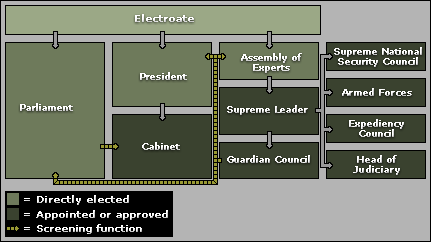
Iran is one of the most misunderstood places in the world for most Westerners. Beyond the obvious misconceptions about language, culture and ethnicity, there is also a mistaken desire to frame their entire existence within a Western paradigm. As many have pointed out, this is a problem (I would suggest reading Michael Axworthy on this). One of the significant ways in which Westerners fail to understand Iran, and in particular the Islamic Republic, is the governmental structure. The United States has a fairly simple system that many are familiar with. It has clearly delineated Executive, Legislative and Judicial branches, where each one of these three acts in a way to compliment and also to prevent the others from becoming too powerful. Iran as well has these three branches but they function in a very different way.
 |
| Available at: http://www.iranchamber.com/government/articles/images/power_chart.gif |
As the preceding chart from IranChamber.com shows, Iran's government is a convoluted and contradictory organizational mess. Not only is it the only state in the world where the head of government (President Rouhani in this case) does not control the armed forces (this includes the IRGC which is loyal to the revolution, and effectively the Supreme Leader), but also the Judicial is subject to the whims of the indirectly 'elected' Supreme Leader. The fact that certain 'elected' bodies (the President for example) have to be 'approved' by unelected groups, certainly doesn't help make the system any more straight-forward to outsiders.
While the former president Mahmoud Ahmadi-Nezhad was in power, many on the right in Israel and America would take his words (whether they were translated well or not) at face-value. They made a sport of raving about how this fanatical and powerful leader was a menace to the world and that he must be stopped etc. Those who spoke to me during this time are probably familiar with the way in which I was sharply dismissive of this idea. President Rouhani does not have the same legal authority as the Supreme Leader, or as much as fear-mongers incorrectly claimed Ahmadi-Nezhad had. However, dismissing him as powerless is just as foolish. It remains to be seen if genuine negotiations can happen on his watch.
Given the amount of possible disinformation and denials coming from the Iranian side, it is unclear if the hardline backbone of the Iranian government will support any sort of concession on their part. They have created a culture of resistance against the West and its allies (against the Americans, the Iraqis, the Israelis, the Shah and leftist movements such as the Communists and the MEK), and while still on this track, it may be increasingly difficult for them to disengage themselves. This same singularity of thought is also true of the conservative American Congress, and much of the Israeli political establishment. The nervous one-track hive-mind is certainly not helped by it's inability to understand the Iranian government's decision making process and power structure. Speculation can, on occasion, be beneficial, but uneducated speculation based upon a simplified understanding of a very complicated Iranian governmental apparatus helps no one.
Sunday, August 4, 2013
Partial List of Rouhani's Cabinet Nominations
Finally the list has been released!
http://en.irna.ir/News.aspx?Nid=80762362
Bijan Namdar Zanganeh for oil ministry (same as Sharq and Tasnim)
Abdolreza Rahmani-Fazli for interior ministry
Ali Tayyeb-Nia for ministry of economy and finance
Mahmoud Alavi for intelligence ministry (many expected Ali Younesi to this position)
Hamid Chitchiyan for energy ministry
Hossein Dehqan for defense ministry (Tasnim picked this)
Mohammad Reza Nematzadeh for industry, mine and commerce ministry
Mahmoud Hojjati for agriculture Jehad ministry
Ali Rabiei for ministry of labor, cooperative and social welfare
Abbas Akhoundi for ministry of roads, housing and urban development
Mohammad Ali Najafi for education ministry
Hassan Qazizadeh-Hashemi for ministry of health, treatment and medical education
Masoud Soltanifar for sports and youth ministry
Mohammad Javad Zarif for foreign ministry
Mostafa Pour-Mohammadi for justice ministry
Ali Jannati for ministry of culture and Islamic guidance
Mahmoud Vaezi for ministry of communications and information technology
Jafar Mili-Monfared for ministry of sciences, research and technology
Comparing this to the list of rumored cabinet members which I compiled from a variety of sources, the end result is is very different. Pretty much the only pick which most got right is Bijan Namdar Zanganeh as Oil Minister.
Zanganeh was a member of Khatami and Rafsanjani's cabinets.
Nematzadeh was a member of Rafsanjani's cabinet.
Najafi was a member of Khatami and Rafsanjani's cabinets.
Comparing this list to the leaked/rumored lists, Ali Younesi was an early front-runner for Intel who was not selected, and Mahmoud Vaezi was a near universal pick for Foreign Ministry who was also not picked. Al-Monitor's Ali Hashem was incorrect in every pick he made, although this list from IRNA is incomplete and there are a few positions which may end up being filled by those that Mr. Hashem claimed would do so. The Iranian newspaper Bahar had a few selections correct such as Mr. Zarif to the Foreign Ministry.
As a reminder, this list is incomplete, and these are only nominations, but this is very very different from what both conservatives and reformist Iranian sources estimated in June.
http://en.irna.ir/News.aspx?Nid=80762362
Bijan Namdar Zanganeh for oil ministry (same as Sharq and Tasnim)
Abdolreza Rahmani-Fazli for interior ministry
Ali Tayyeb-Nia for ministry of economy and finance
Mahmoud Alavi for intelligence ministry (many expected Ali Younesi to this position)
Hamid Chitchiyan for energy ministry
Hossein Dehqan for defense ministry (Tasnim picked this)
Mohammad Reza Nematzadeh for industry, mine and commerce ministry
Mahmoud Hojjati for agriculture Jehad ministry
Ali Rabiei for ministry of labor, cooperative and social welfare
Abbas Akhoundi for ministry of roads, housing and urban development
Mohammad Ali Najafi for education ministry
Hassan Qazizadeh-Hashemi for ministry of health, treatment and medical education
Masoud Soltanifar for sports and youth ministry
Mohammad Javad Zarif for foreign ministry
Mostafa Pour-Mohammadi for justice ministry
Ali Jannati for ministry of culture and Islamic guidance
Mahmoud Vaezi for ministry of communications and information technology
Jafar Mili-Monfared for ministry of sciences, research and technology
Comparing this to the list of rumored cabinet members which I compiled from a variety of sources, the end result is is very different. Pretty much the only pick which most got right is Bijan Namdar Zanganeh as Oil Minister.
Zanganeh was a member of Khatami and Rafsanjani's cabinets.
Nematzadeh was a member of Rafsanjani's cabinet.
Najafi was a member of Khatami and Rafsanjani's cabinets.
Comparing this list to the leaked/rumored lists, Ali Younesi was an early front-runner for Intel who was not selected, and Mahmoud Vaezi was a near universal pick for Foreign Ministry who was also not picked. Al-Monitor's Ali Hashem was incorrect in every pick he made, although this list from IRNA is incomplete and there are a few positions which may end up being filled by those that Mr. Hashem claimed would do so. The Iranian newspaper Bahar had a few selections correct such as Mr. Zarif to the Foreign Ministry.
As a reminder, this list is incomplete, and these are only nominations, but this is very very different from what both conservatives and reformist Iranian sources estimated in June.
Thursday, July 11, 2013
New Iranian Nuclear Sites?
The National Council of Resistance of Iran (political branch of the People's Mujahedin Of Iran/Mujahedin-E Khalq) has "revealed" another "new" Iranian nuclear site. Surprisingly, this article does quite a good job of addressing the potential flaws of these allegations. While this group (NCRI) has correctly identified several sites in the past, they have also been wrong about sites as well.
The NCRI clearly has an agenda, and the timing (right after the election of the 'moderate' cleric Hassan Rouhani to the Iranian presidency) makes me curious why this was released now. Many hawks have been frustrated by the election of a less controversial, antagonistic figure than Mahmoud Ahmadi Nezhad, the last president of Iran who was best known for his incendiary remarks and Holocaust denial.
If Iran were to once again to be in non-compliance with the NPT (requires proper notification to the IAEA if any new nuclear facilities are built etc.) as they admitted in 2003, it would certainly reduce the prospects for negotiations on Iran's nuclear program. Even though Binyamin Netanyahu has finally admitted that Supreme Leader Khamenei is in fact in control of the Iranian nuclear program (not Ahmadi Nezhad as Netanyahu incessantly and vociferously claimed for years), and Mr. Rouhani has not even been sworn in yet, this revelation, if true, would mitigate the positive feelings created by Rouhani's election and his attempts to repair relations with countries.
The NCRI clearly has an agenda, and the timing (right after the election of the 'moderate' cleric Hassan Rouhani to the Iranian presidency) makes me curious why this was released now. Many hawks have been frustrated by the election of a less controversial, antagonistic figure than Mahmoud Ahmadi Nezhad, the last president of Iran who was best known for his incendiary remarks and Holocaust denial.
If Iran were to once again to be in non-compliance with the NPT (requires proper notification to the IAEA if any new nuclear facilities are built etc.) as they admitted in 2003, it would certainly reduce the prospects for negotiations on Iran's nuclear program. Even though Binyamin Netanyahu has finally admitted that Supreme Leader Khamenei is in fact in control of the Iranian nuclear program (not Ahmadi Nezhad as Netanyahu incessantly and vociferously claimed for years), and Mr. Rouhani has not even been sworn in yet, this revelation, if true, would mitigate the positive feelings created by Rouhani's election and his attempts to repair relations with countries.
Sources close to #Rouhani say he is planning to send special envoys to some countries to repair broken ties & start new chapter with #TehranWhile I am skeptical of anything from the NCRI for the obvious reasons, I am also highly suspicious of Iran considering its track record of non-compliance. Things have appeared to have calmed down a bit regarding the Iran-Israel/US conflict and a new problem such as a hidden nuclear site would quickly ramp up tensions once again.
— Negar Mortazavi (@negarmortazavi) July 10, 2013
Saturday, June 15, 2013
Reactions to Rouhani's Big Victory
Here are my initial reactions and questions following the somewhat surprising result of the Iranian Presidential Election
UPDATE 1: mentioned Twitter posts by Khamenei on voter turnout.
1) There should be no doubts that the 2009 election was fraudulent.
Many believe that the 2009 election where reformists Mir-Hossein Mousavi and Mehdi Karroubi were slighted, was fixed in favor of the Supreme Leaders' favored candidate, Mahmoud Ahmadi-Nezhad (also known as Ahmadinejad). There were a number of inconsistencies including Mousavi being defeated in a landslide in his home province and that the election results were announced after only a few hours. This time there was clearly some sort of effort to count the ballots as the 40+ million cast took over 12 hours to count.
2) Reformists and Moderates are still relevant in Iran
Another expectation about this election was that it would be either boycotted or have a low turnout. A mere 8 candidates were allowed to run (out of hundreds that registered and were not approved) and only 2 of these were not conservatives. Without many choices, why would anyone want to vote, especially if their vote would not be counted like in 2009?
3) The Supreme Leader Khamenei is threatened
Hassan Rouhani has close ties to the ruling establishment (just like the other approved presidential candidates did), but he is closer to former president and pistachio magnate Hashemi Rafsanjani. As I have written multiple times, the Supreme Leader owes his current position (along with many other things) to Hashemi. Hashemi's family has been persecuted since raising questions about the integrity of the 2009 elections. This includes the assault and arrest of his daughter, and the arrest of his son. Another son was sacked as the head of the Tehran Metro. These were seen as efforts (endorsed by the Supreme Leader) to curtail Hashemi's influence. Another and probably more important step taken against Hashemi was his removal from the chairmanship of the Assembly of Experts in 2011. These all led to a situation where Khamenei is likely to be unhappy with the result and the potential power struggle with Hashemi, the only one with equal political history, influence, and revolutionary credentials.
In April Khamenei stated that any vote in the election is a vote for the Islamic Republic. He attempted to show that a high turn out validates the legitimacy of the electoral process and the Islamic Republic of Iran. However, two days before the election he changed course stating that everyone should vote even if they disagreed with the Islamic Republic. Khamenei then reversed course again saying that the original statement he made is valid. Khamenei's attempt to exploit Iranian nationalism and increase voter turnout shows that he may actually care about public opinion. The number of moderate votes will not be welcomed by Khamenei.
In April Khamenei stated that any vote in the election is a vote for the Islamic Republic. He attempted to show that a high turn out validates the legitimacy of the electoral process and the Islamic Republic of Iran. However, two days before the election he changed course stating that everyone should vote even if they disagreed with the Islamic Republic. Khamenei then reversed course again saying that the original statement he made is valid. Khamenei's attempt to exploit Iranian nationalism and increase voter turnout shows that he may actually care about public opinion. The number of moderate votes will not be welcomed by Khamenei.
4) The Supreme Leader is not THAT threatened
Despite this not being the "ideal" result for Khamenei, he also may not be so upset about it. Rouhani is a cleric who currently enjoys good relations with most parties in Iran. He did not receive as significant a mandate as former President Khatami, but due to his ties and his clerical background there is a good chance that he will be less radical than Khatami (I realize Khatami is not a liberal but this is a relative comparison). Rouhani does not have the religious stature to challenge Khamenei on clerical matters, and this will always be on Rouhani's mind. When Khamenei's handpicked candidate from the 2009 election Ahmadi Nezhad started acting in a manner which Khamenei did not appreciate. This included firing members of his cabinet who Khamenei then forced him to reinstate. Because of Rouhani's connections to the clergy, a problem like this does not seem to be likely.
5) Will the foreign policy change?
The Supreme Leader is in charge of all major foreign policy decisions and the country's armed forces, but the actions and words of the president can also have a big impact. Under Ahmadi-Nezhad, Iran's foreign policy took on an increasingly combative tone. While they had sponsored terrorism and continued to do so (see 1994 AMIA bombing purportedly green lit by President Rafsanjani, not to mention their ties to Hezbollah), Ahmadi-Nezhad's hostility towards Israel and holocaust denial was incredibly damaging to Iran's reputation. How much will Rouhani tone this down and try to bring about more diplomacy with the West? He is considered to be a pragmatist along with his close mentor Hashemi (who even at one point indicated that he was ok with US intervention in Bosnia if it was done correctly) so it would seem likely that there will be some foreign policy change.
6) Can Reform happen in Iran?
While reformist former president Khatami is still wildly popular in Iran, he is considered by academics to have been an ineffective and weak leader during his two terms (he won both elections in an overwhelming landslide). An example about which I've written before before, was how his attempt to raise the age of marriage from 9 to 13 years. Because of opposition in the majles, this 'change' is a non-compulsory law and does not have to be enforced. Will reformists feel empowered by Rouhani's victory and make an effort to campaign for changes? Will they try to run in the next elections rather than boycotting like the last one?
7) Which way will Rouhani turn?
Will Rouhani pull a Khamenei and betray/abandon those who helped him gain power or will he respect his campaign promises and free political activists, journalists and Mousavi and Karroubi (who are still under house arrest after more than 2 years). Will he attempt to create changes in the economic system (one of the presidents key tasks)? Will he allow the press to become more free? If he does wish to and attempts to make any changes, will the Supreme Leader and the still conservative Majles allow him to, or will he be another Khatami?
UPDATE 1: mentioned Twitter posts by Khamenei on voter turnout.
Friday, May 24, 2013
Religious Minorities in the Iranian Majles
UPDATE: Looks like the news articles were wrong and there were not 14 seats given to religious minorities, but the normal 5. The original article claiming 14 religious minorities were elected was removed from one of the official Iranian sites. Looks like it was just a mistranslation which other news organizations latched on to and then did not bother to fix when the correct information came out. In either case it is interesting to see how they deal with minorities who according to this are persecuted against.
There are several countries in the world that assign certain positions of government to specific ethnicities or population groups, such as Lebanon, and Bosnia. Others like Iran, assign seats in parliament to religious minorities. In the case of Iran, the 290 seat Majles (Parliament) also contains 5 mandatory spots; 2 for Armenians, 1 for Assyrians/Chaldeans (Catholic), 1 for Jews, and 1 for Zoroastrians. This can be quite beneficial especially when there are issues with religious minorities being persecuted, so having a guaranteed spot for a minority like this can afford them some form of protection.
In 2012 the election was billed as a battle between various factions of the conservatives who were divided between those loyal to the Supreme Leader Ayatollah Ali Khamenei, and the President Mahmoud Ahmadi-Nezhad. The Supreme Leader, with absolute authority as designated by the Iranian constitution (revised in 1989 after Ayatollah Khomeini's death), by all accounts won, and was able to take seats away from factions supportive of President Ahmadi-Nezhad.
This article claims that 14 and 5 religious minorities are a part of the Majles. While only 5 are required to be assigned to the 4 recognized religious minorities (Bahais, another significant group, are not recognized and highly persecuted in Iran).
According to the UN there are 300,000 Christians (which includes Armenians, Assyrians and Chaldeans), although the Statistical Center of Iran states that there are 117,700 (Assyrian/Chaldeans are estimated at between 10-20 thousand). The Statistical Center of Iran says that there are 25,000 Zoroastrians, although Zoroastrians claim that there are 60,000. It is believed that there are around 20,000 Jewish Iranian citizens. So in total that results in a total of between 165-400 thousand of the 4 recognized major religious minorities in Iran. Out of a population of around 76 million this is a tiny fraction.
Locating accurate election data figures from Iran is as easy as performing successful brain surgery without going to medical school. Because of this, the poorly referenced Wikipedia "facts" will have to suffice for the purposes of this blog (UPDATE: it is now clear that they are incorrect). Even if the results are inaccurate on Wikipedia (they are), there are multiple news articles corroborating the claim that 14 of the 290 Majles representatives are from religious minorities (this article insinuates that there currently are 5 spots for religious minorities but there will be 14 in the next election, however this apparently is a bad translation).
Iran is approximately 99% Muslim (90% Shia and 9% Sunni), and over 2% of the seats of the Majles go to about half of 1% of the total population. These 'Religious Minorities' vote on a DIFFERENT DAY than other voters and apparently are not allowed to
Saturday, May 4, 2013
Feminism in Iran
Iran is the only country where the Head of Government (President) does not also control the military. The Head of State (Supreme Leader) does. It is also different from most governments in that the constitution expressly prohibits women from obtaining this office. With the Iranian Presidential Elections fast approaching, I thought it would be useful to share a bit about the feminist movement in Iran. Here is an excerpt from a paper I wrote which provides a background for feminism (secular and Islamic) in Iran:
Following the fall of the Shah in 1979, a
theocratic state came to power in Iran. This state took its legitimacy from
Ayatollah Khomeini's theology of Velayat-e
Faqih, which reinterpreted Twelver Shi'a beliefs to include a justification
for clerical involvement in both politics and the state apparatus. This was a
relatively new concept and had come from a new understanding of older practices. The ideas of
innovation and transformation drove the revolution, which itself was
representative of the unhappiness of the general public with the corrupt,
repressive and ineffective Shah.
Having
played a large role in the street protests and civil unrest aimed towards Reza
Shah, many Iranian women expected reforms benefitting them to be enacted after
the fall of the shah[i].
Ayatollah Khomeini encouraged women to take part in the revolution, and so,
despite his earlier writings explicitly describing his religious and political
views, members of the public assumed that the version of Islam that he
preferred was progressive or at least accepting. Khomeini had been quoted
saying that "Islam has never been against [women's] freedom. It is, to the
contrary, opposed to the idea of woman-as-object and it gives her back her
dignity"[ii].
Possibly because of statements like these, most of the Iranian public would
have not imagined a strict theocracy taking over once the shah fell. The
primary motivating factor leading to the revolution was the belief that the
ruler was unjust, corrupt and did not treat the common people with enough
respect. The rapid implementation of gender-biased laws in the public and
private sectors made it clear the rights previously granted (or forced) upon
women were not going to kept[iii].
The progressive trends under the Shah were halted and then reversed, as many of
the social reforms during the reign of the Shah giving women more rights, were
abolished after the revolution[iv].
The
actions of the clerical establishment following their ascent to power resulted
in considerable resentment, especially from those women who had been active in
overthrowing the Shah. They felt as though they deserved credit for their
actions, rather than restrictions on their lifestyle[v].
At
the time of the Iranian Islamic Revolution, new social justice movements took
hold, in particular secular feminism, which was becoming increasingly powerful
in the Western world. In Iran as well, feminism became relevant as women wanted
to play a bigger role in society. These
women came from all portions of society—wealthy, poor, religious and secular[vi].
This diversity indicates the general feeling of malcontent in Iran at the time.
Despite social unhappiness, a military and political event distracted from
this.
The
devastating war between Iran and Iraq from 1980-1988, which resulted in
horrific loss of life on both sides among civilians and military forces[vii],
heightened sentiments of nationalism among Iranians, as they were all
personally affected by the war. A whole generation of Iranian men perished and many women
were forced to work as a result[viii].
Society's reliance on women to provide them with materials for the war empowered
women. The supporting efforts of Iranian women were even more important
than their voluntary actions during the events leading the Islamic revolution.
Perhaps
due to the pressures of the near decade long war with Iraq, economic and social
problems that had existed under the Shah were not solved by the religious
rulers[ix].
These problems were then exacerbated by the baby boom of the 1980s and 1990s. The
Ayatollahs, faced with enormous population growth, determined that a family
planning campaign was necessary. This campaign gave women more access to
contraception, another form of female empowerment[x].
Another
significant change for women in Iran is that increasing numbers have been
afforded the opportunity to attend university. Today, nearly two-thirds of
university students in Iran are female[xi].
Education typically leads to empowerment, but empowerment is difficult within a
restrictive society. The conflict between the restrictions and the expectations
of further freedoms can prove to be problematic, and often results in
unhappiness amongst the female population. This is especially true when highly
educated individuals are unable to find jobs, or the wages of the jobs
available to them are significantly less lucrative than that of men's jobs, and
are far less than that of their counterparts in Western, developed nations[xii].
Although many women who desire and then obtain baccalaureate degrees may be
secular or upper-class and Westernized, the women involved in protests and
efforts to attain social justice are not necessarily secular, Western-oriented
women. Many Iranian women are unsatisfied with the status quo and the lack of
opportunities for economic or social advancement.
This
dissatisfaction was expressed in 1997, when a reformist, Mohammad Khatami was
elected president[xiii].
This shocked the conservative government because they did not expect a
relatively liberal member of the political establishment to be elected to such
an important and influential position. The fact that Khatami won with such an
overwhelming majority proved to be a serious challenge for the conservative
factions of the government[xiv].
While the Supreme Leader continues to have absolute veto power, the fact that the
population could so heavily favor a reformist could have been damaging to the
clerical establishment's monopoly on political power in the Islamic Republic.
Prior to Khatami's election the feminist movement in Iran seemed to be gaining
traction as influential writers and public figures were able to speak more
freely than they had been in the past. Some of this was due to the woman's
magazine Zanan (Persian for ‘women’) which operated from 1992 until its
forced closure in 2008[xv].
While the magazine focused primarily on secular women's voices, it made a point
of including religious feminists as well. Despite the election results and the
positive hopes of feminists and liberals in Iran[xvi],
the government of President Khatami proved ineffective and either unwilling or
unable to stand up to the conservatives in the majlis (Persian for the
Iranian parliament). During Khatami's rule, the legal marriage age for girls
was raised from nine to thirteen, yet as this is a non-compulsory law, it is
not always enforced[xvii].
While in theory this is an improvement for women’s rights activists, the fact
that it is not mandatory has led to accusations of inefficiency and weakness by
President Khatami. Despite the steps towards reformation in the late 1990s and
early 2000s, in 2000 at the height of the reform movement in Iran, a mere 5% of
parliamentarians in Iran were women[xviii].
This is around one-third as many as an average "developing" country according to UN
statistics[xix]. Even
though Khatami had a popular mandate in the form of the overwhelming support he
received during the presidential elections, he failed to create strong, lasting
reforms. While Khatami is considered to have been inefficient president, he
managed to stay in office for a second term.
In
2005, his replacement was Mahmoud Ahmadinejad, who while relatively unknown at
the time, was a former mayor of the Iranian capital of Tehran. Ahmadinejad was
allied with some parts of the conservative camp, as well as with the Islamic
Revolutionary Guards Corps (IRGC) of which he had been a member. President
Ahmadinejad and his allies restricted the feminist movement, reversing some of
the limited reforms that President Khatami had enacted[xx].
In late 2006, President Ahmadinejad caused controversy when he stated that
Iranian women should spend more time in the home raising their children[xxi].
Since his controversial re-election in June 2009 there have been mass protests
of every variety, violently suppressed by the IRGC, its volunteer militias and
the official state security forces.[xxii]
UPDATE: Iran is not the only country where the head of government does not also function as the head of state, but it is the only country where the head of government does NOT control the military. In every other country the ELECTED (or selected or appointed) head of government has control of the armed forces.
[i] Moghadam, Val. "Revolution,
the State, Islam, and Women: Gender Politics in Iran and Afghanistan." Social
Text 22.Spring (1989): 43. Print.
[ii] Sansarian, Eliz via Sameh,
Catherine. "Discourses of Equality, Rights and Islam in the One Million
Signatures Campaign in Iran." International Feminist Journal of
Politics 12 (2010): 446. Print.
[iii] Mojab, Shahrzad. "Theorizing
the Politics of 'Islamic Feminism'" Feminist Review 69.Winter
(2001): 131. Print. , Moghadam, 1989: 45., Tohidi, Nayereh. "The Global-Local
Intersection of Feminism in Muslim Societies: The Cases of Iran and
Azerbaijan." Social Research 69.3 (2002): 858. Print.
[iv] Ibid, p. 858
[v] Ibid, p. 858
[vi] Moghadam 1989, 43
[vii] Estimates vary although some
believe up to 1 million died in the first five years alone
Alnasrawi, Abbas. "Economic Consequences of the Iraq‐Iran War∗."
Third World Quarterly 8.3 (1986): 869. Print.
[ix] An early estimate put the economic
cost of the war at nearly half a billion dollars See. Alnasrawi, 1986, p. 869
[x] Moghadam, Valentine via Sameh 2010:
446
[xi] Ebadi, Shirin via Barlow, Rebecca.,
and Shahram. Akbarzadeh. "Prospects for Feminism in the Islamic Republic
of Iran." Human Rights Quarterly 30.1 (2008): 24. Print. And Esfandiari,
Golnaz. "Number Of Female University Students Rising Dramatically in
Iran." Payvand, Iran News, Directory and Bazar. 21 Nov. 2003. Web.
26 Sept. 2011. <http://www.payvand.com/news/03/nov/1133.html>. And
Mernissi, Fatima. "Muslim Women and Fundamentalism." Middle East
Report 153.Jul-Aug (1988): 8-11+50. Print.
[xii] Barlow, Akbarzadeh 2008: 24
[xiii] Ibid, p. 26
[xiv] "Online
NewsHour: Iranian Elections -- May 26, 1997." PBS: Public Broadcasting
Service. 26 May 1997. Web. 26 Sept. 2011.
<http://www.pbs.org/newshour/bb/middle_east/may97/iran_5-26a.html> .
[xv] "Shutting
Down Zanan." The New York Times - Breaking News, World News &
Multimedia. 7 Feb. 2008. Web. 26 Sept. 2011.
<http://www.nytimes.com/2008/02/07/opinion/07thu1.html>.
[xvi] Ibid, p. 26
[xvii] Ibid, p. 28. The legal age had been
lowered from 18 following the rise of the clergy see Moghadam, Valentine, Revolution, the State, Islam and Women.
1989, 46
[xviii] Ibid, p. 30
[xix] Ibid, p. 30
[xx] Sameh 2010, 448
[xxi] Barlow, Akbarzadeh 2008, 22
[xxii] The literature and news reporting
on the Green Movement is extensive and can be found archived on every major
news network as well as many forms of electronic social communications.
Subscribe to:
Posts (Atom)